


Margins
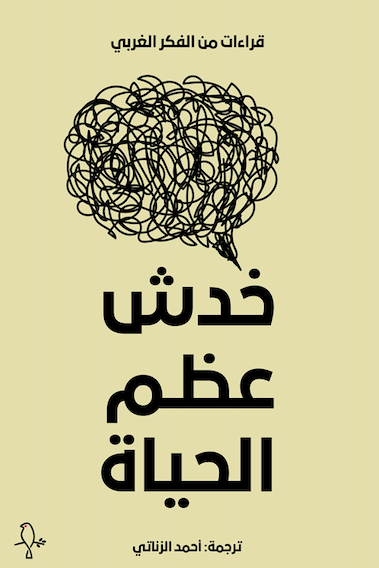
خدش عظم الحياة book cover
خدش عظم الحياة
2022
First Published
3.73
Average Rating
244
Number of Pages

اكتشفتُ أنّ غاية بحثي في الكتب هو أن أعلّم نفسي حُسن العيش وحُسن الممات. يشتمل الكتاب على مقالات قاربت أعمالًا فكرية وأدبية، أغلبها مُترجَم عن الألمانية أو الإنجليزية، أمضيتُ مع مؤلفيها -قارئًا ومترجمًا- وقتًا ممتعًا، متأسِّيًا بطريقة (دي مونتيني) وهو يكتب مقالاته. يمكنني القول إنّ نصوص هذا الكتاب هي تفريغ لمحتويات صندوق بريدي في صورة قراءات ترمي لإسباغ معنى ما على الحياة على نحو ما ذهب جوزيف كامبل.كما سنقرأ في إحدى مقالات هذا العمل. وقد استقرّ المقام على تسمية العمل (خَــدش عَــظْــم الحــياة)، وهو عنوان مقالة عن الكاتبة الأميركية/البلغارية الشابة (ماريا بوبوڤا)، وقد أفردتُ لها نصيبًا وافيًا هنا. ومن ثمّ، فالمقالات هي قراءات تنشد الاقتراب على استحياء من محاولات (دي مونتيني) لـخدش العَـظْـــم المتيّبــس واستثارته لينطق ويضفي على الحياة معنى. . المترجم: أحمد الزناتي
Avg Rating
3.73
Number of Ratings
44
5 STARS
16%
4 STARS
55%
3 STARS
16%
2 STARS
14%
1 STARS
0%
goodreads

Authors

Roberto Calasso
Roberto Calasso
Author · 23 books

Roberto Calasso (1941-2021) was an Italian publisher and writer. He was born into a family of the local upper class, well connected with some of the great Italian intellectuals of their time. His maternal grandfather Giovanni Codignola was a professor of philosophy at Florence University. Codignola created a new publishing house called La Nuova Italia, in Florence, just like his friend Benedetto Croce had done in Bari with Laterza. His uncle Tristano Codignola, partigiano during the Resistenza, after the war joined the political life of the new republic, and was for a while Minister of Education. His mother Melisenda – who gave up a promising academic career to raise her three children – was a scholar of German literature, and had worked on Hölderlin’s translations of the Greek poet Pindar. His father Francesco was a law professor, first at Florence University and then in Rome, where he eventually became dean of his faculty. He has been working for Adelphi Edizioni since its founding in 1962 and became its Chairman in 1999. His books have from 1990 been translated into most European languages. After a successful career in publishing he has become a leading intellectual.[citation needed] He is the author of a work in progress, that started with The Ruin of Kasch in 1983, a book welcome by Italo Calvino, dedicated to the French statesman Talleyrand and to a reflection on the culture of modernity. This was followed in 1988 by The Marriage of Cadmus and Harmony, a book where the tale of Cadmus and his wife Harmonia becomes a pretext for re-writing the great tales of Greek mythology and reflect on the reception of Greek culture for a contemporary readership. The trend for portraying whole civilizations continues with Ka (where the subject of the re-writing is Hindu mythology). K. instead restricts the focus to one single author(Franz Kafka); this trend continues with Il rosa Tiepolo, inspired by an adjective used by Proust to describe a shade of pink used by Tiepolo in his paintings. With his latest book, La folie Baudelaire, Calasso goes back to the fresco of whole civilisations, this time re-writing the lives and works of the artists that revolutionised our artistic taste, the symbolist poets and impressionist painters. His essaystic production is collected in a few books: I quarantanove gradini (The Forty-nine Steps, a collection of essays about major authors and thinkers in European modernity addressed to Pierre Klossowski and his wife). His Oxford lessons are collected in Literature and the Gods. In 2005 Calasso published La follia che viene dalle ninfe, a collection of essays on the influence of the nymph in literature, which is discussed through authors ranging from Plato to Nabokov.

Javier Marías
Javier Marías
Author · 43 books

Javier Marías was a Spanish novelist, translator, and columnist. His work has been translated into 42 languages. Born in Madrid, his father was the philosopher Julián Marías, who was briefly imprisoned and then banned from teaching for opposing Franco. Parts of his childhood were spent in the United States, where his father taught at various institutions, including Yale University and Wellesley College. His mother died when Javier was 26 years old. He was educated at the Colegio Estudio in Madrid. Marías began writing in earnest at an early age. "The Life and Death of Marcelino Iturriaga", one of the short stories in While the Women are Sleeping (2010), was written when he was just 14. He wrote his first novel, "Los dominios del lobo" (The Dominions of the Wolf), at age 17, after running away to Paris. Marías operated a small publishing house under the name of Reino de Redonda. He also wrote a weekly column in El País. An English version of his column "La Zona Fantasma" is published in the monthly magazine The Believer. In 1997 Marías won the Nelly Sachs Prize.

Ludwig Hohl
Ludwig Hohl
Author · 2 books

Hohl was the son of a pastor and was born in the small town of Netstal. He went to Gymnasium in Frauenfeld but was expelled due to the alleged bad influence he had on other students. He never worked in an ordinary profession and spent most of his life in poverty suffering from alcoholism. From 1924 to 1937 he lived outside of Switzerland, first in Paris (1924–1930), then in Vienna (1930/31) and The Hague (1931–1937). He then returned to Switzerland and lived first in Biel, then in Geneva, from 1954 to 1974 in a small basement flat which became legendary. His financial situation then improved due to an inheritance, but in his last years, he suffered from several physical illnesses. Hohl died in 1980 from an inflammation of his legs. He had been married five times and had one daughter. Hohl’s works never gained him commercial success; he published several himself. His small income came from writing for magazines and newspapers as well as private and public support. In the 1940s and 50s, he took legal action against his publisher who refused to print the second volume of his Notizen (see below) because the first volume had sold less than two hundred copies. Hohl won – which, according to some sources, substantially improved the position of authors versus publishers in Swiss jurisdiction – but the second volume sold equally badly. In the 1970s, he finally achieved some recognition from the literary world. Siegfried Unseld, head of the renowned German publishing house Suhrkamp Verlag, had been introduced to Hohl by Adolf Muschg, and Unseld and Hohl agreed on a contract for a new edition of Hohl's works. In 1970 and 1976, Hohl was awarded prizes by the Schweizerische Schillerstiftung, in 1978 he received a special prize dedicated to the 100th anniversary of Robert Walser's birth, and in 1980 he won the Petrarca-Preis. Ludwig Hohl's literary estate is archived in the Swiss Literary Archives in Bern. Works[edit] Hohl published some poems and stories. His best work of fiction may be the narrative Bergfahrt (the German word Bergfahrt, literary mountain ride, is an old term for climbing), which he wrote in 1926, rewrote several times over the next decades and which was finally published in 1975. An English edition of this novella, called Ascent, was published in 2012; it is the first and, as of 2013, only English translation of one of Hohl's works. Many regard Die Notizen oder Von der unvoreiligen Versöhnung as Hohl’s opus magnum. The title could be translated as Notes, or: On Non-Premature Reconciliation. Hohl wrote it in 1934-36; problems with his publisher (see above) delayed the publication until 1954; it was re-published, with some additions and in one volume, in 1981, a few months after his death. The volume is divided into twelve parts (with titles like 'On Working', 'On Writing', 'On Death') which consist of hundreds of numbered 'notes' in the form of short essays, aphorisms, quotations, poems, outlines for stories etc. Hohl insisted that these notes are not a disparate collection but have a deep inner connection. The main thought which lies behind them is that there is only one true meaning of life, namely to exercise one’s own creative forces. This is what Hohl calls 'Arbeit' (work). This 'work' includes the philosophical concepts of knowledge and action, which become one in the person who works. Hohl also polemizes against the masses of people who do not 'work' in this way, but are very busy trying to 'avoid' such true work. Hohl personifies this flawed way of life in his antagonist, 'der Apotheker' (the pharmacist) or 'Herr Meier' (Mr. Average). A second volume with similar format was not published until after Hohl's death. It is called 'Von den hereinbrechenden Rändern' ('On the margins closing in') or simply 'Nachnotizen' ('After-notes'). Hohl often quotes the few authors and thinkers he held in highest esteem. They include Goethe, Lichtenberg, Montaigne and Spinoza. He called Goethe's writings his 'daily br

Harold Bloom
Harold Bloom
Author · 175 books
Harold Bloom was an American literary critic and the Sterling Professor of Humanities at Yale University. Since the publication of his first book in 1959, Bloom has written more than forty books of literary criticism, several books discussing religion, and one novel. He edited hundreds of anthologies.
Ralph Waldo Emerson
Ralph Waldo Emerson
Author · 95 books

Ralph Waldo Emerson was born in Boston in 1803. Educated at Harvard and the Cambridge Divinity School, he became a Unitarian minister in 1826 at the Second Church Unitarian. The congregation, with Christian overtones, issued communion, something Emerson refused to do. "Really, it is beyond my comprehension," Emerson once said, when asked by a seminary professor whether he believed in God. (Quoted in 2,000 Years of Freethought edited by Jim Haught.) By 1832, after the untimely death of his first wife, Emerson cut loose from Unitarianism. During a year-long trip to Europe, Emerson became acquainted with such intelligentsia as British writer Thomas Carlyle, and poets Wordsworth and Coleridge. He returned to the United States in 1833, to a life as poet, writer and lecturer. Emerson inspired Transcendentalism, although never adopting the label himself. He rejected traditional ideas of deity in favor of an "Over-Soul" or "Form of Good," ideas which were considered highly heretical. His books include Nature (1836), The American Scholar (1837), Divinity School Address (1838), Essays, 2 vol. (1841, 1844), Nature, Addresses and Lectures (1849), and three volumes of poetry. Margaret Fuller became one of his "disciples," as did Henry David Thoreau. The best of Emerson's rather wordy writing survives as epigrams, such as the famous: "A foolish consistency is the hobgoblin of little minds, adored by little statesmen and philosophers and divines." Other one- (and two-) liners include: "As men's prayers are a disease of the will, so are their creeds a disease of the intellect" (Self-Reliance, 1841). "The most tedious of all discourses are on the subject of the Supreme Being" (Journal, 1836). "The word miracle, as pronounced by Christian churches, gives a false impression; it is a monster. It is not one with the blowing clover and the falling rain" (Address to Harvard Divinity College, July 15, 1838). He demolished the right wing hypocrites of his era in his essay "Worship": ". . . the louder he talked of his honor, the faster we counted our spoons" (Conduct of Life, 1860). "I hate this shallow Americanism which hopes to get rich by credit, to get knowledge by raps on midnight tables, to learn the economy of the mind by phrenology, or skill without study, or mastery without apprenticeship" (Self-Reliance). "The first and last lesson of religion is, 'The things that are seen are temporal; the things that are not seen are eternal.' It puts an affront upon nature" (English Traits, 1856). "The god of the cannibals will be a cannibal, of the crusaders a crusader, and of the merchants a merchant." (Civilization, 1862). He influenced generations of Americans, from his friend Henry David Thoreau to John Dewey, and in Europe, Friedrich Nietzsche, who takes up such Emersonian themes as power, fate, the uses of poetry and history, and the critique of Christianity. D. 1882. Ralph Waldo Emerson was his son and Waldo Emerson Forbes, his grandson.

Gerald Murnane
Gerald Murnane
Author · 16 books

Murnane's first two books, Tamarisk Row (1974) and A Lifetime on Clouds (1976), seem to be semi-autobiographical accounts of his childhood and adolescence. Both are composed largely of very long but grammatical sentences. In 1982, he attained his mature style with The Plains, a short novel about a young filmmaker who travels to a fictive country far within Australia, where his failure to make a film is perhaps his most profound achievement. The novel is both a metaphysical parable about appearance and reality, and a parodic examination of traditions and cultural horizons. The novel depicts an abstracted Australia, akin to something out of mythology or fable. The novel was followed by: Landscape With Landscape (1985), Inland (1988), Velvet Waters (1990), and Emerald Blue (1995). A book of essays, Invisible Yet Enduring Lilacs, appeared in 2005, and a new work of fiction, Barley Patch, was released in 2009. All of these books are concerned with the relation between memory, image, and landscape, and frequently with the relation between fiction and non-fiction. Murnane is mainly known within Australia. A seminar was held on his work at the University of Newcastle in 2001. Murnane does, however, also have a following in other countries, especially Sweden and the United States, where The Plains was published in 1985 and reprinted in 2004 (New Issues Poetry & Prose), and where Dalkey Archive Press has recently issued Barley Patch and will be reprinting Inland in 2012. In 2011, The Plains' was translated into French and published in France by P.O.L, and in 2012 will be published in Hungarian.

Paul Tillich
Paul Tillich
Author · 24 books
Paul Tillich was a German-American theologian and Christian existentialist philosopher. Tillich was – along with his contemporaries Rudolf Bultmann (Germany), Karl Barth (Switzerland), and Reinhold Niebuhr (United States) – one of the four most influential Protestant theologians of the 20th century. Among the general populace, he is best known for his works The Courage to Be (1952) and Dynamics of Faith (1957), which introduced issues of theology and modern culture to a general readership. Theologically, he is best known for his major three-volume work Systematic Theology (1951–63), in which he developed his "method of correlation": an approach of exploring the symbols of Christian revelation as answers to the problems of human existence raised by contemporary existential philosophical analysis.
Maria Popova
Maria Popova
Author · 8 books
Maria Popova is a reader and a writer, and writes about what she reads on Brain Pickings (brainpickings.org), which is included in the Library of Congress permanent digital archive of culturally valuable materials. She hosts The Universe in Verse—an annual charitable celebration of science through poetry—at the interdisciplinary cultural center Pioneer Works in Brooklyn.
Julian Barnes
Julian Barnes
Author · 37 books

Julian Patrick Barnes is a contemporary English writer of postmodernism in literature. He has been shortlisted three times for the Man Booker Prize - Flaubert's Parrot (1984), England, England (1998), and Arthur & George (2005), and won the prize for The Sense of an Ending (2011). He has written crime fiction under the pseudonym Dan Kavanagh. Following an education at the City of London School and Merton College, Oxford, he worked as a lexicographer for the Oxford English Dictionary. Subsequently, he worked as a literary editor and film critic. He now writes full-time. His brother, Jonathan Barnes, is a philosopher specialized in Ancient Philosophy. He lived in London with his wife, the literary agent Pat Kavanagh, until her death on 20 October 2008.

Joseph Campbell
Joseph Campbell
Author · 68 books

Joseph Campbell was an American author and teacher best known for his work in the field of comparative mythology. He was born in New York City in 1904, and from early childhood he became interested in mythology. He loved to read books about American Indian cultures, and frequently visited the American Museum of Natural History in New York, where he was fascinated by the museum's collection of totem poles. Campbell was educated at Columbia University, where he specialized in medieval literature, and continued his studies at universities in Paris and Munich. While abroad he was influenced by the art of Pablo Picasso and Henri Matisse, the novels of James Joyce and Thomas Mann, and the psychological studies of Sigmund Freud and Carl Jung. These encounters led to Campbell's theory that all myths and epics are linked in the human psyche, and that they are cultural manifestations of the universal need to explain social, cosmological, and spiritual realities. After a period in California, where he encountered John Steinbeck and the biologist Ed Ricketts, he taught at the Canterbury School, and then, in 1934, joined the literature department at Sarah Lawrence College, a post he retained for many years. During the 40s and '50s, he helped Swami Nikhilananda to translate the Upanishads and The Gospel of Sri Ramakrishna. He also edited works by the German scholar Heinrich Zimmer on Indian art, myths, and philosophy. In 1944, with Henry Morton Robinson, Campbell published A Skeleton Key to Finnegans Wake. His first original work, The Hero with a Thousand Faces, came out in 1949 and was immediately well received; in time, it became acclaimed as a classic. In this study of the "myth of the hero," Campbell asserted that there is a single pattern of heroic journey and that all cultures share this essential pattern in their various heroic myths. In his book he also outlined the basic conditions, stages, and results of the archetypal hero's journey. Throughout his life, he traveled extensively and wrote prolifically, authoring many books, including the four-volume series The Masks of God, Myths to Live By, The Inner Reaches of Outer Space and The Historical Atlas of World Mythology. Joseph Campbell died in 1987. In 1988, a series of television interviews with Bill Moyers, The Power of Myth, introduced Campbell's views to millions of people.

Lore Segal
Lore Segal
Author · 16 books

Lore Segal was born in Vienna in 1928. In 1938, she arrived in England as one of the thousands of Jewish children brought out of Germany, Austria, and Czechoslovakia by the Kindertransport and lived with several foster families in succession. She graduated from the University of London and, after a sojourn in Trujillo's Dominican Republic, came to New York City. She married the editor David Segal with whom she has two children. David Segal died in 1970. She has taught at a number of colleges and universities, currently at the Ninety-Second Street Y. Her four works of fiction are Other People's Houses (1964), Lucinella (1976), Her First American (1985), and Shakespeare's Kitchen (2007). She has also published translations and numerous books for children. She is working on a new book, And If They Have Not Died. A finalist for the 2008 Pulitzer Prize for Fiction, Segal has won a Guggenheim Fellowship, two PENO/O. Henry Awards, the American Academy and Institute of Arts and Letters Award, and a fellowship at the Dorothy and Lewis B. Cullman Center for Scholars and Writers, and is a member of the American Academy of Arts and Sciences. Segal has also written for the New Yorker, the New York Times Book Review, the New Republic, and Harper's Magazine, among others. She lives in New York City. Information sources: Wikipedia | Bookslut Interview from December 2011 | Book "Other People's Houses"

Mircea Eliade
Mircea Eliade
Author · 85 books
Romanian-born historian of religion, fiction writer, philosopher, professor at the University of Chicago, and one of the pre-eminent interpreters of world religion in the last century. Eliade was an intensely prolific author of fiction and non-fiction alike, publishing over 1,300 pieces over 60 years. He earned international fame with LE MYTHE DE L'ÉTERNAL RETOUR (1949, The Myth of the Eternal Return), an interpretation of religious symbols and imagery. Eliade was much interested in the world of the unconscious. The central theme in his novels was erotic love.
Emil M. Cioran
Emil M. Cioran
Author · 37 books

Born in 1911 in Rășinari, a small village in the Carpathian Mountains of Romania, raised under the rule of a father who was a Romanian Orthodox priest and a mother who was prone to depression, Emil Cioran wrote his first five books in Romanian. Some of these are collections of brief essays (one or two pages, on average); others are collections of aphorisms. Suffering from insomnia since his adolescent years in Sibiu, the young Cioran studied philosophy in the “little Paris” of Bucarest. A prolific publicist, he became a well-known figure, along with Mircea Eliade, Constantin Noïca, and his future close friend Eugene Ionesco (with whom he shared the Royal Foundation’s Young Writers Prize in 1934 for his first book, On the Heights of Despair). Influenced by the German romantics, by Schopenhauer, Nietzsche, and the Lebensphilosophie of Schelling and Bergson, by certain Russian writers, including Chestov, Rozanov, and Dostoyevsky, and by the Romanian poet Eminescu, Cioran wrote lyrical and expansive meditations that were often metaphysical in nature and whose recurrent themes were death, despair, solitude, history, music, saintliness and the mystics (cf. Tears and Saints, 1937) – all of which are themes that one finds again in his French writings. In his highly controversial book, The Transfiguration of Romania (1937), Cioran, who was at that time close to the Romanian fascists, violently criticized his country and his compatriots on the basis of a contrast between such “little nations” as Romania, which were contemptible from the perspective of universal history and great nations, such as France or Germany, which took their destiny into their own hands. After spending two years in Germany, Cioran arrived in Paris in 1936. He continued to write in Romanian until the early 1940s (he wrote his last article in Romanian in 1943, which is also the year in which he began writing in French). The break with Romanian became definitive in 1946, when, in the course of translating Mallarmé, he suddenly decided to give up his native tongue since no one spoke it in Paris. He then began writing in French a book that, thanks to numerous intensive revisions, would eventually become the impressive 'A Short History of Decay' (1949) — the first of a series of ten books in which Cioran would continue to explore his perennial obsessions, with a growing detachment that allies him equally with the Greek sophists, the French moralists, and the oriental sages. He wrote existential vituperations and other destructive reflections in a classical French style that he felt was diametrically opposed to the looseness of his native Romanian; he described it as being like a “straight-jacket” that required him to control his temperamental excesses and his lyrical flights. The books in which he expressed his radical disillusionment appeared, with decreasing frequency, over a period of more than three decades, during which time he shared his solitude with his companion Simone Boué in a miniscule garret in the center of Paris, where he lived as a spectator more and more turned in on himself and maintaining an ever greater distance from a world that he rejected as much on the historical level (History and Utopia, 1960) as on the ontological (The Fall into Time, 1964), raising his misanthropy to heights of subtlety (The Trouble with being Born, 1973), while also allowing to appear from time to time a humanism composed of irony, bitterness, and preciosity (Exercices d’admiration, 1986, and the posthumously published Notebooks). Denied the right to return to Romania during the years of the communist regime, and attracting international attention only late in his career, Cioran died in Paris in 1995. Nicolas Cavaillès Translated by Thomas Cousineau

548 Market St PMB 65688, San Francisco California 94104-5401 USA
© 2026 Paratext Inc. All rights reserved