Margins
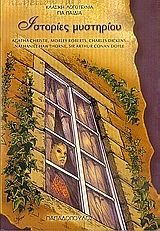
Ιστορίες μυστηρίου book cover
Ιστορίες μυστηρίου
2006
First Published
3.80
Average Rating
92
Number of Pages
Έξι θαυμάσιες ιστορίες μυστηρίου, γραμμένες από τους μάστορες του είδους- την Αγκάθα Κρίστι, τον Κάρολο Ντίκενς, τον Σερ Άρθουρ Κόναν Ντόιλ, τον Ναθάνιελ Χόθορν, τον Μόρλι Ρόμπερτς. Ο κάθε συγγραφέας με το δικό του τρόπο, αλλά όλοι εξίσου εκπληκτικά και απαράμιλλα, μας περιγράφουν με ζωντάνια τις σκοτεινές πλευρές και το μυστήριο της ανθρώπινης ψυχής, που κανείς ποτέ δεν μπόρεσε να καταλάβει απόλυτα.

Avg Rating
3.80
Number of Ratings
5
5 STARS
20%
4 STARS
40%
3 STARS
40%
2 STARS
0%
1 STARS
0%
goodreads

Authors

Arthur Conan Doyle
Arthur Conan Doyle
Author · 779 books

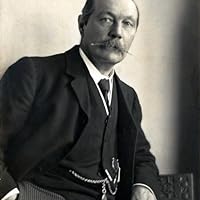
Sir Arthur Ignatius Conan Doyle was born the third of ten siblings on 22 May 1859 in Edinburgh, Scotland. His father, Charles Altamont Doyle, a talented illustrator, was born in England of Irish descent, and his mother, born Mary Foley, was Irish. They were married in 1855. Although he is now referred to as "Conan Doyle", the origin of this compound surname (if that is how he meant it to be understood) is uncertain. His baptism record in the registry of St Mary's Cathedral in Edinburgh gives 'Arthur Ignatius Conan' as his Christian name, and simply 'Doyle' as his surname. It also names Michael Conan as his godfather. At the age of nine Conan Doyle was sent to the Roman Catholic Jesuit preparatory school, Hodder Place, Stonyhurst. He then went on to Stonyhurst College, leaving in 1875. From 1876 to 1881 he studied medicine at the University of Edinburgh. This required that he provide periodic medical assistance in the towns of Aston (now a district of Birmingham) and Sheffield. While studying, Conan Doyle began writing short stories. His first published story appeared in "Chambers' Edinburgh Journal" before he was 20. Following his graduation, he was employed as a ship's doctor on the SS Mayumba during a voyage to the West African coast. He completed his doctorate on the subject of tabes dorsalis in 1885. In 1885 Conan Doyle married Louisa (or Louise) Hawkins, known as "Touie". She suffered from tuberculosis and died on 4 July 1906. The following year he married Jean Elizabeth Leckie, whom he had first met and fallen in love with in 1897. Due to his sense of loyalty he had maintained a purely platonic relationship with Jean while his first wife was alive. Jean died in London on 27 June 1940. Conan Doyle fathered five children. Two with his first wife—Mary Louise (28 January 1889 – 12 June 1976), and Arthur Alleyne Kingsley, known as Kingsley (15 November 1892 – 28 October 1918). With his second wife he had three children—Denis Percy Stewart (17 March 1909 – 9 March 1955), second husband in 1936 of Georgian Princess Nina Mdivani (circa 1910 – 19 February 1987; former sister-in-law of Barbara Hutton); Adrian Malcolm (19 November 1910–3 June 1970) and Jean Lena Annette (21 December 1912–18 November 1997). Conan Doyle was found clutching his chest in the hall of Windlesham, his house in Crowborough, East Sussex, on 7 July 1930. He had died of a heart attack at age 71. His last words were directed toward his wife: "You are wonderful." The epitaph on his gravestone in the churchyard at Minstead in the New Forest, Hampshire, reads: STEEL TRUE BLADE STRAIGHT ARTHUR CONAN DOYLE KNIGHT PATRIOT, PHYSICIAN & MAN OF LETTERS Conan Doyle's house, Undershaw, located in Hindhead, south of London, where he had lived for a decade, had been a hotel and restaurant between 1924 and 2004. It now stands empty while conservationists and Conan Doyle fans fight to preserve it. A statue honours Conan Doyle at Crowborough Cross in Crowborough, where Conan Doyle lived for 23 years. There is also a statue of Sherlock Holmes in Picardy Place, Edinburgh, close to the house where Conan Doyle was born. Series: * Sherlock Holmes

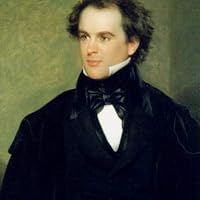
Nathaniel Hawthorne
Nathaniel Hawthorne
Author · 195 books

Nathaniel Hawthorne was a 19th century American novelist and short story writer. He is seen as a key figure in the development of American literature for his tales of the nation's colonial history. Shortly after graduating from Bowdoin College, Hathorne changed his name to Hawthorne. Hawthorne anonymously published his first work, a novel titled Fanshawe, in 1828. In 1837, he published Twice-Told Tales and became engaged to painter and illustrator Sophia Peabody the next year. He worked at a Custom House and joined a Transcendentalist Utopian community, before marrying Peabody in 1842. The couple moved to The Old Manse in Concord, Massachusetts, later moving to Salem, the Berkshires, then to The Wayside in Concord. The Scarlet Letter was published in 1850, followed by a succession of other novels. A political appointment took Hawthorne and family to Europe before returning to The Wayside in 1860. Hawthorne died on May 19, 1864, leaving behind his wife and their three children. Much of Hawthorne's writing centers around New England and many feature moral allegories with a Puritan inspiration. His work is considered part of the Romantic movement and includes novels, short stories, and a biography of his friend, the United States President Franklin Pierce.

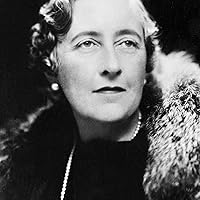
Agatha Christie
Agatha Christie
Author · 741 books

Agatha Christie is the top-selling author of all time, with a legacy spanning 66 crime novels, 14 plays, and six romance novels under a pseudonym. Her works have sold over two billion copies globally, translated into at least 103 languages, making her the most translated author. She introduced the world to iconic characters Hercule Poirot and Miss Jane Marple, and wrote *The Mousetrap*, the record-holding longest-running play in modern theater. The youngest in the Miller family, her experience as a nurse during WWI and later roles in pharmacies during both World Wars deeply influenced her mystery novels, often featuring poisons. Christie’s writing career launched in 1920 with *The Mysterious Affair at Styles*. Her life was as captivating as her fiction, notably her 1926 disappearance after her first husband’s affair became public, sparking a nationwide search. Christie's second marriage to archaeologist Max Mallowan enriched her life and work, with travels and homes like the Greenway Estate and Abney Hall providing settings for several novels. Her marriage to Mallowan lasted until her death in 1976. Christie's contributions to literature earned her the title Commander of the Order of the British Empire, solidifying her place in literary history.

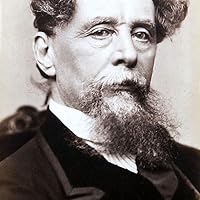
Charles Dickens
Charles Dickens
Author · 429 books

Charles John Huffam Dickens (1812-1870) was a writer and social critic who created some of the world's best-known fictional characters and is regarded as the greatest novelist of the Victorian era. His works enjoyed unprecedented popularity during his lifetime, and by the twentieth century critics and scholars had recognised him as a literary genius. His novels and short stories enjoy lasting popularity. Dickens left school to work in a factory when his father was incarcerated in a debtors' prison. Despite his lack of formal education, he edited a weekly journal for 20 years, wrote 15 novels, five novellas, hundreds of short stories and non-fiction articles, lectured and performed extensively, was an indefatigable letter writer, and campaigned vigorously for children's rights, education, and other social reforms. Dickens was regarded as the literary colossus of his age. His 1843 novella, A Christmas Carol, remains popular and continues to inspire adaptations in every artistic genre. Oliver Twist and Great Expectations are also frequently adapted, and, like many of his novels, evoke images of early Victorian London. His 1859 novel, A Tale of Two Cities, set in London and Paris, is his best-known work of historical fiction. Dickens' creative genius has been praised by fellow writers—from Leo Tolstoy to George Orwell and G. K. Chesterton—for its realism, comedy, prose style, unique characterisations, and social criticism. On the other hand, Oscar Wilde, Henry James, and Virginia Woolf complained of a lack of psychological depth, loose writing, and a vein of saccharine sentimentalism. The term Dickensian is used to describe something that is reminiscent of Dickens and his writings, such as poor social conditions or comically repulsive characters. On 8 June 1870, Dickens suffered another stroke at his home after a full day's work on Edwin Drood. He never regained consciousness, and the next day he died at Gad's Hill Place. Contrary to his wish to be buried at Rochester Cathedral "in an inexpensive, unostentatious, and strictly private manner," he was laid to rest in the Poets' Corner of Westminster Abbey. A printed epitaph circulated at the time of the funeral reads: "To the Memory of Charles Dickens (England's most popular author) who died at his residence, Higham, near Rochester, Kent, 9 June 1870, aged 58 years. He was a sympathiser with the poor, the suffering, and the oppressed; and by his death, one of England's greatest writers is lost to the world." His last words were: "On the ground", in response to his sister-in-law Georgina's request that he lie down. (from Wikipedia)

548 Market St PMB 65688, San Francisco California 94104-5401 USA
© 2026 Paratext Inc. All rights reserved