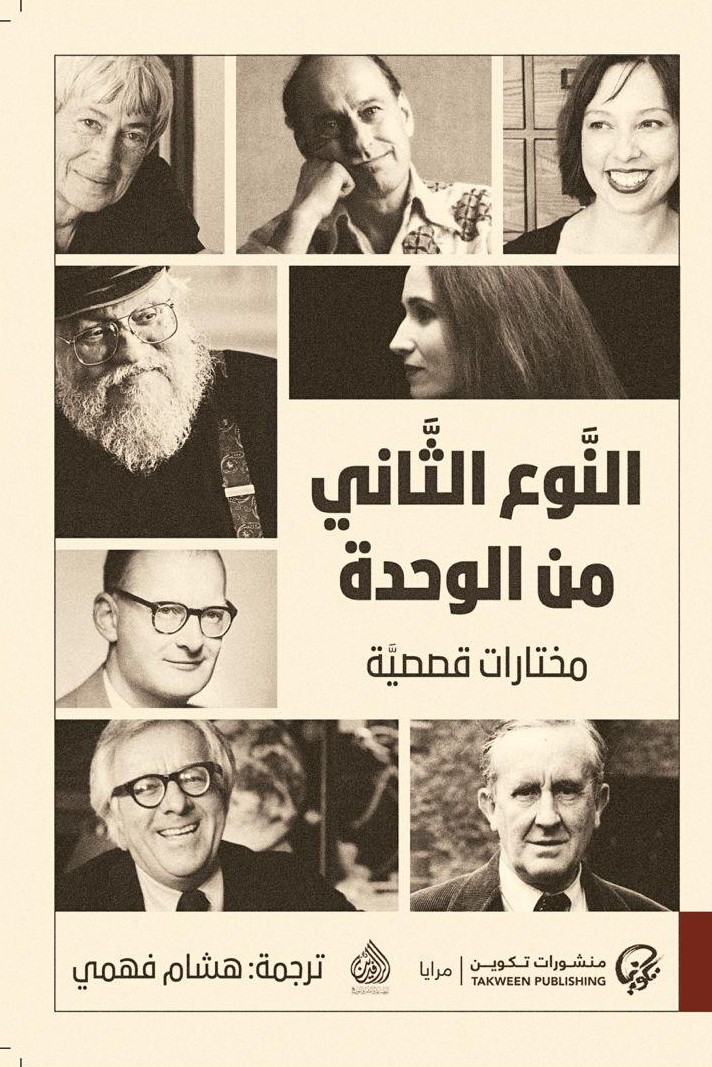



من حافة المجموعة الشمسية إلى عوالم أخرى غريبة، تأخذنا هذه المختارات في رحلة آسرة داخل عوالم الفانتازيا والخيال العلمي. بين الدهشة والتأمل، وبين المألوف والمتخَيَّل، تمتد القصص لتختبر حدود الواقع وتحرِّض خيالنا على الاستكشاف، ويصير وسيلةً لفهم العالم والتعبير عن هشاشته. بعض القصص في هذه المجموعة لعددٍ من أهم وأشهر مؤلِّفي هذين المجاليْن في التاريخ، مثل: جورج ر. ر. مارتن، إرسولا ك. لِجوِن، آرثر تشارلز كلارك، و ج. ر. ر. تولكين، وبعضها لكتَّاب لم يحظوا بالقدر نفسه من الشُّهرة لكنني سعدتُ باكتشافهم ورأيتُ أن أنقل إلى القارئ العربي لمحات مما كتبوه. كعادتي في مثل هذه المجموعات القصصيَّة، العامل المشترك الأكبر بينها أنها من اختيار المُترجم وتفضيلاته، وعسى أن يجد القارئ فيها ما يروقه. المترجم *** مع هشام تصير الترجمة عملًا مرهِقًا مدقَّقًا خاليًا من الثغرات، خصوصًا مع لغته العربيَّة الممتازة. أحمد خالد توفيق
Authors

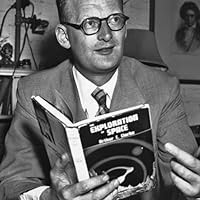
Sir Arthur Charles Clarke was one of the most important and influential figures in 20th century science fiction. He spent the first half of his life in England, where he served in World War Two as a radar operator, before emigrating to Ceylon in 1956. He is best known for the novel and movie 2001: A Space Odyssey, which he co-created with the assistance of Stanley Kubrick. Clarke was a graduate of King's College, London where he obtained First Class Honours in Physics and Mathematics. He is past Chairman of the British Interplanetary Society, a member of the Academy of Astronautics, the Royal Astronomical Society, and many other scientific organizations. Author of over fifty books, his numerous awards include the 1961 Kalinga Prize, the AAAS-Westinghouse science writing prize, the Bradford Washburn Award, and the John W. Campbell Award for his novel Rendezvous With Rama. Clarke also won the Nebula Award of the Science Fiction Writers of America in 1972, 1974 and 1979, the Hugo Award of the World Science Fiction Convention in 1974 and 1980, and in 1986 became Grand Master of the Science Fiction Writers of America. He was awarded the CBE in 1989.

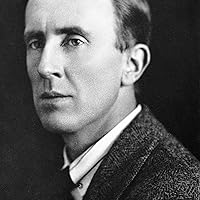
John Ronald Reuel Tolkien: writer, artist, scholar, linguist. Known to millions around the world as the author of The Lord of the Rings, Tolkien spent most of his life teaching at the University of Oxford where he was a distinguished academic in the fields of Old and Middle English and Old Norse. His creativity, confined to his spare time, found its outlet in fantasy works, stories for children, poetry, illustration and invented languages and alphabets. Tolkien’s most popular works, The Hobbit and The Lord of the Rings are set in Middle-earth, an imagined world with strangely familiar settings inhabited by ancient and extraordinary peoples. Through this secondary world Tolkien writes perceptively of universal human concerns – love and loss, courage and betrayal, humility and pride – giving his books a wide and enduring appeal. Tolkien was an accomplished amateur artist who painted for pleasure and relaxation. He excelled at landscapes and often drew inspiration from his own stories. He illustrated many scenes from The Silmarillion, The Hobbit and The Lord of the Rings, sometimes drawing or painting as he was writing in order to visualize the imagined scene more clearly. Tolkien was a professor at the Universities of Leeds and Oxford for almost forty years, teaching Old and Middle English, as well as Old Norse and Gothic. His illuminating lectures on works such as the Old English epic poem, Beowulf, illustrate his deep knowledge of ancient languages and at the same time provide new insights into peoples and legends from a remote past. Tolkien was born in Bloemfontein, South Africa, in 1892 to English parents. He came to England aged three and was brought up in and around Birmingham. He graduated from the University of Oxford in 1915 and saw active service in France during the First World War before being invalided home. After the war he pursued an academic career teaching Old and Middle English. Alongside his professional work, he invented his own languages and began to create what he called a mythology for England; it was this ‘legendarium’ that he would work on throughout his life. But his literary work did not start and end with Middle-earth, he also wrote poetry, children’s stories and fairy tales for adults. He died in 1973 and is buried in Oxford where he spent most of his adult life.

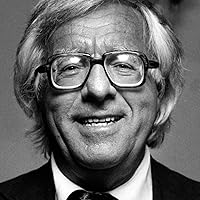
Ray Douglas Bradbury, American novelist, short story writer, essayist, playwright, screenwriter and poet, was born August 22, 1920 in Waukegan, Illinois. He graduated from a Los Angeles high school in 1938. Although his formal education ended there, he became a "student of life," selling newspapers on L.A. street corners from 1938 to 1942, spending his nights in the public library and his days at the typewriter. He became a full-time writer in 1943, and contributed numerous short stories to periodicals before publishing a collection of them, Dark Carnival, in 1947. His reputation as a writer of courage and vision was established with the publication of The Martian Chronicles in 1950, which describes the first attempts of Earth people to conquer and colonize Mars, and the unintended consequences. Next came The Illustrated Man and then, in 1953, Fahrenheit 451, which many consider to be Bradbury's masterpiece, a scathing indictment of censorship set in a future world where the written word is forbidden. In an attempt to salvage their history and culture, a group of rebels memorize entire works of literature and philosophy as their books are burned by the totalitarian state. Other works include The October Country, Dandelion Wine, A Medicine for Melancholy, Something Wicked This Way Comes, I Sing the Body Electric!, Quicker Than the Eye, and Driving Blind. In all, Bradbury has published more than thirty books, close to 600 short stories, and numerous poems, essays, and plays. His short stories have appeared in more than 1,000 school curriculum "recommended reading" anthologies. Ray Bradbury's work has been included in four Best American Short Story collections. He has been awarded the O. Henry Memorial Award, the Benjamin Franklin Award, the World Fantasy Award for Lifetime Achievement, the Grand Master Award from the Science Fiction Writers of America, the PEN Center USA West Lifetime Achievement Award, among others. In November 2000, the National Book Foundation Medal for Distinguished Contribution to American Letters was conferred upon Mr. Bradbury at the 2000 National Book Awards Ceremony in New York City. Ray Bradbury has never confined his vision to the purely literary. He has been nominated for an Academy Award (for his animated film Icarus Montgolfier Wright), and has won an Emmy Award (for his teleplay of The Halloween Tree). He adapted sixty-five of his stories for television's Ray Bradbury Theater. He was the creative consultant on the United States Pavilion at the 1964 New York World's Fair. In 1982 he created the interior metaphors for the Spaceship Earth display at Epcot Center, Disney World, and later contributed to the conception of the Orbitron space ride at Euro-Disney, France. Married since 1947, Mr. Bradbury and his wife Maggie lived in Los Angeles with their numerous cats. Together, they raised four daughters and had eight grandchildren. Sadly, Maggie passed away in November of 2003. On the occasion of his 80th birthday in August 2000, Bradbury said, "The great fun in my life has been getting up every morning and rushing to the typewriter because some new idea has hit me. The feeling I have every day is very much the same as it was when I was twelve. In any event, here I am, eighty years old, feeling no different, full of a great sense of joy, and glad for the long life that has been allowed me. I have good plans for the next ten or twenty years, and I hope you'll come along."


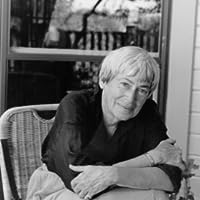
Ursula K. Le Guin published twenty-two novels, eleven volumes of short stories, four collections of essays, twelve books for children, six volumes of poetry and four of translation, and has received many awards: Hugo, Nebula, National Book Award, PEN-Malamud, etc. Her recent publications include the novel Lavinia, an essay collection, Cheek by Jowl, and The Wild Girls. She lived in Portland, Oregon. She was known for her treatment of gender (The Left Hand of Darkness, The Matter of Seggri), political systems (The Telling, The Dispossessed) and difference/otherness in any other form. Her interest in non-Western philosophies was reflected in works such as "Solitude" and The Telling but even more interesting are her imagined societies, often mixing traits extracted from her profound knowledge of anthropology acquired from growing up with her father, the famous anthropologist, Alfred Kroeber. The Hainish Cycle reflects the anthropologist's experience of immersing themselves in new strange cultures since most of their main characters and narrators (Le Guin favoured the first-person narration) are envoys from a humanitarian organization, the Ekumen, sent to investigate or ally themselves with the people of a different world and learn their ways.

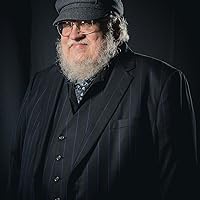
George Raymond Richard "R.R." Martin, born on September 20, 1948, in Bayonne, New Jersey, is a distinguished fantasy and science fiction writer. Son to Raymond Collins Martin, a longshoreman, and Margaret Brady Martin, he grew up with two sisters, Darleen Martin Lapinski and Janet Martin Patten. Martin's passion for writing emerged early, selling monster stories to neighborhood kids, which later evolved into a keen interest in comic books during his high school years, where he also started writing fiction for comic fanzines. His first professional story, The Hero, was sold in 1970 at age 21 and published in Galaxy's February 1971 issue. After earning a B.S. and then a M.S. in Journalism from Northwestern University, Martin served as a conscientious objector with VISTA, tied to the Cook County Legal Assistance Foundation from 1972-1974, alongside directing chess tournaments and teaching journalism. His marriage to Gale Burnick in 1975 ended in divorce by 1979 without children. Martin transitioned to full-time writing in 1979, after a stint as writer-in-residence at Clarke College. In Hollywood, Martin contributed to Twilight Zone and Beauty and the Beast on CBS, later producing his own pilot, Doorways. Residing in Santa Fe, New Mexico, he's been actively involved with the Science Fiction & Fantasy Writers of America and the Writers' Guild of America, West.

Roger Zelazny made his name with a group of novellas which demonstrated just how intense an emotional charge could be generated by the stock imagery of sf; the most famous of these is A Rose for Ecclesiastes in which a poet struggles to convince dying and sterile Martians that life is worth continuing. Zelazny continued to write excellent short stories throughout his career. Most of his novels deal, one way or another, with tricksters and mythology, often with rogues who become gods, like Sam in Lord of Light, who reinvents Buddhism as a vehicle for political subversion on a colony planet. The fantasy sequence The Amber Chronicles, which started with Nine Princes in Amber, deals with the ruling family of a Platonic realm at the metaphysical heart of things, who can slide, trickster-like through realities, and their wars with each other and the related ruling house of Chaos. Zelazny never entirely fulfilled his early promise—who could?—but he and his work were much loved, and a potent influence on such younger writers as George R. R. Martin and Neil Gaiman. He won the Nebula award three times (out of 14 nominations) and the Hugo award six times (out of 14 nominations). His papers are housed at the Albin O. Khun Library of the University of Maryland, Baltimore County (UMBC). http://en.wikipedia.org/wiki/Roger\_Ze...