Margins
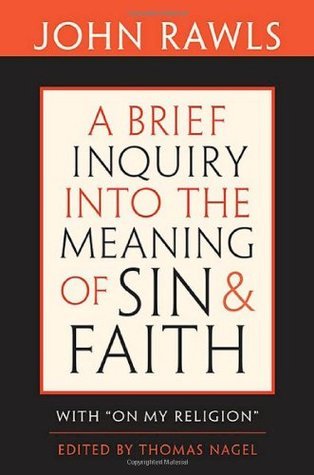
A Brief Inquiry into the Meaning of Sin & Faith with On My Religion book cover
A Brief Inquiry into the Meaning of Sin & Faith with On My Religion
2009
First Published
3.82
Average Rating
288
Number of Pages
John Rawls never published anything about his own religious beliefs, but after his death two texts were discovered which shed extraordinary light on the subject. A Brief Inquiry into the Meaning of Sin and Faith is Rawls’s undergraduate senior thesis, submitted in December 1942, just before he entered the army. At that time Rawls was deeply religious; the thesis is a significant work of theological ethics, of interest both in itself and because of its relation to his mature writings. “On My Religion,” a short statement drafted in 1997, describes the history of his religious beliefs and attitudes toward religion, including his abandonment of orthodoxy during World War II. The present volume includes these two texts, together with an Introduction by Joshua Cohen and Thomas Nagel, which discusses their relation to Rawls’s published work, and an essay by Robert Merrihew Adams, which places the thesis in its theological context. The texts display the profound engagement with religion that forms the background of Rawls’s later views on the importance of separating religion and politics. Moreover, the moral and social convictions that the thesis expresses in religious form are related in illuminating ways to the central ideas of Rawls’s later writings. His notions of sin, faith, and community are simultaneously moral and theological, and prefigure the moral outlook found in Theory of Justice.

Avg Rating
3.82
Number of Ratings
50
5 STARS
30%
4 STARS
34%
3 STARS
26%
2 STARS
8%
1 STARS
2%
goodreads

Author

John Rawls
John Rawls
Author · 11 books

John Bordley Rawls was an American philosopher and a leading figure in moral and political philosophy. He held the James Bryant Conant University Professorship at Harvard. His magnum opus A Theory of Justice (1971) is now regarded as "one of the primary texts in political philosophy." His work in political philosophy, dubbed Rawlsianism, takes as its starting point the argument that "most reasonable principles of justice are those everyone would accept and agree to from a fair position." Rawls employs a number of thought experiments—including the famous veil of ignorance—to determine what constitutes a fair agreement in which "everyone is impartially situated as equals," in order to determine principles of social justice. Rawls received both the Schock Prize for Logic and Philosophy and the National Humanities Medal in 1999, the latter presented by President Bill Clinton, in recognition of how Rawls' thought "helped a whole generation of learned Americans revive their faith in democracy itself."

548 Market St PMB 65688, San Francisco California 94104-5401 USA
© 2026 Paratext Inc. All rights reserved