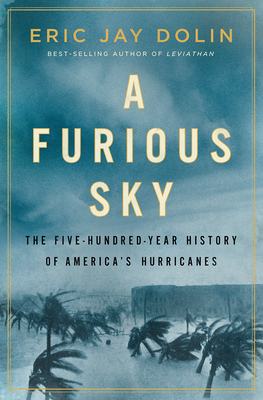
With A Furious Sky, best-selling author Eric Jay Dolin tells the history of America itself through its five-hundred-year battle with the fury of hurricanes. Hurricanes menace North America from June through November every year, each as powerful as 10,000 nuclear bombs. These megastorms will likely become more intense as the planet continues to warm, yet we too often treat them as local disasters and TV spectacles, unaware of how far-ranging their impact can be. As best-selling historian Eric Jay Dolin contends, we must look to our nation’s past if we hope to comprehend the consequences of the hurricanes of the future. With A Furious Sky, Dolin has created a vivid, sprawling account of our encounters with hurricanes, from the nameless storms that threatened Columbus’s New World voyages to the destruction wrought in Puerto Rico by Hurricane Maria. Weaving a story of shipwrecks and devastated cities, of heroism and folly, Dolin introduces a rich cast of unlikely heroes, such as Benito Vines, a nineteenth-century Jesuit priest whose innovative methods for predicting hurricanes saved countless lives, and puts us in the middle of the most devastating storms of the past, none worse than the Galveston Hurricane of 1900, which killed at least 6,000 people, the highest toll of any natural disaster in American history. Dolin draws on a vast array of sources as he melds American history, as it is usually told, with the history of hurricanes, showing how these tempests frequently helped determine the nation’s course. Hurricanes, it turns out, prevented Spain from expanding its holdings in North America beyond Florida in the late 1500s, and they also played a key role in shifting the tide of the American Revolution against the British in the final stages of the conflict. As he moves through the centuries, following the rise of the United States despite the chaos caused by hurricanes, Dolin traces the corresponding development of hurricane science, from important discoveries made by Benjamin Franklin to the breakthroughs spurred by the necessities of the World War II and the Cold War. Yet after centuries of study and despite remarkable leaps in scientific knowledge and technological prowess, there are still limits on our ability to predict exactly when and where hurricanes will strike, and we remain terribly vulnerable to the greatest storms on earth. A Furious Sky is, ultimately, a story of a changing climate, and it forces us to reckon with the reality that as bad as the past has been, the future will probably be worse, unless we drastically reimagine our relationship with the planet. 103 black-and-white illustrations; 8 pages of color illustrations
Author

I grew up near the coasts of New York and Connecticut, and since an early age I was fascinated by the natural world, especially the ocean. I spent many days wandering the beaches on the edge of Long Island Sound and the Atlantic, collecting seashells and exploring tidepools. When I left for college I wanted to become a marine biologist or more specifically a malacologist (seashell scientist). At Brown University I quickly realized that although I loved learning about science, I wasn't cut out for a career in science, mainly because I wasn't very good in the lab, and I didn't particularly enjoy reading or writing scientific research papers. So, after taking a year off and exploring a range of career options, I shifted course turning toward the field of environmental policy, first earning a double-major in biology and environmental studies, then getting a masters degree in environmental management from Yale, and a Ph.D. in environmental policy and planning from MIT, where my dissertation focused on the role of the courts in the cleanup of Boston Harbor. I have held a variety of jobs, including stints as a fisheries policy analyst at the National Marine Fisheries Service, a program manager at the U.S. Environmental Protection Agency, an environmental consultant stateside and in London, an American Association for the Advancement of Science writing fellow at Business Week, a curatorial assistant in the Mollusk Department at Harvard's Museum of Comparative Zoology, and an intern at the National Wildlife Federation, the Massachusetts Office of Coastal Zone Management, and the U.S. Senate. Throughout my career, one thing remained constant—I enjoyed writing and telling stories. And that's why I started writing books—to share the stories that I find most intriguing (I have also published more than 60 articles for magazines, newspapers, and professional journals). My most recent books include: ***A Furious Sky: The Five-Hundred-Year History of America's Hurricanes (Liveright, 2020), which was chosen by: The Washington Post—One of 50 Notable works of Nonfiction for 2020 Library Journal—One of the Best Science & Technology Books of 2020 Kirkus Reviews—One of the top 100 nonfiction books of 2020 (it was also a finalist for the Kirkus Prize) Booklist — 10 Top Sci-Tech Books of 2020 Amazon.com—One of the Best Science Books of 2020 And also was an Editor's Choice by the New York Times Book Review. New York Times—Editor's Choice ***Black Flags, Blue Waters: The Epic History of America's Most Notorious Pirates (Liveright, 2018), which was chosen as a "Must-Read" book for 2019 by the Massachusetts Center for the Book, and was a finalist for the 2019 Julia Ward Howe Award given by the Boston Author's Club. ***Brilliant Beacons: A History of the American Lighthouse (Liveright, 2016), which was chosen by gCaptain and Classic Boat as one of the best nautical books of 2016. ***When America First Met China: An Exotic History of Tea, Drugs, and Money in the Age of Sail (Liveright, September 2012), which was chosen by Kirkus Reviews as one of the ten best non-fiction books of Fall 2012. ***Fur, Fortune, and Empire: the Epic History of the Fur Trade in America (W. W. Norton, 2010), a national bestseller, which was chosen by New West, The Seattle Times, and The Rocky Mountain Land Library as one of the top non-fiction books of 2010. It also won the 2011 James P. Hanlan Book Award, given by the New England Historical Association, and was awarded first place in the Outdoor Writers Association of America, Excellence in Craft Contest. ***Leviathan: The History of Whaling in America (W. W. Norton, 2007), which was selected as one of the best nonfiction books of 2007 by The Los Angeles Times, The Boston Globe, and The Providence Journal. Leviathan was also chosen by Amazon.com's editors as one of the 10 best history books of 2007. Leviathan garnered the the 23rd annual (2007) L. Byrne Waterman