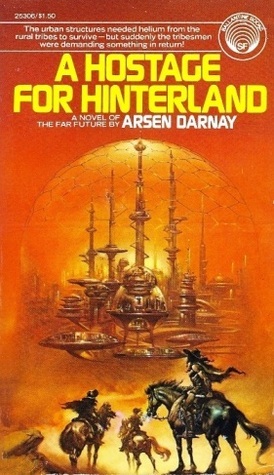
They rode to the floating urban structure city on horseback. Ecofreak tribesmen in beaded leather suits. Their long hair was braided, their faces tanned; and gilded red Crestmore bibles hung from their belts. They had come to negotiate with urban leaders for the helium so desperately needed to keep the structures aloft. At least, that's what everyone thought... But the truth was that they had come to fulfil a prophecy—a prophecy of death and carnage that would sweep the powerful urban structures from the face of the Earth forever!
Author
Arsen Julius Darnay. Hungarian-born writer, in the USA from 1953 and a US citizen from 1961. He resides in Michigan with wife Brigitte Theodora nee Schulz, retired reference publisher, also born in Europe. They have 3 children, 5 grandchildren, and 2+ great-grandchildren. http://www.isfdb.org/wiki/index.php/B... Since age 7, he has considered his "calling to be a writer, even poet". His first sf story, "The Splendid Freedom", appeared in Galaxy in 1974; his first novel, A Hostage for Hinterland, set the pattern for much of his work: in a Post-Holocaust USA, where floating Cities depend upon land-dwelling ecofreak tribesmen for the helium that cools their reactors, crisis erupts into a bleak and somewhat metaphysical confrontation, at the end of which the cities die. A similarly abstract dichotomy, set on a Rimworld, is destabilized in The Siege of Faltara (1978). The Splendid Freedom (collection of linked stories, 1980) carries its protagonists, who are linked through Reincarnation, into a variety of Dystopias. Darnay did not publish fiction 1981-2009.