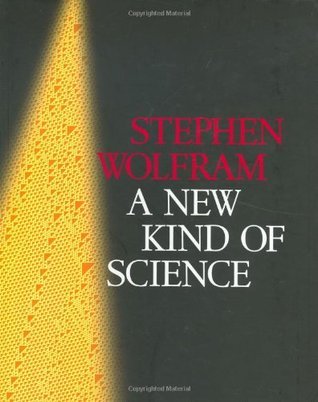
Physics and computer science genius Stephen Wolfram, whose Mathematica computer language launched a multimillion-dollar company, now sets his sights on a more daunting goal: understanding the universe. Wolfram lets the world see his work in A New Kind of Science, a gorgeous, 1,280-page tome more than a decade in the making. With patience, insight, and self-confidence to spare, Wolfram outlines a fundamental new way of modeling complex systems. On the frontier of complexity science since he was a boy, Wolfram is a champion of cellular automata—256 "programs" governed by simple nonmathematical rules. He points out that even the most complex equations fail to accurately model biological systems, but the simplest cellular automata can produce results straight out of nature—tree branches, stream eddies, and leopard spots, for instance. The graphics in A New Kind of Science show striking resemblance to the patterns we see in nature every day. Wolfram wrote the book in a distinct style meant to make it easy to read, even for nontechies; a basic familiarity with logic is helpful but not essential. Readers will find themselves swept away by the elegant simplicity of Wolfram's ideas and the accidental artistry of the cellular automaton models. Whether or not Wolfram's revolution ultimately gives us the keys to the universe, his new science is absolutely awe-inspiring. —Therese Littleton
Author
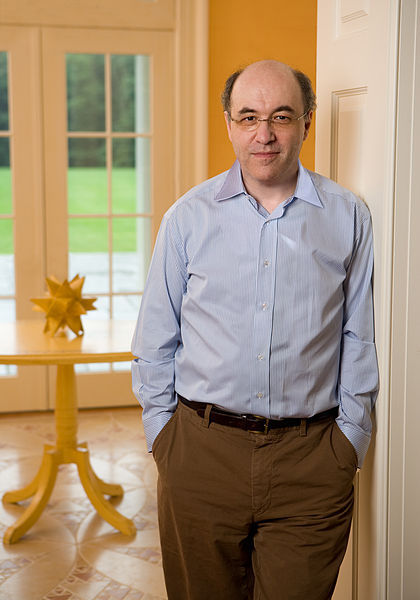
Stephen Wolfram's parents were Jewish refugees who emigrated from Germany to England in the 1930s. Wolfram's father Hugo was a textile manufacturer and novelist (Into a Neutral Country) and his mother Sybil was a professor of philosophy at the University of Oxford. He has a younger brother, Conrad. Wolfram is married to a mathematician and has four children. He was educated at Eton College, but claimed to be bored and left it prematurely in 1976. He entered St John's College, Oxford at age 17 but found lectures "awful", and left in 1978 without graduating. He received a Ph.D. in particle physics from the California Institute of Technology at age 20,[8] joined the faculty there and received one of the first MacArthur awards in 1981, at age 21. Wolfram presented a talk at the TED conference in 2010, and he was named Speaker of the Event for his 2012 talk at SXSW. In 2012 he became a fellow of the American Mathematical Society.