Margins
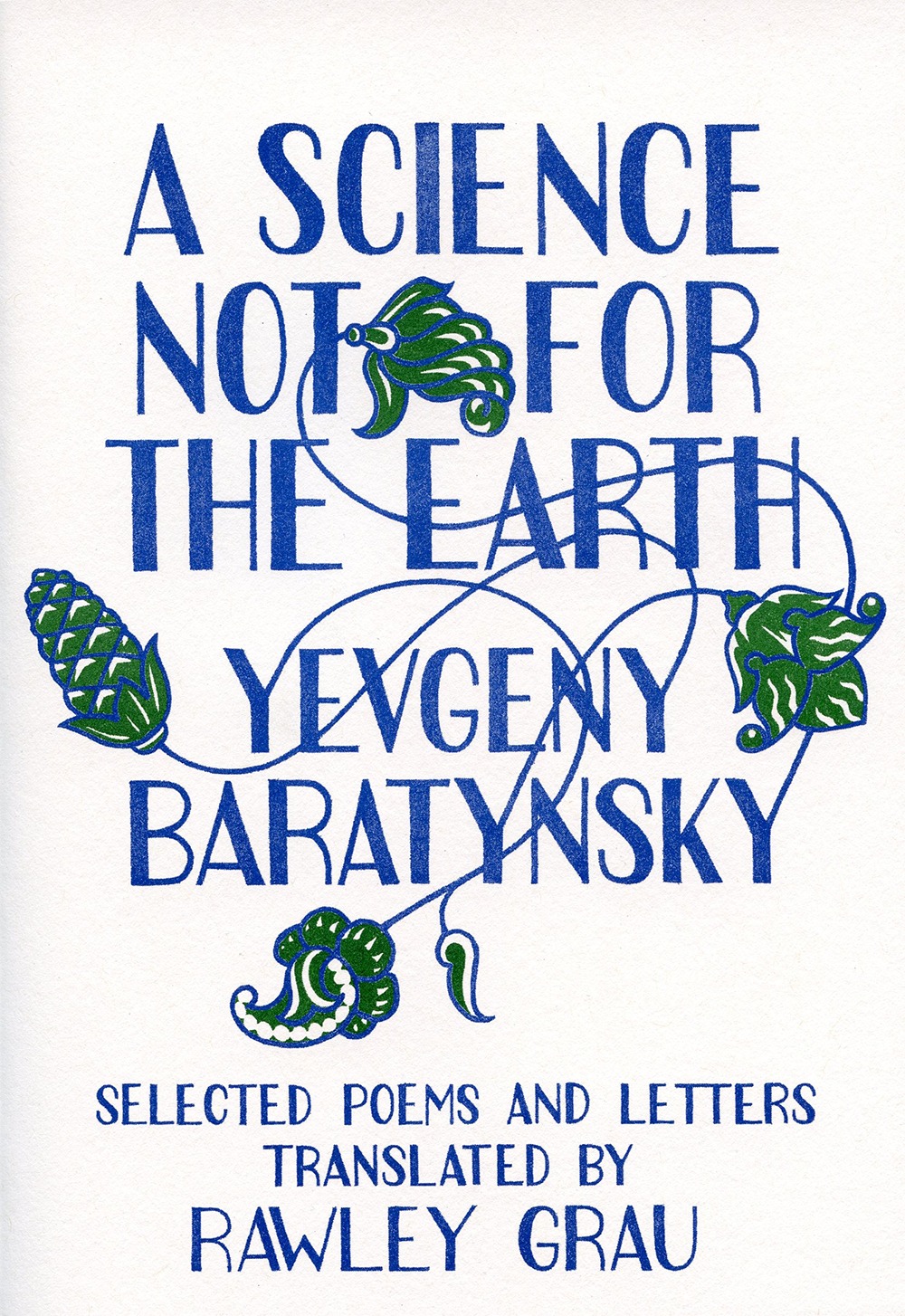
A Science Not for the Earth book cover
A Science Not for the Earth
2015
First Published
3.91
Average Rating
640
Number of Pages
Poetry. Letters. Translated from the Russian by Rawley Grau. Edited by Ilya Bernstein. It is only in the past quarter-century or so that Yevgeny Abramovich Baratynsky (1800-1844) has gained wide recognition in Russia as one of the great poets of the 19th century. While the psychologically acute love elegies and meditations he wrote in the early 1820s earned him some fame during his lifetime, his later lyric verse was ignored or misunderstood by most of his contemporaries. Yet it is this body of work in particular, where he explores fundamental questions about the meaning of existence from an analytical epistemological perspective, that today seems remarkably modern. The poet's radical skepticism, as well as his increasing sense of isolation from the literary world, is reflected most profoundly in his lyric masterpiece, the book Dusk (Sumerki, 1842) translated in its entirety in this volume a work that is notable, among other things, for being the first collection of poems published in Russia as a coherent literary cycle (a practice that would become standard only 60 years later). Featuring some 75 poems, from the early elegies to poems from his final years, Baratynsky'sA SCIENCE NOT FOR THE EARTH will be the first representative collection of the poet's lyric verse in English. The translations by Rawley Grau aim to be as semantically close to the original as possible while still conveying a strong sense of the formal aspects of the verse. A selection of Baratynsky's letters, reflecting his critical thoughts on writing as well as his personal struggles, is also included. The book is guest-edited by Russian-American poet Ilya Bernstein."

Avg Rating
3.91
Number of Ratings
11
5 STARS
18%
4 STARS
64%
3 STARS
9%
2 STARS
9%
1 STARS
0%
goodreads

Author

Yevgeny Baratynsky
Yevgeny Baratynsky
Author · 2 books

Yevgeny Abramovich Baratynsky (Russian: Евгений Абрамович Баратынский; 2 March 1800 in Saint Petersburg – 11 July 1844 in Naples) was lauded by Alexander Pushkin as the finest Russian elegiac poet. After a long period when his reputation was on the wane, Baratynsky was rediscovered by Anna Akhmatova and Joseph Brodsky as a supreme poet of thought. Of noble ancestry, Baratynsky was educated at the Page Corps at St. Petersburg, from which he was expelled at the age of 15 after stealing a snuffbox and five hundred roubles from the bureau of his accessory's uncle. After three years in the countryside and deep emotional turmoil, he entered the army as a private. In 1820 the young poet made his acquaintance with Anton Delvig, who rallied his falling spirits and introduced him to the literary press. Soon Baratynsky was transferred to Finland, where he remained six years. His first long poem, Eda, written during this period, established his reputation. In January 1826, he married the daughter of the Major-General Gregory G. Engelhardt. Through the interest of friends he obtained leave from the tsar to retire from the army, and settled in 1827 in Muranovo near Moscow (now a literary museum). There he completed his longest work, The Gipsy, a poem written in the style of Pushkin. Baratynsky's family life seemed to be happy, but a profound melancholy remained the background of his mind and of his poetry. He published several books of verse that were highly valued by Pushkin and other perceptive critics, but met with the comparatively cool reception of the public, and violent ridicule on the part of the young journalists of the "plebeian party". As the time went by, Baratynsky's mood progressed from pessimism to hopelessness, and elegy became his preferred form of expression. He died in 1844 at Naples, where he had gone in pursuit of a milder climate.

548 Market St PMB 65688, San Francisco California 94104-5401 USA
© 2026 Paratext Inc. All rights reserved