Margins




548 Market St PMB 65688, San Francisco California 94104-5401 USA
© 2026 Paratext Inc. All rights reserved
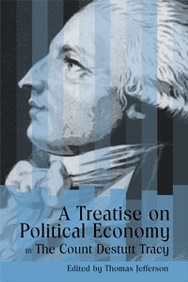
The neglect of Antoine Louis Claude Destutt de Tracy (1754–1836) in the history of political economy is both strange and tragic. He was, after all, Thomas Jefferson's number one, favorite economist, the thinker who influenced him and, arguably, laid the ideological foundation of the American economic system as Jefferson understood it. What's more, this reprint of the 1817 edition of his book was prepared personally by Jefferson and contains an editorial note by him. "It would be difficult to do justice, in any translation, to the style of the original, in which no word is unnecessary, no word can be changed for the better, and severity of logic results in that brevity, to which we wish all science reduced. The merit of this work will, I hope, place it in the hands of every reader in our country. By diffusing sound principles of Political Economy, it will protect the public industry from the parasite institutions now consuming it, and lead us to that just and regular distribution of the public burthens from which we have sometimes strayed." This high praise from Jefferson has somehow not translated into deserved fame for this book. One reason for this has to do with Tracy's own radicalism. He went further than any of his French contemporaries in the defense of trade, property, hard money, commerce, and his attacks on the state. This led to the banishment of his works in France, and an attempt by Napoleon to blunt his influence. Whereas Tracy coined the term "ideology" to refer to the science of the formation of ideals, Napoleon dismissed him and all those he influenced as "ideologues." This is how the term enters into modern usage. In this passage, Tracy sums up his view of society: "Society is purely and solely a continual series of exchanges. It is never anything else, in any epoch of its duration, from its commencement the most unformed, to its greatest perfection. And this is the greatest eulogy we can give to it, for exchange is an admirable transaction, in which the two contracting parties always both gain; consequently society is an uninterrupted succession of advantages, unceasingly renewed for all its members." He is extremely precise about the nature of value: it is subjective and revealed in action. His account of regulation is telling: "For it is very certain that in general the most powerful encouragement that can be given to industry of every kind, is to let it alone, and not to meddle with it. The human mind would advance very rapidly if only not restrained; and it would be led, by the force of things to do always what is most essential on every occurrence. To direct it artificially on one side rather than on another, is commonly to lead it astray instead of guiding it." This work presents the main thrust of all of his ideas, including his loathing of inflation and state-granted monopoly privilege. He was even opposed to state spending on infrastructure, pointing out that private individuals have built bridges, roads, canals, and even monuments. Summing up this book, Professor Timothy Terrell writes that despite the neglect of Tracy, it is clear that his "deductive methodology, his subjectivism, his catallactics, and his opposition to governmental monetary fraud and regulation have been carried through to the modern-day Austrian school in the tradition of Ludwig von Mises and Murray Rothbard." This edition is a facsimile of the original edited by Jefferson. [Mises.org]