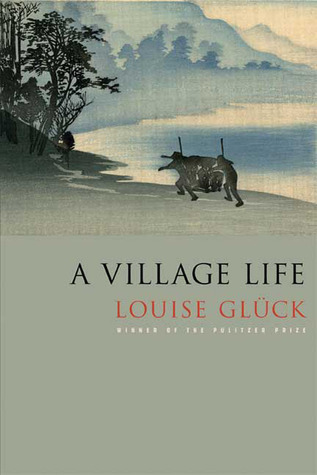
A Village Life, Louise Glück's eleventh collection of poems, begins in the topography of a village, a Mediterranean world of no definite moment or place: All the roads in the village unite at the fountain. Avenue of Liberty, Avenue of the Acacia Trees—The fountain rises at the center of the plaza; on sunny days, rainbows in the piss of the cherub. —from "tributaries" Around the fountain are concentric circles of figures, organized by age and in degrees of distance: fields, a river, and, like the fountain's opposite, a mountain. Human time superimposed on geologic time, all taken in at a glance, without any undue sensation of speed. Glück has been known as a lyrical and dramatic poet; since Ararat, she has shaped her austere intensities into book-length sequences. Here, for the first time, she speaks as "the type of describing, supervising intelligence found in novels rather than poetry," as Langdon Hammer has written of her long lines—expansive, fluent, and full—manifesting a calm omniscience. While Glück's manner is novelistic, she focuses not on action but on pauses and intervals, moments of suspension (rather than suspense), in a dreamlike present tense in which poetic speculation and reflection are possible.
Author
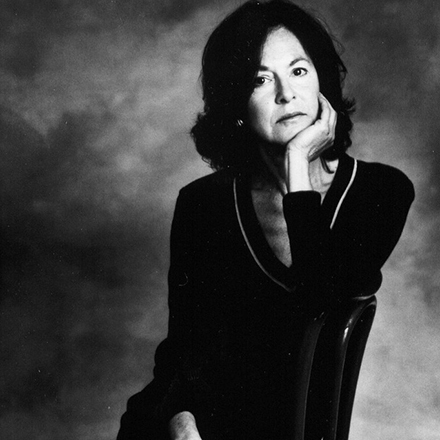
American poet Louise Elisabeth Glück served as poet laureate of the United States from 2003 to 2004. Parents of Hungarian Jewish heritage reared her on Long Island. She attended Sarah Lawrence College and later Columbia University. She is the author of twelve books of poetry, including: A Village Life (2009); Averno (2006), which was a finalist for The National Book Award; The Seven Ages (2001); Vita Nova (1999), which was awarded The New Yorker's Book Award in Poetry; Meadowlands (1996); The Wild Iris (1992), which received the Pulitzer Prize and the William Carlos Williams Award of the Poetry Society of America; Ararat (1990), which received the Rebekah Johnson Bobbitt National Prize for Poetry from the Library of Congress. She also published a collection of essays, Proofs and Theories: Essays on Poetry (1994), which won the PEN/Martha Albrand Award for First Nonfiction. In 2001, Yale University awarded Louise Glück its Bollingen Prize in Poetry, given biennially for a poet's lifetime achievement in his or her art. Her other honors include the Lannan Literary Award for Poetry, the Sara Teasdale Memorial Prize (Wellesley, 1986), the Pulitzer Prize for Poetry in 1993 for her collection, The Wild Iris . Glück is the recipient of the National Book Critics Circle Award ( Triumph of Achilles ), the Academy of American Poet's Prize ( Firstborn ), as well as the Massachusetts Institute of Technology Anniversary Medal (2000), and fellowships from the Guggenheim, Rockefeller foundations and the National Endowment for the Arts. In 2020, Glück was awarded the Nobel Prize in Literature, "for her unmistakable poetic voice that with austere beauty makes individual existence universal." Glück also worked as a senior lecturer in English at Williams College in Williamstown, Massachusetts, served as a member of the faculty of the University of Iowa and taught at Goddard College in Vermont. She currently lives in Cambridge, Massachusetts, and teaches as the Rosencranz writer in residence at Yale University and in the creative writing program of Boston University.