Margins
Margins
548 Market St PMB 65688, San Francisco California 94104-5401 USA
hello@margins.app
·
+1 (650) 223-5283
Privacy Policy
·
Terms of Use
© 2026 Paratext Inc. All rights reserved
Aldous Huxley Complete Essays
Aldous Huxley Complete Essays
Series · 4 books · 2000-2002
By
Aldous Huxley
Books in series
#1
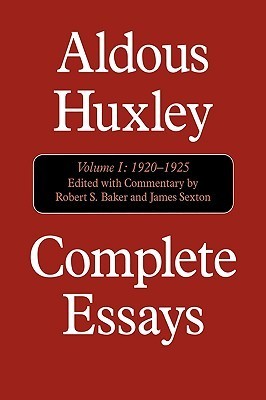
Complete Essays, Vol. I
2000
These first two volumes of a projected five, in preparation for several years, begin a major publishing venture, collecting the complete essays of one of the giants of modern English prose and of social commentary in our time. The first two volumes span the most productive period of Huxley's career. Volume I begins with his essays for Gilbert Murray's Athenaeum and his music essays for the New Westminster Gazette. Volume II continues through the 1920s and includes his controversial essays on India and the empire in "Jesting Pilate." The essays of both volumes range from nuanced assessments of art and architecture to political analyses, history, science, religion, and art, and a newly discovered series on music. Wide-ranging, allusive, and witty, they are informed by the probing skepticism of a highly educated and ironically incisive member of the English upper middle class. Huxley's fascination with the codes and conventions of European culture, his growing apprehensions about the menacing collapse of the European political order, and his awareness of the impact of science and technology on the post-Versailles world of England, France, Germany, and the United States form the basis for his critique. His subjects overlap with the satirical novels he wrote during the period between the wars, culminating in Point Counter Point and Brave New World. At their best, these essays stand among the finest examples of the genre in modern literature.
#2
Si mi biblioteca ardiera esta noche
2000
Cuando en 1947, Aldous Huxley escribió el artículo que da título a este volumen no podía imaginar siquiera que quince años más tarde su biblioteca de Los Ángeles sería realmente pasto de las llamas, pero es ésta una coincidencia y una anticipación muy propia del autor de obras como Un mundo feliz y La isla. Plantearse y analizar problemas que apenas empezaban a vislumbrarse, además de un estilo particularmente afilado y un muy riguroso pensamiento, es una de las señas de identidad de Aldous Huxley, de quien se reúnen aquí ensayos sobre temas tan diversos y sugerentes como los "Demasiados libros", las relaciones entre "Ficción y realidad", "La sinceridad en el arte", los "Best-sellers", "La difusión del arte mediocre", "La música y la política", o las posibilidades de las "Drogas que moldean la mente de los hombres". Una buena dosis de Aldous Huxley quintaesenciado que demuestra la absoluta vigencia de uno de los grandes escritores del siglo XX.
#3
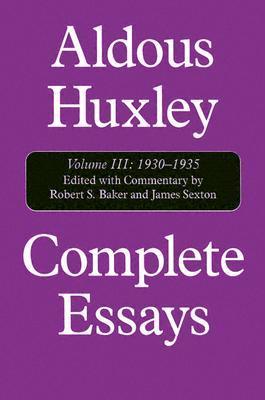
Complete Essays, Vol. III
2001
This third volume of a projected six reinforces Huxley s stature as one of the most acute and informed observers of the social and ideological trends of the years between the world wars. It contains the important collection of essays "Music at Night" as well as the majority of Huxley s journalistic writing for the Hearst newspapers in the United States and for a variety of British periodicals such as Nash s Pall Mall Magazine, the Evening Standard, and Time and Tide. Much of the attraction of the Hearst essays lies in their vivid period detail: references to the raucous voices of Nazi broadcasters, speeches by Roosevelt and Stalin, Soviet five-year plans, and the effects of the Great Depression combine to provide a rich context for Huxley s increasingly active role in organized pacifism and his sense of standing on the threshold of a new era. The essays of "Music at Night" define this trend as the New Romanticism, a celebration of Enlightenment modernity and an excessive faith in instrumental reason and applied science. Huxley was both intrigued by and suspicious of state planning and centralized bureaucratic authority. The essays in Volume III (and the volume to follow) register his growing ambivalence about the role of technocracy and science in an era of experimentation in the concentration of executive and legislative power. At their best, Huxley s essays stand among the finest examples of the genre in modern literature. "He was among the few writers who...played with ideas so freely, so gaily, with such virtuosity, that the responsive reader...was dazzled and excited." Isaiah Berlin.
#5
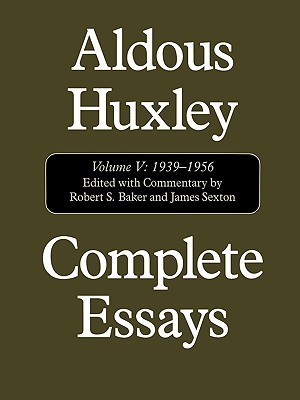
Complete Essays, Vol. V
2002
In this fifth of six volumes in a major publishing enterprise, Huxley continues to explore the role of science and technology in modern culture, and seeks a final level of foundational Truth that might provide the basis for his growing interest in religious mysticism. His philosophy of history took its final form in this period. At their best, Huxley's essays stand among the finest examples of the genre in modern literature. "A remarkable publishing event...beautifully produced and authoritatively edited." Jeffrey Hart. "He writes with an easy assurance and a command of classical and modern cross-references," Christopher Hitchens, Los Angeles Times. "There is much to enjoy in these volumes...they are important as a document of his times, and of a window on to a stage in the evolution of his mind." Economist. "You have to marvel at the range of Huxley s] interests and the intelligence with which he explores them....What we experience in this high journalism is a man of intelligence, sensibility, and formidable erudition engaging his era and struggling for equilibrium while sharing the widespread perception that something ghastly has happened to European civilization...." Washington Times
Author
Aldous Huxley
Author · 103 books