


Margins
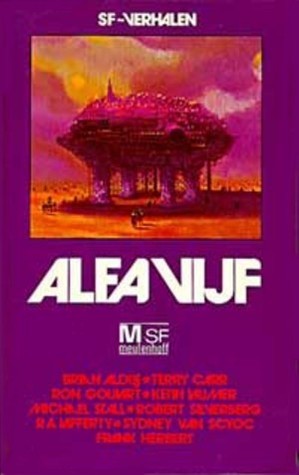
Alfa vijf book cover
Alfa vijf
1976
First Published
3.56
Average Rating
291
Number of Pages

11 SF/Fantasy-verhalen: Frank Herbert: Groenslaven (Greenslaves, 1965) Ron Goulart: Het probleem met machines (The trouble with machines, 1968) Michael Stall: De vijf deuren (The five doors, 1973) R.A. Lafferty: De man die er helemaal niet was (The man who never was, 1967) Brain Aldiss: Totale omgeving (Total environment, 1968) Keith Laumer: De planeetvernielers (The planet wreckers, 1966) Terry Carr: Zij wonen op niveaus (They live on levels, 1973) R.A. Lafferty: Alle stukken van een rivieroever (All pieces of a rivershore, 1970) Sydney J. van Scyoc: Dodenzang (Deathsong, 1974) Ron Goulart: Hooizolder (Lofthouse, 1969) Robert Silverberg: Nadat de mythen naar huis gingen (After the myths went home, 1969)

Avg Rating
3.56
Number of Ratings
9
5 STARS
0%
4 STARS
67%
3 STARS
22%
2 STARS
11%
1 STARS
0%
goodreads

Authors

Keith Laumer
Keith Laumer
Author · 93 books

John Keith Laumer was an American science fiction author. Prior to becoming a full-time writer, he was an officer in the U.S. Air Force and a U.S. diplomat. His brother March Laumer was also a writer, known for his adult reinterpretations of the Land of Oz (also mentioned in Keith's The Other Side of Time). Keith Laumer (aka J.K Laumer, J. Keith Laumer) is best known for his Bolo stories and his satirical Retief series. The former chronicles the evolution of juggernaut-sized tanks that eventually become self-aware through the constant improvement resulting from centuries of intermittent warfare against various alien races. The latter deals with the adventures of a cynical spacefaring diplomat who constantly has to overcome the red-tape-infused failures of people with names like Ambassador Grossblunder. The Retief stories were greatly influenced by Laumer's earlier career in the United States Foreign Service. In an interview with Paul Walker of Luna Monthly, Laumer states "I had no shortage of iniquitous memories of the Foreign Service." Four of his shorter works received Hugo or Nebula Award nominations (one of them, "In the Queue", received nominations for both) and his novel A Plague of Demons was nominated for the Nebula Award for Best Novel in 1966. During the peak years of 1959–1971, Laumer was a prolific science fiction writer, with his novels tending to follow one of two patterns: fast-paced, straight adventures in time and space, with an emphasis on lone-wolf, latent superman protagonists, self-sacrifice and transcendence or, broad comedies, sometimes of the over-the-top variety. In 1971, Laumer suffered a stroke while working on the novel The Ultimax Man. As a result, he was unable to write for a few years. As he explained in an interview with Charles Platt published in The Dream Makers (1987), he refused to accept the doctors' diagnosis. He came up with an alternative explanation and developed an alternative (and very painful) treatment program. Although he was unable to write in the early 1970s, he had a number of books which were in the pipeline at the time of the stroke published during that time. In the mid-1970s, Laumer partially recovered from the stroke and resumed writing. However, the quality of his work suffered and his career declined (Piers Anthony, How Precious Was That While, 2002). In later years Laumer also reused scenarios and characters from his earlier works to create "new" books, which some critics felt was to their detriment: Alas, Retief to the Rescue doesn't seem so much like a new Retief novel, but a kind of Cuisnart mélange of past books. — Somtow Sucharitkul (Washington Post, Mar 27, 1983. p. BW11) His Bolo creations were popular enough that other authors have written standalone science-fiction novels about them. Laumer was also a model airplane enthusiast, and published two dozen designs between 1956 and 1962 in the U.S. magazines Air Trails, Model Airplane News and Flying Models, as well as the British magazine Aero Modeler. He published one book on the subject, How to Design and Build Flying Models in 1960. His later designs were mostly gas-powered free flight planes, and had a whimsical charm with names to match, like the "Twin Lizzie" and the "Lulla-Bi". His designs are still being revisited, reinvented and built today.

Terry Carr
Terry Carr
Author · 12 books

Carr was born in Grants Pass, Oregon. He attended the City College of San Francisco and the University of California, Berkeley from 1954 to 1959. Carr discovered science fiction fandom in 1949, where he became an enthusiastic publisher of fanzines, which later helped open his way into the commercial publishing world. (He was one of the two fans responsible for the hoax fan 'Carl Brandon' after whom the Carl Brandon Society takes its name.) Despite a long career as a science fiction professional, he continued to participate as a fan until his death. He was nominated five times for Hugos for Best Fanzine (1959–1961, 1967–1968), winning in 1959, was nominated three times for Best Fan Writer (1971–1973), winning in 1973, and was Fan Guest of Honor at ConFederation in 1986. Though he published some fiction in the early 1960s, Carr concentrated on editing. He first worked at Ace Books, establishing the Ace Science Fiction Specials series which published, among other novels, The Left Hand of Darkness by Ursula K. Le Guin and Rite of Passage by Alexei Panshin. After conflicts with Ace head Donald A. Wollheim, he worked as a freelancer. He edited an original story anthology series called Universe, and a popular series of The Best Science Fiction of the Year anthologies that ran from 1972 until his death in 1987. He also edited numerous one-off anthologies over the same time span. He was nominated for the Hugo for Best Editor thirteen times (1973–1975, 1977–1979, 1981–1987), winning twice (1985 and 1987). His win in 1985 was the first time a freelance editor had won. Carr taught at the Clarion Workshop at Michigan State University in 1978, where his students included Richard Kadrey and Pat Murphy.

R.A. Lafferty
R.A. Lafferty
Author · 58 books
Raphael Aloysius Lafferty, published under the name R.A. Lafferty, was an American science fiction and fantasy writer known for his original use of language, metaphor, and narrative structure, as well as for his etymological wit. He also wrote a set of four autobiographical novels, a history book, and a number of novels that could be loosely called historical fiction.
Ron Goulart
Ron Goulart
Author · 77 books

Pseudonyms: Howard Lee; Frank S Shawn; Kenneth Robeson; Con Steffanson; Josephine Kains; Joseph Silva; William Shatner. Ron Goulart is a cultural historian and novelist. Besides writing extensively about pulp fiction—including the seminal Cheap Thrills: An Informal History of Pulp Magazines (1972)—Goulart has written for the pulps since 1952, when the Magazine of Fantasy & Science Fiction published his first story, a sci-fi parody of letters to the editor. Since then he has written dozens of novels and countless short stories, spanning genres and using a variety of pennames, including Kenneth Robeson, Joseph Silva, and Con Steffanson. In the 1990s, he became the ghostwriter for William Shatner’s popular TekWar novels. Goulart’s After Things Fell Apart (1970) is the only science-fiction novel to ever win an Edgar Award. In the 1970s Goulart wrote novels starring series characters like Flash Gordon and the Phantom, and in 1980 he published Hail Hibbler, a comic sci-fi novel that began the Odd Jobs, Inc. series. Goulart has also written several comic mystery series, including six books starring Groucho Marx. Having written for comic books, Goulart produced several histories of the art form, including the Comic Book Encyclopedia (2004).

Frank Herbert
Frank Herbert
Author · 69 books
Frank Herbert (1920–1986) was an American novelist best known for the landmark science‑fiction epic Dune, a visionary saga that fused ecology, politics, religion, and power into a new literary architecture for the genre. Dune won the Hugo and Nebula Awards and spawned a cycle of sequels—Dune Messiah, Children of Dune, God Emperor of Dune, Heretics of Dune, and Chapterhouse: Dune—that deepened its philosophical reach while shaping modern world‑building and serialized storytelling. Beyond Dune, Herbert’s craft ranged from social SF like The Dosadi Experiment to ecological thrillers such as The Green Brain, each marked by rigorous systems thinking, layered prose, and moral ambiguity. His influence endures in the canon of speculative fiction: a writer who proved science fiction could be intellectually audacious, commercially vital, and artistically consequential.
Brian W. Aldiss
Brian W. Aldiss
Author · 83 books

Pseudonyms: Jael Cracken, Peter Pica, John Runciman, C.C. Shackleton, Arch Mendicant, & "Doc" Peristyle. Brian Wilson Aldiss was one of the most important voices in science fiction writing today. He wrote his first novel while working as a bookseller in Oxford. Shortly afterwards he wrote his first work of science fiction and soon gained international recognition. Adored for his innovative literary techniques, evocative plots and irresistible characters, he became a Grand Master of Science Fiction in 1999. Brian Aldiss died on August 19, 2017, just after celebrating his 92nd birthday with his family and closest friends. Brian W. Aldiss Group on Good Reads

548 Market St PMB 65688, San Francisco California 94104-5401 USA
© 2026 Paratext Inc. All rights reserved