Margins
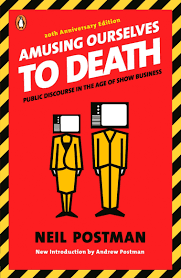
Amusing Ourselves to Death book cover
Amusing Ourselves to Death
Public Discourse in the Age of Show Business
1985
First Published
4.17
Average Rating
206
Number of Pages
Television has conditioned us to tolerate visually entertaining material measured out in spoonfuls of time, to the detriment of rational public discourse and reasoned public affairs. In this eloquent, persuasive book, Neil Postman alerts us to the real and present dangers of this state of affairs, and offers compelling suggestions as to how to withstand the media onslaught. Before we hand over politics, education, religion, and journalism to the show business demands of the television age, we must recognize the ways in which the media shape our lives and the ways we can, in turn, shape them to serve out highest goals.
Avg Rating
4.17
Number of Ratings
37,160
5 STARS
44%
4 STARS
36%
3 STARS
15%
2 STARS
4%
1 STARS
2%
goodreads

Author

Neil Postman
Neil Postman
Author · 13 books

Neil Postman, an important American educator, media theorist and cultural critic was probably best known for his popular 1985 book, Amusing Ourselves to Death. For more than four decades he was associated with New York University, where he created and led the Media Ecology program. He is the author of more than thirty significant books on education, media criticism, and cultural change including Teaching as a Subversive Activity, The Disappearance of Childhood, Technopoly, and Building a Bridge to the Eighteenth Century. Amusing Ourselves to Death (1985), a historical narrative which warns of a decline in the ability of our mass communications media to share serious ideas. Since television images replace the written word, Postman argues that television confounds serious issues by demeaning and undermining political discourse and by turning real, complex issues into superficial images, less about ideas and thoughts and more about entertainment. He also argues that television is not an effective way of providing education, as it provides only top-down information transfer, rather than the interaction that he believes is necessary to maximize learning. He refers to the relationship between information and human response as the Information-action ratio.

548 Market St PMB 65688, San Francisco California 94104-5401 USA
© 2026 Paratext Inc. All rights reserved