Margins
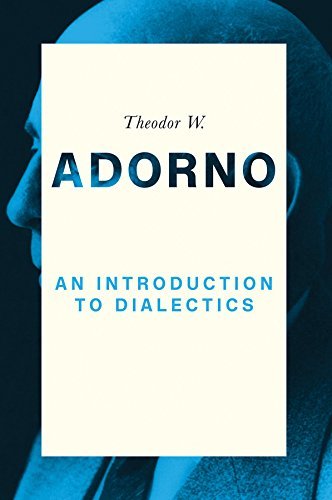
An Introduction to Dialectics book cover
An Introduction to Dialectics
1958
First Published
4.42
Average Rating
336
Number of Pages
This volume comprises Adorno's first lectures specifically dedicated to the subject of the dialectic, a concept which has been key to philosophical debate since classical times. While discussing connections with Plato and Kant, Adorno concentrates on the most systematic development of the dialectic in Hegel's philosophy, and its relationship to Marx, as well as elaborating his own conception of dialectical thinking as a critical response to this tradition. Delivered in the summer semester of 1958, these lectures allow Adorno to explore and probe the significant difficulties and challenges this way of thinking posed within the cultural and intellectual context of the post-war period. In this connection he develops the thesis of a complementary relationship between positivist or functionalist approaches, particularly in the social sciences, as well as calling for the renewal of ontological and metaphysical modes of thought which attempt to transcend the abstractness of modern social experience by appeal to regressive philosophical categories. While providing an account of many central themes of Hegelian thought, he also alludes to a whole range of other philosophical, literary and artistic figures of central importance to his conception of critical theory, notably Walter Benjamin and the idea of a constellation of concepts as the model for an 'open or fractured dialectic' beyond the constraints of method and system. These lectures are seasoned with lively anecdotes and personal recollections which allow the reader to glimpse what has been described as the 'workshop' of Adorno's thought. As such, they provide an ideal entry point for all students and scholars in the humanities and social sciences who are interested in Adorno's work as well as those seeking to understand the nature of dialectical thinking.

Avg Rating
4.42
Number of Ratings
154
5 STARS
54%
4 STARS
36%
3 STARS
8%
2 STARS
2%
1 STARS
0%
goodreads

Author

Theodor W. Adorno
Theodor W. Adorno
Author · 51 books

Theodor Wiesengrund Adorno was one of the most important philosophers and social critics in Germany after World War II. Although less well known among anglophone philosophers than his contemporary Hans-Georg Gadamer, Adorno had even greater influence on scholars and intellectuals in postwar Germany. In the 1960s he was the most prominent challenger to both Sir Karl Popper's philosophy of science and Martin Heidegger's philosophy of existence. Jürgen Habermas, Germany's foremost social philosopher after 1970, was Adorno's student and assistant. The scope of Adorno's influence stems from the interdisciplinary character of his research and of the Frankfurt School to which he belonged. It also stems from the thoroughness with which he examined Western philosophical traditions, especially from Kant onward, and the radicalness to his critique of contemporary Western society. He was a seminal social philosopher and a leading member of the first generation of Critical Theory. Unreliable translations hampered the initial reception of Adorno's published work in English speaking countries. Since the 1990s, however, better translations have appeared, along with newly translated lectures and other posthumous works that are still being published. These materials not only facilitate an emerging assessment of his work in epistemology and ethics but also strengthen an already advanced reception of his work in aesthetics and cultural theory.

548 Market St PMB 65688, San Francisco California 94104-5401 USA
© 2026 Paratext Inc. All rights reserved