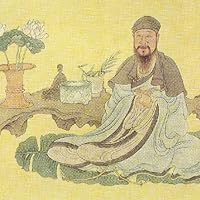
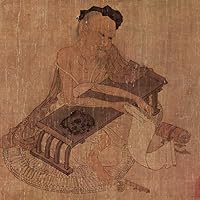
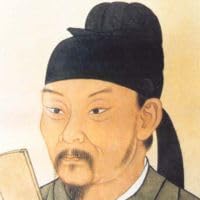
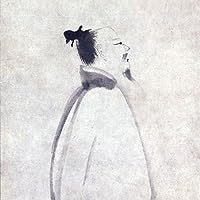
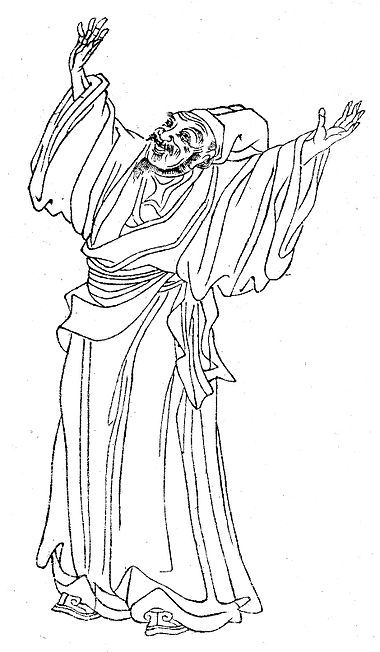
Esta coletânea bilíngüe, em chinês e português, é, possivelmente, a mais abrangente já publicada na língua portuguesa de poesia da Dinastia Tang (618-907), a “idade de ouro” da literatura chinesa clássica. Reúne mais de 200 poemas de mais de 30 autores, incluindo algumas mulheres. Os três principais nomes da poesia daquele período – Li Bai, Du Fu, Wang Wei – estão representados na obra, que também contempla traduções de escritores como Bai Juyi, Meng Haoran, Li Shangyin, Du Mu, Liu Yuxi, Cen Shen, Wen Tingyun e Li He. Entre as autoras, estão presentes aqui trabalhos assinados por Li Ye, Xue Tao, Yu Xuanji. O livro é uma contribuição relevante para o desenvolvimento dos estudos de literatura chinesa em países de língua portuguesa. Com uma introdução histórica e de teoria literária, notas explicativas e resenhas sobre os autores, baseia-se, principalmente, nas antologias mais consagradas – 300 Poemas da Dinastia Tang (século XVII), ePoemas de 1000 mestres (século XIII). Além disso, considera os principais textos de referência da tradição da tradução em português, inglês, francês e espanhol. A introdução e as notas abordam ainda questões da teoria da tradução, apresentam aspectos estruturais da poesia clássica chinesa, expõem os conceitos de paralelismo, tradução-recriação, tradução estrangeirizante, com base em aportes teóricos de Walter Benjamin, Roman Jakobson, Haroldo de Campos, François Cheng, Ezra Pound, Octavio Paz. No princípio da Dinastia Tang, as pesquisas formais e estudos lingüísticos haviam alcançado alto grau de refinamento na China. Em consequência do desenvolvimento próprio da ambiência literária ou de necessidades criadas pelos exames imperiais, que demandavam a sistematização de conteúdos, chegou-se, à época, a uma codificação e definição precisas das formas em uso, as quais constituiriam os modelos clássicos, que predominaram até o advento do Modernismo, nas primeiras décadas do século 20.
Authors
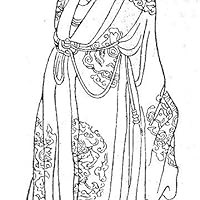
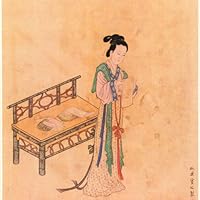
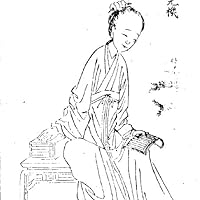
Li Ye (Chinese: 李冶; Wade–Giles: Li Yeh; died 784), also known by her courtesy name Li Jilan (李季蘭), was a Tang dynasty Chinese poet, Taoist nun, courtesan, and entertainer who was known for her talent in poetry as well as her beauty. In the tumultuous years of the late Tang, she was accused of treason for poems denigrating the imperial house of Tang that the rebel leader Zhu Ci forced her to write. She was condemned to death and executed in 784. Li is one of the few Tang-dynasty women whose poetry has survived. Li Ye was born in Wuxing, in present-day Huzhou, Zhejiang Province. As a child, she enjoyed writing poetry and was described by her father as "exceptionally clever" when she was six, after he read a poem she had written. However, he worried that she would grow up to become an "unchaste woman." Li's father was encouraging of her literary promise and believed that her talent would be wasted on marriage. As a courtesan, Li was particularly known for her "beauty and grace," as well as her talents for poetry, music, and calligraphy. She was well known in literary circles and associated with famous poets such as Liu Changqing, Jiaoran and Lu Yu, and her writing was praised by her contemporaries. She also had a reputation for being an "unchaste" woman. Her friend Jiaoran, the renowned poet and Buddhist monk, composed a poem after she paid him a visit: "A celestial fairy came to test me, / With the intention of spreading her blossoms onto my clothes." In her middle age, Li was recognized as a poet laureate by Emperor Daizong of Tang, who summoned her to the court after learning of her literary talent. She stayed in the palace for about a month, where she was treated lavishly by the emperor. However, she preferred her former carefree life and was allowed to return home. In 783, rebel leader Zhu Ci captured Chang'an, the capital of China and seated himself on the throne. Li was forced to write poems denigrating the imperial house of Tang. Zhu was defeated the following year, and Emperor Dezong, Daizong's successor, returned to Chang'an. Dezong accused Li of treason for her anti-Tang poetry. She was condemned to death and executed in 784.

Xue Tao (simplified Chinese: 薛涛; traditional Chinese: 薛濤; pinyin: Xuē Tāo; Wade–Giles: Hsüeh T'ao, 768–831), courtesy name Hongdu (洪度/宏度) was a well-known female Chinese poet of the Tang Dynasty, ranked with two other of the most famous women poets of Tang poetry, Yu Xuanji and Li Ye (李冶).Xue Tao was the daughter of a minor government official in Chang'an, which was the Chinese capital during the Tang Dynasty. Her father, Xue Yun (薛郧) was transferred to Chengdu, when she was still little, or possibly before her birth. Her father died while she was young, but it's possible that she had some literary education from him; her adult career also offered her the opportunity to learn from practicing poets. Since the girl's mother did not return to Chang'an, it is possible that they were too poor to do so. Xue was registered with the guild of courtesans and entertainers in Chengdu and in time became well known for her wit and her poetic talent. Her poetry attracted the attention of Wei Gao, the military governor of Xichuan Circuit (西川, headquartered in modern Chengdu, Sichuan) and she was made his official hostess. In this position she met poets like Yuan Zhen, to whom she was said to have become close; at the very least, this story indicates the charisma of both figures. Certainly, she exchanged poems with Yuan and many other well-known writers of the day, and continued as hostess after Wei's death. In later years, Xue was able to live independently in a site outside the city associated with the great poet of an earlier generation, Du Fu. Some sources record that she supported herself as a maker of artisanal paper used for writing poems. A contemporary wrote that she took on the garments of a Daoist adept, signaling a relatively autonomous status within Tang society. Some 450 poems by Xue were gathered in The Brocade River Collection that survived until the 14th century. About 100 of her poems are known nowadays, which is more than of any other Tang dynasty woman. They range widely in tone and topic, giving evidence of a lively intelligence and more than passing acquaintance with the great tradition of earlier Chinese poetry. Hsueh T'ao, a Venusian crater is named after her.
Wang Zhihuan (traditional Chinese: 王之渙; simplified Chinese: 王之涣; pinyin: Wáng Zhīhuàn, 688–742[1]) and whose name has been traditionally been transcribed "Wang Tsu-huan" was a Chinese poet of the Tang dynasty's Kaiyuan era. He is best known for his famous poem entitled "On the Stork Tower" (登鸛雀樓). Wang Zhihuan had two of his poems included in the famous poetry anthology Three Hundred Tang Poems, translated by Witter Bynner as "AT HERON LODGE" (also called "On the Stork Tower", a five-character-quatrain) and "BEYOND THE BORDER", a folk-song-styled-verse.

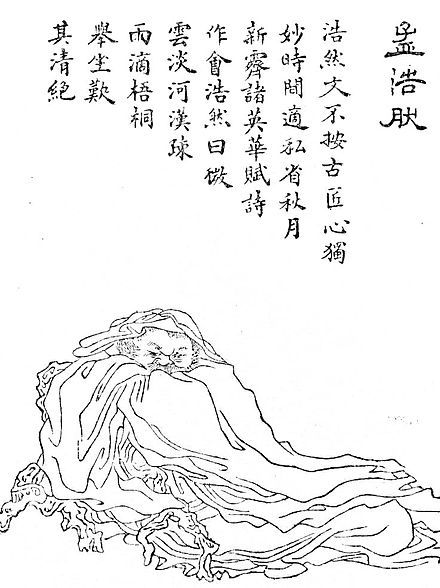
Meng Haoran (Chinese: 孟浩然; Wade–Giles: Meng Hao-jan; 689/691–740) was a major Tang dynasty poet, and a somewhat older contemporary of Wang Wei, Li Bai and Du Fu. Despite his brief pursuit of an official career, Meng Haoran mainly lived in and wrote about the area in which he was born and raised, in what is now Hubei province, China. Meng Haoran was a major influence on other contemporary and subsequent poets of the High Tang era because of his focus on nature as a main topic for poetry. Meng Haoran was also prominently featured in the Qing dynasty (and subsequently frequently republished) poetry anthology Three Hundred Tang Poems, having the fifth largest number of his poems included, for a total of fifteen, exceeded only by Du Fu, Li Bai, Wang Wei, and Li Shangyin. These poems of Meng Haoran were available in the English translations by Witter Bynner and Kiang Kanghu, by 1920, with the publication of The Jade Mountain. The Three Hundred Tang Poems also has two poems by Li Bai addressed to Meng Haoran, one in his praise and one written in farewell on the occasion of their parting company. Meng Haoran was also influential to Japanese poetry. First of the major High Tang poets, Meng Haoran was born in Xiangyang, south of the Han River, in the modern province of Hubei. He remained strongly attached to this area and its scenery throughout his life. He had a rather abbreviated civil service career, passing the Jinshi civil service test, beginning at the late age of 39 and ending not much later. He received his first and last position three years before his death, but resigned after less than a year. He lived in the Xiangyang area almost all his life (although he traveled to the major metropolis of Chang'an, where he was hosted by Wang Wei in 728). The landscape, history and legends of his home area are the subjects of many poems. Particularly prominent are Nanshan (or South Mountain, his family seat) and Lumen Shan, a temple site, where he briefly lived in retreat.

Li Shangyin (c. 813–858), courtesy name Yishan (義山), was a Chinese poet of the late Tang Dynasty, born in Henei (now Qinyang, Henan). Along with Li He, he was much admired and "rediscovered" in the 20th century by young Chinese writers for the imagist quality of his poems. He is particularly famous for his tantalizing "no title" (無題) poems. Li Shangyin's career was rough, and he never obtained a high position, either because of factional disputes, or because of his association with Liu Fen (劉蕡), a prominent opponent of the eunuchs.
Meng Jiao (Chinese: 孟郊; Wade–Giles: Meng Chiao; 751–814) was a Chinese poet during the Tang Dynasty. Two of his poems have been collected in the popular anthology Three Hundred Tang Poems. Meng was the oldest of the Mid-Tang poets and is noted for the unusual forcefulness and harshness of his poems. Meng Jiao's courtesy name was Dongye (traditional Chinese: 東野; simplified Chinese: 东野; pinyin: Dōngyě). Meng Jiao was born into difficult times. His pursuit of poetry and reluctance until late in life to write and pass the imperial examinations (which if taken earlier in life might have eventually lead to a well-paid political career) resulted in his living a life in which necessities were scarce. Nevertheless, his commitment to poetry resulted in him becoming an influential leader in terms of poetic innovation.

Du Fu (Chinese: 杜甫; pinyin: Du Fu; Wade-Giles: Tu Fu, 712–770) was a prominent Chinese poet of the Tang Dynasty. Along with Li Bai (Li Po), he is frequently called the greatest of the Chinese poets. His own greatest ambition was to help his country by becoming a successful civil servant, but he proved unable to make the necessary accommodations. His life, like the whole country, was devastated by the An Lushan Rebellion of 755, and the last 15 years of his life were a time of almost constant unrest. Initially little known, his works came to be hugely influential in both Chinese and Japanese culture. Of his poetic writing, nearly fifteen hundred poems written by Du Fu have been handed down over the ages. He has been called Poet-Historian and the Poet-Sage by Chinese critics, while the range of his work has allowed him to be introduced to Western readers as "the Chinese Virgil, Horace, Ovid, Shakespeare, Milton, Burns, Wordsworth, Béranger, Hugo or Baudelaire".

Du Mu (Chinese: 杜牧; pinyin: Dù Mù; Wade–Giles: Tu4 Mu4; 803–852) was a leading Chinese poet of the late Tang dynasty. His courtesy name was Muzhi (牧之), and sobriquet Fanchuan (樊川).[1] He is best known for his lyrical and romantic quatrains.[2] Regarded as a major poet during a golden age of Chinese poetry, his name is often mentioned together with that of another renowned Late Tang poet, Li Shangyin, as the Little Li-Du (小李杜), in contrast to the Great Li-Du: Li Bai and Du Fu. Among his influences were Du Fu, Li Bai, Han Yu and Liu Zongyuan.
Luo Yin (c. 833 – 26 January 910, courtesy name Zhaojian), born Luo Heng, was a poet of the late Tang dynasty and early Wuyue kingdom. Luo's poetry was widely read and cherished, but he was unsuccessful in life; having failed the imperial examination 10 times, he had been penniless until the warlord and Wuyue founder Qian Liu gave him official posts in his hometown Hang Prefecture. Luo was said to be very ugly and arrogant. Luo was born in Fuyang, Zhejiang. At the age of 20, he took his first Imperial examination. He failed the exam ten times. As a result, he gave himself the pseudonym "Yin" (lit. "dormant"). He was said to be of ugly countenance, and that he thought highly of himself and looked down on others. A famous anecdote demonstrates his ugliness: grand councilor Zheng Tian had a young daughter who enjoyed literature, and Luo Yin's poems which she frequently read out loud were her favorite readings. Zheng Tian became worried about her infatuation. One day, he invited Luo to his residence, and his daughter took a peek at the guest from behind the curtains. From that day on she never read his poems again. In 870, he was given a post in Hunan. However, he was unable to take advantage of the post, and returned to Zhejiang in 887. Penniless and frustrated, he later became an assistant to Qian Liu, but never shed his arrogant ways. He died at the age of 77.
Cui Hao (simplified Chinese: 崔颢; traditional Chinese: 崔顥; pinyin: Cuī Hào; Wade–Giles: Ts'ui Hao, 704?–754[1]) was a Chinese poet of the Tang Dynasty in China and considered a main early exponent of the regulated verse form of Classical Chinese poetry (also known as jintishi). Cui Hao was born in Biànzhōu (汴州 present day Kaifeng) and passed the imperial examinations in 723. He is known to have traveled extensively as an official, particularly between the years 723-744. He was known for three poetry topic - women, frontier outposts, and natural scenery. His life was initially conventional; along with Wang Wei, he was one of the perfectors of the jintishi form. Later, however, he acquired a reputation for disreputable personal behaviour and passed through several marriages. His later verse is similarly unconstrained.
Wang Han (Chinese: 王翰; pinyin: Wáng Hàn early part eighth century[1]) was a Chinese poet of the Tang dynasty, with one of his poems being included in the famous anthology Three Hundred Tang Poems. Much detailed biographical detail of Wang Han's life is lacking, such as the years of his birth and death.

Wen Tingyun (simplified Chinese: 温庭筠; traditional Chinese: 溫庭筠; 812–870) born Wen Qi (simplified Chinese: 温歧; traditional Chinese: 溫歧; pinyin: Wēn Qí), courtesy name Feiqing (simplified Chinese: 飞卿; traditional Chinese: 飛卿; pinyin: Fēiqīng) was an important Chinese lyricist of the late Tang Dynasty. He was born in Qi, Shanxi province, China. Over his literary career, Wen became regarded as the first truly distinctive writer of ci, the song-verse style of poetry that dominated Chinese poetry during much of the late Tang dynasty and the Song dynasty.[1] Most of his poems are "boudoir"-style verses that described the opulent furnishings and gardens of solitary women and their hidden desires.[2] This style of poetry was commonly used for romantic communications between men and women in the entertainment districts of the Chinese capital Chang'an during the Tang dynasty.[2] Yu Xuanji was among his followers.

Wang Wei (simplified Chinese: 王维; traditional Chinese: 王維; pinyin: Wáng Wéi; 699–759) and also known by other names such as Wang Youcheng, was a Tang dynasty Chinese poet, musician, painter, and statesman. He was one of the most famous men of arts and letters of his time. Many of his poems are preserved, and twenty-nine were included in the highly influential 18th century anthology Three Hundred Tang Poems. Source: http://en.wikipedia.org/wiki/Wang\_Wei...

Date of Birth: ca. 701 A.D. Date of Death: ca. 762 A.D. This is a Chinese name. The family name is Li. Li Bai (Li Pai; Chinese: 李白; pinyin: Lǐ Bái; Wade–Giles: Li Pai), also known as Li Bo (or Li Po; pinyin: Lǐ Bó; Wade–Giles: Li Po) was a Chinese poet. He was part of the group of Chinese scholars called the "Eight Immortals of the Wine Cup" in a poem by fellow poet Du Fu. Li Po is often regarded, along with Du Fu, as one of the two greatest poets in China's literary history. Approximately 1,100 of his poems remain today. The first translations in a Western language were published in 1862 by Marquis d'Hervey de Saint-Denys in his Poésies de l'Époque des Thang. The English-speaking world was introduced to Li Po's works by a Herbert Allen Giles publication History of Chinese Literature (1901) and through the liberal, but poetically influential, translations of Japanese versions of his poems made by Ezra Pound. Li Po is best known for the extravagant imagination and striking Taoist imagery in his poetry, as well as for his great love for liquor. Like Du Fu, he spent much of his life travelling, although in his case it was because his wealth allowed him to, rather than because his poverty forced him. He is said, famously but untruly, to have drowned in the Yangtze River, having fallen from his boat while drunkenly trying to embrace the reflection of the moon.
Wang Changling (simplified Chinese: 王昌龄; traditional Chinese: 王昌齡; pinyin: Wáng Chānglíng; 698–756) was a major Tang dynasty poet. His courtesy name was Shaobo (Chinese: 少伯). He was originally from Taiyuan in present-day Shanxi province, according to the editors of the Three Hundred Tang Poems, although other sources claim that he was actually from Jiangning near modern-day Nanjing. After passing the prestigious jinshi examination, he became a secretarial official and later held other imperial positions, including that of an official posting to Sishui (汜水), in what is currently Xingyang, in Henan province. Near the end of his life he was appointed as a minister of Jiangning county. He died in the An Lushan Rebellion. He is best known for his poems describing battles in the frontier regions of western China. Wang Changling was one of the competitors in the famous wine shop competition along with Gao Shi and Wang Zhihuan.

Li He (c. 790–791 – c. 816–817) was a Chinese poet of the mid-Tang dynasty. His courtesy name was Changji, and he is also known as Guicai and Shigui. He was a native of Fuchang County (west of modern-day Yiyang County, Henan Province). His family were of distant royal descent (from the Li family who were the ruling dynastic family of the Tang Dynasty), but his branch's fortunes had declined early on, and by Li He's time they were of low rank. He started composing poetry at the age of 7, and by around 15 he was being compared to the yuefu master Li Yi. When Li was 20, he attempted to take the Imperial Examination, but was forbidden from doing so because of a naming taboo: the first character (晉 jin) of his father's given name (晉肅 Jinsu) was a homonym of the first character (進) of Jinshi (進士), the name of the degree that would have been conferred on him had he passed.[6] Ueki et al. (1999) speculate that this was a pretext devised by rivals who were jealous of his poetic skill to prevent him from sitting the examination. Han Yu, who admired his poetry, wrote Hui Bian (諱弁) to encourage him to take the exam, but Li was ultimately unsuccessful. He served only three years, in the low-ranking office of Fenglilang (奉禮郎) before returning to his hometown.
Qian Qi (traditional Chinese: 錢起; simplified Chinese: 钱起; pinyin: Qián Qǐ; Wade–Giles: Ch'ien Ch'i; 710–782) was a Chinese poet of the Tang dynasty. Three of his poems have been included within the famous anthology Three Hundred Tang Poems. His courtesy name) was Zhongwen (Chinese: 仲文; pinyin: Zhòngwén). Part of one of Qian Qi's poems was used by Gustav Mahler in his Das Lied von der Erde.[1] He is credited under the name Chang Tsi as the author of the original Chinese text for the second movement of Mahler's Das Lied von der Erde.[2][3] The movement's title is "Der Einsame im Herbst" in German and "The Lonely Soul of Autumn" in English. The lyrics lament the dying of flowers and the passing of beauty. The inclusion of Qian Qi's poetry in Mahler's work joins him into the company of the other Tang poets whose works Mahler drew upon for this piece: Li Bo, Wang Wei, and Meng Haoran.
Wei Yingwu (traditional Chinese: 韋應物; simplified Chinese: 韦应物; pinyin: Wéi Yìngwù; Wade–Giles: Wei Ying-wu; 737–792) was a Chinese poet of the Tang dynasty. Twelve of Wei's poems have been included in the Three Hundred Tang Poems anthology. According to John C. H. Wu, the turbulence and lack of strong central leadership of China during Wei Yingwu's poetry-writing years was a major influencing factor upon his work. One example of such sociopolitical turmoil is the An Shi Rebellion of 755-763. Wu suggests that images such as the boat moving without a person steering in "At Chuzhou on the Western Stream" is a reference to the ship of state without a person at the helm.


Yu Xuanji (simplified Chinese: 鱼玄机; traditional Chinese: 魚玄機; pinyin: Yú Xuánjī; Wade–Giles: Yü Hsüan-chi, approximate dates 844–868/869), courtesy names Youwei (Chinese: 幼微; pinyin: Yòuwēi) and Huilan (simplified Chinese: 蕙兰; traditional Chinese: 蕙蘭; pinyin: Huìlán), was a Chinese poet and courtesan of the late Tang dynasty, from Chang'an. She was one of the most famous women poets of Tang, along with Xue Tao, her fellow courtesan.[1] Her family name, Yu, is relatively rare. Her given name, Xuanji, means something like "Profound Theory" or "Mysterious Principle," and is a technical term in Daoism and Buddhism. "Yòuwēi" means something like "Young and Tiny;" and, Huìlán refers to a species of fragrant orchid. She is distinctive for the quality of her poems, including many written in what seems to be a remarkably frank and direct autobiographical style; that is, using her own voice rather than speaking through a persona.

Liu Zongyuan (773 – November 28, 819) was a Chinese writer and poet who lived during the Tang Dynasty. Liu was born in present-day Yongji, Shanxi. Along with Han Yu, he was a founder of the Classical Prose Movement. He has been traditionally classed as one of the "Eight Great Prose Masters of the Tang and Song". His courtesy name was Zihou.
Cen Shen or Cen Can (traditional Chinese: 岑參; simplified Chinese: 岑参; pinyin: Cén Shēn; Wade–Giles: Ts'en Shen, or, sometimes, Ts'en Ts'an), also called Cen Jiazhou (Chinese: 岑嘉州; pinyin: Cén Jiāzhōu; Wade–Giles: Ts'en Chia-chou), (715–770) was a Chinese poet of the Tang Dynasty. He was born to a bureaucratic family in Nanyang (in today's Henan), but later moved to Jiangling, Jizhou (in today's Hubei). His great-grandfather Cen Wenben, granduncle Cen Changqian and uncle Cen Xi were all chancellors. His father Cen Zhi was Governor (Cishi) of Jingzhou. When Cen Shen was 10, his father died, and the financial situation of his family worsened. After then, Cen was learning with assiduity, reading a lot of scriptures and history books. He moved to Chang'an when he was 20, and obtained jinshi, in 744. In 749, Cen's ambitions lead him towards a stint of military service which would last about ten years, where he served as a subordinate to General Gao Xianzhi, and, later, Feng Changqing. In about 751, Cen met Gao Shi and Du Fu, and the three had became good friends. All three were poets. Cen's other friend was the great Tang poet Li Bai, who composed a poem titled "Bring in the Wine", and included a verse which mentioned his friend Cen Shen. ..."To the old master, Cen"... Bring in the wine! Let your cups never rest! Let me sing you a song! Let your ears attend!" Cen Shen lived through the period from 755 through 763 when the An-Shi disturbances shook the land, spreading civil war, disaster, and all sorts of turmoil throughout the northern parts of China. During this period he held several assignments in the Central Asian outposts of the far-reaching Tang empire. Having supported the loyalist cause, he succeeded to a number of provincial posts (primarily in Sichuan) under the restoration until his retirement in 768. Cen's early poems were always landscape poems, although this is not the case of his later ones. Cen served in the northwest frontier territories area for about ten years, his experience in this area with its harsh climate and the relentless combat of the times made a deep impact on his poetry.