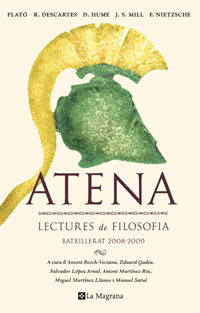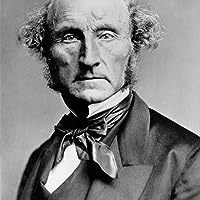



El curs de filosofia del nou batxillerat s'ha concebut com una història del pensament que inclou un recull ampli i complex de teories, interpretacions de món, reflexions sobre el coneixement, sobre la història, sobre el llenguatge, sobre la societat, sobre els motius de les accions humanes... Per això, a Atena trobareu obres senceres o fragments llargs de les obres dels autors que formen part dels programa: Plató, Descartes, Locke, J.S. Mill i Nietzsche. Els textos de cada perìode ( filosofia antigua, filosofia moderna i filosofia del segle XIX) van precedits d'una breu introducció, que constitueix a més una nota biobibliogràfica de cada autor. I, al final, una annex dóna indicacions sobre l'estructura de l'exercici i criteris generals d'avaluació de l'examen de Filosofia del Batxillerat a les proves d'accés a les universitats (PAU) de Catalunya. Esperem que les lectures d'aquest llibre no solament siguin una bona ajuda per preparar la prova de filosofia de l'examen de selectivitat, sinó que augmentin la capacitat crítica i el gust per la lectura de l'assaig filosófic.
Authors

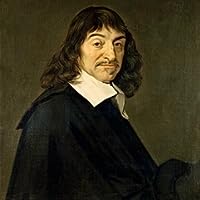
René Descartes, also known as Renatus Cartesius (Latinized form), was a highly influential French philosopher, mathematician, scientist, and writer. He has been dubbed the "Father of Modern Philosophy," and much of subsequent Western philosophy is a response to his writings, which continue to be studied closely. His influence in mathematics is also apparent, the Cartesian coordinate system that is used in plane geometry and algebra being named for him, and he was one of the key figures in the Scientific Revolution. Descartes frequently sets his views apart from those of his predecessors. In the opening section of the Passions of the Soul, a treatise on the Early Modern version of what are now commonly called emotions, he goes so far as to assert that he will write on his topic "as if no one had written on these matters before". Many elements of his philosophy have precedents in late Aristotelianism, the revived Stoicism of the 16th century, or in earlier philosophers like St. Augustine. In his natural philosophy, he differs from the Schools on two major points: First, he rejects the analysis of corporeal substance into matter and form; second, he rejects any appeal to ends—divine or natural—in explaining natural phenomena. In his theology, he insists on the absolute freedom of God’s act of creation. Descartes was a major figure in 17th century continental rationalism, later advocated by Baruch Spinoza and Gottfried Leibniz, and opposed by the empiricist school of thought consisting of Hobbes, Locke, Berkeley, and Hume. Leibniz, Spinoza and Descartes were all versed in mathematics as well as philosophy, and Descartes and Leibniz contributed greatly to science as well. As the inventor of the Cartesian coordinate system, Descartes founded analytic geometry, the bridge between algebra and geometry, crucial to the invention of calculus and analysis. Descartes' reflections on mind and mechanism began the strain of Western thought that much later, impelled by the invention of the electronic computer and by the possibility of machine intelligence, blossomed into the Turing test and related thought. His most famous statement is: Cogito ergo sum (French: Je pense, donc je suis; English: I think, therefore I am), found in §7 of part I of Principles of Philosophy (Latin) and in part IV of Discourse on the Method (French).

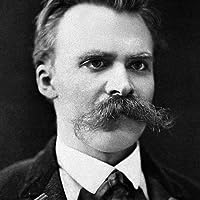
Friedrich Wilhelm Nietzsche (Ph.D., Philology, Leipzig University, 1869) was a German philosopher of the late 19th century who challenged the foundations of Christianity and traditional morality. He was interested in the enhancement of individual and cultural health, and believed in life, creativity, power, and the realities of the world we live in, rather than those situated in a world beyond. Central to his philosophy is the idea of “life-affirmation,” which involves a questioning of all doctrines that drain life's expansive energies, however socially prevalent those views might be. Often referred to as one of the first existentialist philosophers along with Søren Kierkegaard (1813–1855). From the Stanford Encyclopedia of Philosophy


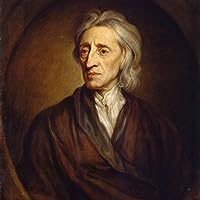
Librarian Note: There is more than one author in the GoodReads database with this name. John Locke was an English philosopher. He is considered the first of the British Empiricists, but is equally important to social contract theory. His ideas had enormous influence on the development of epistemology and political philosophy, and he is widely regarded as one of the most influential Enlightenment thinkers and contributors to liberal theory. His writings influenced Voltaire and Rousseau, many Scottish Enlightenment thinkers, as well as the American revolutionaries. This influence is reflected in the American Declaration of Independence. Locke's theory of mind is often cited as the origin for modern conceptions of identity and "the self", figuring prominently in the later works of philosophers such as David Hume, Jean-Jacques Rousseau and Immanuel Kant. Locke was the first Western philosopher to define the self through a continuity of "consciousness." He also postulated that the mind was a "blank slate" or "tabula rasa"; that is, contrary to Cartesian or Christian philosophy, Locke maintained that people are born without innate ideas.