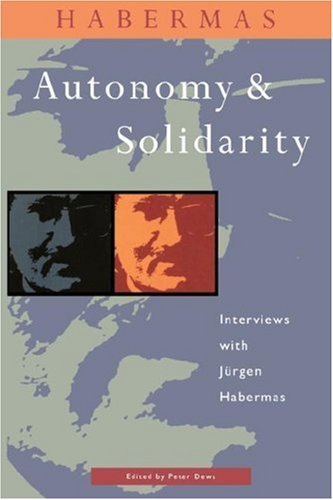
Over the last half decade or so, Jürgen Habermas has increasingly employed the interview format, both as a means of presenting his changing views on philosophical topics in an accessible way, and as a means of debating current social and political issues. This new, expanded edition of Autonomy and Solidarity includes an additional five interviews in which Habermas discusses such themes as the history and significance of the Frankfurt School, the social and political development of post-war Germany, the moral status of civil disobedience, the implications of the “Historians‘ Dispute,” and the function of national identity in the modern world. Never before published autobiographical material covering Habermas‘ early years at the Frankfurt Institute for Social Research is followed by an extended philosophical interrogation of his latest thinking on the relations between ethics, morality and law. With an extended introduction by Peter Dews, exploring the status and prospects of Critical Theory in the light of the recent revolutionary transformations in Europe, Autonomy and Solidarity should be of interest and value both to newcomers and those already familiar with Habermas‘ thought.