Margins
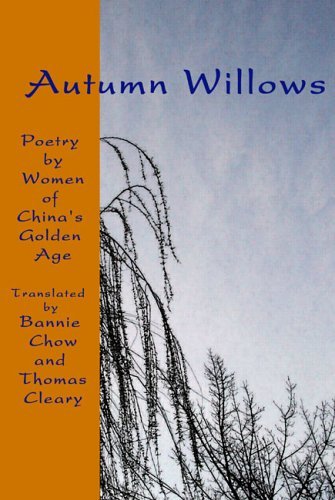
Autumn Willows book cover
Autumn Willows
Poetry by Women of China's Golden Age
Li Ye
2003
First Published
3.43
Average Rating
110
Number of Pages
The fabled middle Tang dynasty of China lasted almost three hundred years (618?905). These centuries embodied martial conflict, unbelievable wealth and opulence for a few, and horrible poverty for many. Through it all, an unwieldy caste system governed lord and serf alike. In this exotic, beautiful, and forbidding culture, poetry was revered and practiced by many. Three women poets, especially, endured through the centuries as the voices of their time. For the first time in English, the poetry of the Taoist priestesses, Le Yi and Yu Xuanji, and the slave, Xue Tao is presented.

Avg Rating
3.43
Number of Ratings
14
5 STARS
29%
4 STARS
14%
3 STARS
36%
2 STARS
14%
1 STARS
7%
goodreads

Author

Li Ye
Author · 2 books

Li Ye (Chinese: 李冶; Wade–Giles: Li Yeh; died 784), also known by her courtesy name Li Jilan (李季蘭), was a Tang dynasty Chinese poet, Taoist nun, courtesan, and entertainer who was known for her talent in poetry as well as her beauty. In the tumultuous years of the late Tang, she was accused of treason for poems denigrating the imperial house of Tang that the rebel leader Zhu Ci forced her to write. She was condemned to death and executed in 784. Li is one of the few Tang-dynasty women whose poetry has survived. Li Ye was born in Wuxing, in present-day Huzhou, Zhejiang Province. As a child, she enjoyed writing poetry and was described by her father as "exceptionally clever" when she was six, after he read a poem she had written. However, he worried that she would grow up to become an "unchaste woman." Li's father was encouraging of her literary promise and believed that her talent would be wasted on marriage. As a courtesan, Li was particularly known for her "beauty and grace," as well as her talents for poetry, music, and calligraphy. She was well known in literary circles and associated with famous poets such as Liu Changqing, Jiaoran and Lu Yu, and her writing was praised by her contemporaries. She also had a reputation for being an "unchaste" woman. Her friend Jiaoran, the renowned poet and Buddhist monk, composed a poem after she paid him a visit: "A celestial fairy came to test me, / With the intention of spreading her blossoms onto my clothes." In her middle age, Li was recognized as a poet laureate by Emperor Daizong of Tang, who summoned her to the court after learning of her literary talent. She stayed in the palace for about a month, where she was treated lavishly by the emperor. However, she preferred her former carefree life and was allowed to return home. In 783, rebel leader Zhu Ci captured Chang'an, the capital of China and seated himself on the throne. Li was forced to write poems denigrating the imperial house of Tang. Zhu was defeated the following year, and Emperor Dezong, Daizong's successor, returned to Chang'an. Dezong accused Li of treason for her anti-Tang poetry. She was condemned to death and executed in 784.

548 Market St PMB 65688, San Francisco California 94104-5401 USA
© 2026 Paratext Inc. All rights reserved