Being and Truth
2001
First Published
3.82
Average Rating
256
Number of Pages
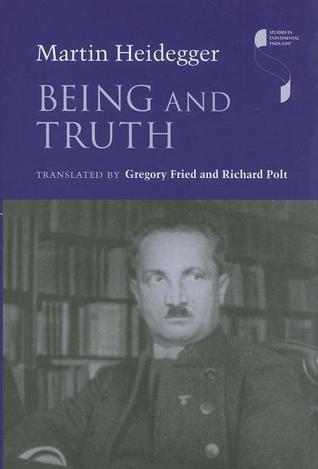
In these lectures, delivered in 1933-1934 while he was Rector of the University of Freiburg and an active supporter of the National Socialist regime, Martin Heidegger addresses the history of metaphysics and the notion of truth from Heraclitus to Hegel. First published in German in 2001, these two lecture courses offer a sustained encounter with Heidegger's thinking during a period when he attempted to give expression to his highest ambitions for a philosophy engaged with politics and the world. While the lectures are strongly nationalistic and celebrate the revolutionary spirit of the time, they also attack theories of racial supremacy in an attempt to stake out a distinctively Heideggerian understanding of what it means to be a people. This careful translation offers valuable insight into Heidegger's views on language, truth, animality, and life, as well as his political thought and activity.

Avg Rating
3.82
Number of Ratings
33
5 STARS
33%
4 STARS
33%
3 STARS
18%
2 STARS
12%
1 STARS
3%
goodreads
Author

Martin Heidegger
Author · 91 books
Martin Heidegger (1889-1976) was a German philosopher whose work is perhaps most readily associated with phenomenology and existentialism, although his thinking should be identified as part of such philosophical movements only with extreme care and qualification. His ideas have exerted a seminal influence on the development of contemporary European philosophy. They have also had an impact far beyond philosophy, for example in architectural theory (see e.g., Sharr 2007), literary criticism (see e.g., Ziarek 1989), theology (see e.g., Caputo 1993), psychotherapy (see e.g., Binswanger 1943/1964, Guignon 1993) and cognitive science (see e.g., Dreyfus 1992, 2008; Wheeler 2005; Kiverstein and Wheeler forthcoming).