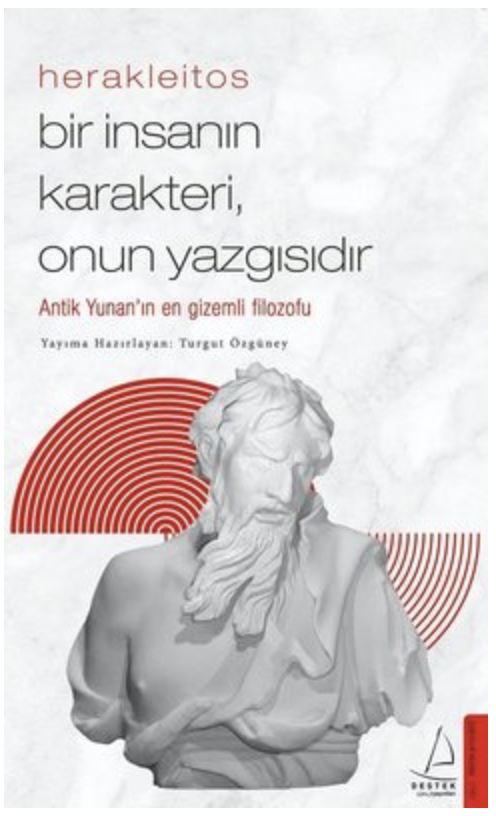
“İnsanların en bilgesi Tanrı karşısında maymundur. Maymunların en güzeli insan soyuyla karşılaştırıldığında çirkindir.” Antik Yunan’ın karanlık filozofu Herakleitos felsefe tarihine gizemli fragmanlarıyla damgasını vurmuştur. Yalnızlığı seven, asık suratlı, somurtkan Herakleitos’a sözleri anlaşılamadığından dolayı yurttaşları “Karanlık” adını takmıştır. Ona göre evrende var olan her şey ateşten oluşmuştur, ateş her şeyin ilkesidir ve yine onda çözülür. Şeylerin sürekli değişimi, karşıtların birliği, kozmik ateş, genesis, logos, nemli ve kuru ruhların hermeneutiği onun derinlikli felsefesinde değindiği başlıca konulardandır.
Authors

Heraclitus of Ephesus (Greek: Ἡράκλειτος ὁ Ἐφέσιος,c.535 – c.475 BCE) was a pre-Socratic Greek philosopher, a native of the Greek city Ephesus, Ionia, on the coast of Asia Minor. He was of distinguished parentage. Little is known about his early life and education, but he regarded himself as self-taught and a pioneer of wisdom. From the lonely life he led, and still more from the apparently riddled and allegedly paradoxical nature of his philosophy and his stress upon the needless unconsciousness of humankind, he was called "The Obscure" and the "Weeping Philosopher". Heraclitus was famous for his insistence on ever-present change as being the fundamental essence of the universe, as stated in the famous saying, "No man ever steps in the same river twice". This position was complemented by his stark commitment to a unity of opposites in the world,stating that "the path up and down are one and the same". Through these doctrines Heraclitus characterized all existing entities by pairs of contrary properties, whereby no entity may ever occupy a single state at a single time. This, along with his cryptic utterance that "all entities come to be in accordance with this Logos" (literally, "word", "reason", or "account") has been the subject of numerous interpretations.