Margins
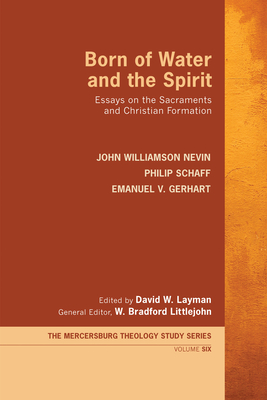
Born of Water and the Spirit book cover
Born of Water and the Spirit
Essays on the Sacraments and Christian Formation
2016
First Published
5.00
Average Rating
280
Number of Pages

Part of Series

Born of Water and the Spirit presents essays on the sacraments by the three major representatives of ""Mercersburg Theology,"" John Nevin, Philip Schaff, and Emanuel Gerhart. It focuses on Mercersburg's doctrine of baptism and Christian nurture, attempts to correct putative deficiencies of the major Reformed trajectories (e.g., New England and Princeton), and vigorously critiques the anti-sacramental animus of revivalistic evangelicalism. Mercersburg understood baptism as initiating a person (adult or infant) into the sacramental life of the church. Baptism and Eucharist were objective, spiritually real actions that made (what Nevin called) the ""mystical presence"" of Jesus Christ present to Christians, bringing transformative power into their lives. The present critical edition carefully preserves the original texts, while providing extensive introductions, annotations, and bibliography to orient the modern reader and facilitate further scholarship. The Mercersburg Theology Study Series is an attempt to make available for the first time, in attractive, readable, and scholarly modern editions, the key writings of the nineteenth-century movement known as the Mercersburg Theology. An ambitious multiyear project, it aims to make an important contribution to the scholarly community and to the broader reading public, who can at last be properly introduced to this unique blend of American and European, Reformed and Catholic theology. ""These provocative essays articulate a potent alternative to revivalism's identification of conversion with a disjunctive psychological crisis. David Layman's magisterial introduction clarifies how the Mercersburg theologians sought to recover a vision of salvation as a process of being shaped by the corporate life of the church, and baptism as the initial insertion of the individual into the life of Christ. Our churches desperately need such an antidote to self-generated and self-aggrandizing forms of spirituality."" —Lee Barrett, Stager Professor of Theology, Lancaster Theological Seminary; Author, Eros and Self-Emptying: Intersections of Augustine and Kierkegaard and Kierkegaard: Foundations of Theology John Williamson Nevin (1803-86) and Philip Schaff (1819-93) were professors at Mercersburg Seminary of the German Reformed Church, Nevin being among the leading American Protestant theologians of his day and Schaff quickly rising to become the nineteenth century's premier church historian. Emanuel V. Gerhart (1817-1904) was another leading teacher in the German Reformed church, teaching and writing at several denominational institutions from the 1840s until the close of his career. David W. Layman earned his PhD in Religion from Temple University in 1994. Since then, he has been a lecturer in religious studies and philosophy at schools in south central Pennsylvania and has researched and written several articles on the Mercersburg movement. W. Bradford Littlejohn is Director of the Davenant Trust, a nonprofit organization sponsoring historical research at the intersection of the church and academy, and is author of The Mercersburg Theology and the Quest for Reformed Catholicity and Richard Hooker: A Companion to His Life and Work.

Avg Rating
5.00
Number of Ratings
1
5 STARS
100%
4 STARS
0%
3 STARS
0%
2 STARS
0%
1 STARS
0%
goodreads

Authors

Philip Schaff
Philip Schaff
Author · 12 books

Philip Schaff was educated at the gymnasium of Stuttgart, and at the universities of Tübingen, Halle and Berlin, where he was successively influenced by Baur and Schmid, by Tholuck and Julius Müller, by David Strauss and, above all, Neander. At Berlin, in 1841, he took the degree of B.D., and passed examinations for a professorship. He then traveled through Italy and Sicily as tutor to Baron Krischer. In 1842 he was Privatdozent in the University of Berlin, where he lectured on exegesis and church history. In 1843 he was called to become professor of church history and Biblical literature in the German Reformed Theological Seminary of Mercersburg, Pennsylvania, then the only seminary of that church in America. On his journey he stayed in England and met Edward Pusey and other Tractarians. His inaugural address on The Principle of Protestantism, delivered in German at Reading, Pennsylvania, in 1844, and published in German with an English version by John Williamson Nevin was a pioneer work in English in the field of symbolics (that is, the authoritative ecclesiastical formulations of religious doctrines in creeds or confessions). This address and the "Mercersburg Theology" which he taught seemed too pro-Catholic to some, and he was charged with heresy. But, at the synod at York in 1845, he was unanimously acquitted. Schaff's broad views strongly influenced the German Reformed Church, through his teaching at Mercersburg, through his championship of English in German Reformed churches and schools in America, through his hymnal (1859), through his labours as chairman of the committee which prepared a new liturgy, and by his edition (1863) of the Heidelberg Catechism. His History of the Apostolic Church (in German, 1851; in English, 1853) and his History of the Christian Church (7 vols., 1858-1890), opened a new period in American study of ecclesiastical history. In 1854, he visited Europe, representing the American German churches at the ecclesiastical diet at Frankfort and at the Swiss pastoral conference at Basel. He lectured in Germany on America, and received the degree of D.D. from Berlin. In consequence of the ravages of the American Civil War the theological seminary at Mercersburg was closed for a while and so in 1863 Dr. Schaff became secretary of the Sabbath Committee (which fought the “continental Sunday”) in New York City, and held the position till 1870. In 1865 he founded the first German Sunday School in Stuttgart. In 1862-1867 he lectured on church history at Andover. Schaff was a member of the Leipzig Historical Society, the Netherland Historical Society, and other historical and literary societies in Europe and America. He was one of the founders, and honorary secretary, of the American branch of the Evangelical Alliance, and was sent to Europe in 1869, 1872, and 1873 to arrange for the general conference of the Alliance, which, after two postponements on account of the Franco-Prussian War, was held in New York in October 1873. Schaff was also, in 1871, one of the Alliance delegates to the emperor of Russia to plead for the religious liberty of his subjects in the Baltic provinces. He became a professor at Union Theological Seminary, New York City in 1870 holding first the chair of theological encyclopedia and Christian symbolism till 1873, of Hebrew and the cognate languages till 1874, of sacred literature till 1887, and finally of church history, till his death. He also served as president of the committee that translated the American Standard Version of the Bible, though he died before it was published in 1901. His History of the Christian Church resembled Neander's work, though less biographical, and was pictorial rather than philosophical. He also wrote biographies, catechisms and hymnals for children, manuals of religious verse, lectures and essays on Dante, etc. He translated Johann Jakob Herzog's Real-Encyklopädie für protestantische Theologie und Kirche into English.

548 Market St PMB 65688, San Francisco California 94104-5401 USA
© 2026 Paratext Inc. All rights reserved