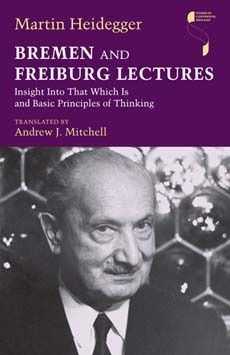
Bremen and Freiburg Lectures
Insight Into That Which Is and Basic Principles of Thinking
2012
First Published
4.33
Average Rating
224
Number of Pages
This volume consists of two lecture series given by Heidegger in the 1940s and 1950s. The lectures given in Bremen constitute the first public lectures Heidegger delivered after World War II, when he was officially banned from teaching. Here, Heidegger openly resumes thinking that deeply engaged him with Holderlin's poetry and themes developed in his earlier works. In the Freiburg lectures Heidegger ponders thought itself and freely engages with the German idealists and Greek thinkers who had provoked him in the past. Andrew J. Mitchell's translation allows English-speaking readers to explore important connections with Heidegger's earlier works on language, logic, and reality.

Avg Rating
4.33
Number of Ratings
40
5 STARS
53%
4 STARS
35%
3 STARS
8%
2 STARS
3%
1 STARS
3%
goodreads
Author

Martin Heidegger
Author · 91 books
Martin Heidegger (1889-1976) was a German philosopher whose work is perhaps most readily associated with phenomenology and existentialism, although his thinking should be identified as part of such philosophical movements only with extreme care and qualification. His ideas have exerted a seminal influence on the development of contemporary European philosophy. They have also had an impact far beyond philosophy, for example in architectural theory (see e.g., Sharr 2007), literary criticism (see e.g., Ziarek 1989), theology (see e.g., Caputo 1993), psychotherapy (see e.g., Binswanger 1943/1964, Guignon 1993) and cognitive science (see e.g., Dreyfus 1992, 2008; Wheeler 2005; Kiverstein and Wheeler forthcoming).