


Margins
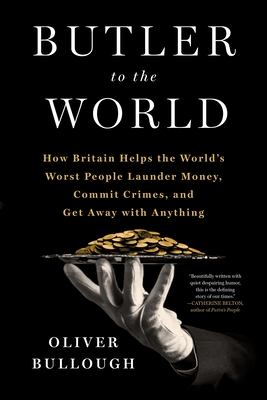
Butler to the World book cover
Butler to the World
The Book the Oligarchs Don't Want You to Read - How Britain Helps the World's Worst People Launder Money, Commit Crimes, and Get Away with Anything
2022
First Published
3.99
Average Rating
297
Number of Pages

In his punchy follow-up to Moneyland, Oliver Bullough's Butler to the World unravels the dark secret of how Britain placed itself at the centre of the global offshore economy and at the service of the worst people in the world… The Suez Crisis of 1956 was Britain’s twentieth century nadir, the moment when the once superpower was bullied into retreat. In the immortal words of former US Secretary of State Dean Acheson, ‘Britain has lost an empire and not yet found a role.’ But the funny thing was, Britain had already found a role. It even had the costume. The leaders of the world just hadn’t noticed it yet. Butler to the World reveals how the UK took up its position at the elbow of the worst people on Earth: the oligarchs, kleptocrats and gangsters. We pride ourselves on values of fair play and the rule of law, but few countries do more to frustrate global anti- corruption efforts. We are now a nation of Jeeveses, snobbish enablers for rich halfwits of considerably less charm than Bertie Wooster. It doesn’t have to be that way.
Avg Rating
3.99
Number of Ratings
2,886
5 STARS
29%
4 STARS
45%
3 STARS
21%
2 STARS
4%
1 STARS
1%
goodreads

Author

Oliver Bullough
Oliver Bullough
Author · 5 books

I moved to Russia in 1999, after growing up in mid-Wales and studying at Oxford University. I had no particular plan, beyond a desire to learn Russian, but got a job at a local magazine and realised I liked finding things out and writing about them. The next year I moved to Bishkek, Kyrgyzstan, then joined Reuters news agency, which sent me to Moscow. The first major story I reported on was the Moscow theatre siege of 2002, when a group of Chechens seized a theatre in the capital. It both horrified and fascinated me, and I resolved to find out as much as I could about Chechnya and the North Caucasus, to try to understand the roots of the conflict that had burst so unexpectedly into my life. I travelled extensively in the mountains that form Russia’s southern border, falling in love with the scenery, the food and above all the warm and welcoming people. When I left Russia in 2006, I was exhausted by it, however. I had seen too much misery and never wanted to write about Chechnya again. But I had promised to give a talk to a society in London. After the talk, I was asked if I would ever write a book about what I had seen. I wrote down a few thoughts, took them to a friend who knew about books, and she introduced me to a publisher. I travelled in a dozen countries to meet all the people I needed for the stories I wanted to tell, and wrote them down in Let Our Fame Be Great. Penguin published it in the UK in 2010. It won the Oxfam Emerging Writer Prize and was short-listed for the Orwell Prize, with prize judge James Naughtie calling it “an extraordinary book... a wonderful part-travelogue, part-history”. Basic Books published it in the United States, where the Overseas Press Club awarded it the Cornelius Ryan Award for “best nonfiction book on international affairs”. After it came out, though, a number of Russian friends objected that I had made the Russians into the villains. I don’t think I did, but their complaints chewed away at me a little. Perhaps some readers had been left feeling all Russians were complicit in the crimes of their leaders. The Russians after all suffered as much as anyone at the hands of the government in Moscow. That provoked me into writing my second book, The Last Man in Russia, which describes the struggle of a Russian to live in freedom and the efforts of Soviet officials to stop him. The life story of Father Dmitry, the Orthodox priest I chose as my central figure, seems to me to mirror the life of his whole nation, which is beset by depression and alcoholism. Travelling to meet the people I wanted to talk to and to see the places I wanted to describe took me to the far north of Russia, to rotting gulag towns; to the west of Russia, to half-abandoned villages; and to the Ural Mountains, where the communists locked up their doughtiest opponents; and to Moscow itself, that great fat spider in the centre of its web. I would like to write more books one day but, at the moment, I’m concentrating on my day job as Caucasus Editor for the Institute of War and Peace Reporting. I also write freelance articles and worry about the Welsh rugby team. http://www.oliverbullough.com/biograp...

548 Market St PMB 65688, San Francisco California 94104-5401 USA
© 2026 Paratext Inc. All rights reserved