


Margins
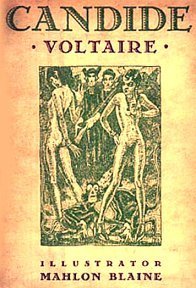
Candide in English & French – 1918 Boni & Liveright Translation book cover
Candide in English & French – 1918 Boni & Liveright Translation
2024
First Published
3.85
Average Rating
142
Number of Pages

1 Enlightenment philosopher and one of the greatest French writers ever.

a top 100 most influential book. But which translation should you read? This one - the most darkly hilarious. But why? As Voltaire once wrote, after translating Hamlet’s famous “Do not imagine that I have translated the English of Shakespeare word for word. Woe to the writers of literal translations, who in translating each word enervates the charm, and extinguishes the fire. It is here we may say that the letter kills, and the spirit gives life.” Every other Candide translation is slavishly literal. A hollow shell of the wit and satire of the original. This one, Zogbonk’s version, breathes fresh life into this philosophical masterpiece. It’s the one that augments and amplifies the comedy, while hitting every plot point and nuance of the original satire. Written in the true spirit of Voltaire, it’s the one he’d want you to experience—if you’re not reading the original French, of course. Humor is the non-negotiable core of the translation. By prioritizing the humor, we stay true to Candide in the most important way. A “close” translation may check the boxes on linguistic accuracy, but if it sacrifices the humor and absurdity, it misses Voltaire’s intent. Instead, I embraced the essential to be truly faithful to Voltaire’s Candide you must take liberties with the words to capture the spirit. In fact, my aim wasn't just translation - it was to write what Voltaire himself would have written had he been working in 21st century English. Based on what everyone who’s read this version tells me, I haven’t just achieved this goal but may have even exceeded it. What Makes This Version So The density of humor in this book is unprecedented—working on multiple levels like Douglas Adams or Terry Pratchett, but with classical philosophical weight behind it. It's equally at home in a college classroom or in the hands of someone who just wants a cleverly written comic novel. This version maintains all of Voltaire's philosophical substance and satirical bite while making the discourse more engaging and the references more accessible. For academics, every plot point and philosophical argument remains intact - sometimes even improved (like the Dervish scene). For comedy lovers, it's a wild adventure story filled with absurd situations and sharp humor. You can appreciate the jokes just for being funny, or for how they serve the deeper satire. Who will love it? If you enjoy the Hitchhikers Guide to the Galaxy or standup comedians like Anthony Jeselnik or Ricky Gervais, give it a try. You will know by page 7 if you’re going to like it. Who shouldn’t read If you think 1984 needs a trigger warning, believe in safe spaces for literature, or that there are some things you just don’t joke about, THIS BOOK IS NOT FOR YOU.
Avg Rating
3.85
Number of Ratings
34
5 STARS
41%
4 STARS
24%
3 STARS
18%
2 STARS
15%
1 STARS
3%
goodreads

Author

Voltaire
Voltaire
Author · 83 books

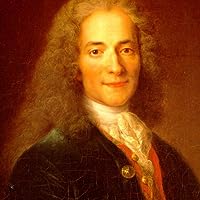
Complete works (1880) : https://archive.org/details/oeuvresco... In 1694, Age of Enlightenment leader Francois-Marie Arouet, known as Voltaire, was born in Paris. Jesuit-educated, he began writing clever verses by the age of 12. He launched a lifelong, successful playwriting career in 1718, interrupted by imprisonment in the Bastille. Upon a second imprisonment, in which Francois adopted the pen name Voltaire, he was released after agreeing to move to London. There he wrote Lettres philosophiques (1733), which galvanized French reform. The book also satirized the religious teachings of Rene Descartes and Blaise Pascal, including Pascal's famed "wager" on God. Voltaire wrote: "The interest I have in believing a thing is not a proof of the existence of that thing." Voltaire's French publisher was sent to the Bastille and Voltaire had to escape from Paris again, as judges sentenced the book to be "torn and burned in the Palace." Voltaire spent a calm 16 years with his deistic mistress, Madame du Chatelet, in Lorraine. He met the 27 year old married mother when he was 39. In his memoirs, he wrote: "I found, in 1733, a young woman who thought as I did, and decided to spend several years in the country, cultivating her mind." He dedicated Traite de metaphysique to her. In it the Deist candidly rejected immortality and questioned belief in God. It was not published until the 1780s. Voltaire continued writing amusing but meaty philosophical plays and histories. After the earthquake that leveled Lisbon in 1755, in which 15,000 people perished and another 15,000 were wounded, Voltaire wrote Poème sur le désastre de Lisbonne (Poem on the Lisbon Disaster): "But how conceive a God supremely good/ Who heaps his favours on the sons he loves,/ Yet scatters evil with as large a hand?" Voltaire purchased a chateau in Geneva, where, among other works, he wrote Candide (1759). To avoid Calvinist persecution, Voltaire moved across the border to Ferney, where the wealthy writer lived for 18 years until his death. Voltaire began to openly challenge Christianity, calling it "the infamous thing." He wrote Frederick the Great: "Christianity is the most ridiculous, the most absurd, and bloody religion that has ever infected the world." Voltaire ended every letter to friends with "Ecrasez l'infame" (crush the infamy—the Christian religion). His pamphlet, The Sermon on the Fifty (1762) went after transubstantiation, miracles, biblical contradictions, the Jewish religion, and the Christian God. Voltaire wrote that a true god "surely cannot have been born of a girl, nor died on the gibbet, nor be eaten in a piece of dough," or inspired "books, filled with contradictions, madness, and horror." He also published excerpts of Testament of the Abbe Meslier, by an atheist priest, in Holland, which advanced the Enlightenment. Voltaire's Philosophical Dictionary was published in 1764 without his name. Although the first edition immediately sold out, Geneva officials, followed by Dutch and Parisian, had the books burned. It was published in 1769 as two large volumes. Voltaire campaigned fiercely against civil atrocities in the name of religion, writing pamphlets and commentaries about the barbaric execution of a Huguenot trader, who was first broken at the wheel, then burned at the stake, in 1762. Voltaire's campaign for justice and restitution ended with a posthumous retrial in 1765, during which 40 Parisian judges declared the defendant innocent. Voltaire urgently tried to save the life of Chevalier de la Barre, a 19 year old sentenced to death for blasphemy for failing to remove his hat during a religious procession. In 1766, Chevalier was beheaded after being tortured, then his body was burned, along with a copy of Voltaire's Philosophical Dictionary. Voltaire's statue at the Pantheon was melted down during Nazi occupation. D. 1778. Voltaire (1694-1778), pseudónimo de François-

548 Market St PMB 65688, San Francisco California 94104-5401 USA
© 2026 Paratext Inc. All rights reserved