Margins
Margins
548 Market St PMB 65688, San Francisco California 94104-5401 USA
hello@margins.app
·
+1 (650) 223-5283
Privacy Policy
·
Terms of Use
© 2026 Paratext Inc. All rights reserved
Charles Edmondson Historical Lectures
Books in series
#1
Britain in "Decline"?
1998
In this elegantly written work, Cannadine neatly captures the essence of and makes his own provocative contributions to a major historiographical controversy over the decline of Britain, and personalizes it through penetrating portraits of three seemingly unrelated political leaders: Joseph Chamberlain, Winston Churchill, and Margaret Thatcher. The argument that British decline was and is inevitable—but also that the decline is geopolitical and not personal in terms of individual standards of living—is a convincing one, and Cannadine's ability to juxtapose this decline against the aggressive policies of these three twentieth-century leaden adds an element of irony to his tale. Included in this work is a thoughtful discussion of how historical writing is shaped by and perhaps also shapes its environment. Cannadine offers suggestions on how we might go about rewriting the history of Britain as we enter a new century and a new millennium. These insights and comments are particularly important as they come from the General Editor of the new Penguin History of Britain series, through which Cannadine's theories about and approaches to the writing of history are being put into practice. While the work is limited to a discussion of British history, the observations Cannadine offers might equally well be applied students of American or other national histories.
#2
Culture & Politics in the Great Depression
1999
Professor Brinkley looks at the time in American history when the idea of the American dream first emerged—the Great Depression. To illustrate the variety of ways in which the American people have defined the dream, Brinkley discusses four interpretations of the Great Depression, described as persistence, empathy, rebellion, and community.
#3
Empire and Nation in Russian History
1993
Hosking presents the historical conception of Russia as two nations―imperial and ethnic―and relates this to the challenge facing present-day Russia, that of creating a democratic nation without an empire.
#4
George Wallace, Richard Nixon, and the Transformation of American Politics
1992
Carter addresses the impact of George Wallace on the national political scene, showing how he succeeded in tapping the pulse of American society in the 1960s and 1970s.
#5
Growing Up
2005
In these lectures, Peter N. Stearns combines two flourishing historical fields-the history of childhood and world history-to address the question of how much of childhood is natural and how much is historically determined. The first lecture gauges the impact of impact of the development of agriculture, civilization, and religion upon the pre-modern experience of childhood. The second lecture turns to how modern perspectives on childhood contrasted with traditional ones, and how and why a modern perspective developed and spread. These lectures clearly outline the basic changes in childhood that are surprisingly recent and surprisingly sweeping.
#6
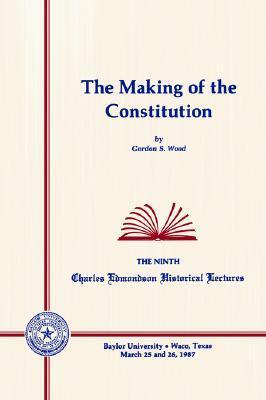
The Making of the Constitution
1987
Wood presents important information about the founding period in our nation's history, conveying not only the content but also the spirit of the debates surrounding the Philadelphia convention and its aftermath.
#7
Not Quite American?
2004
In this essay Yvonne Haddad explores the history of immigration and integration of Arab Muslims in the United States and their struggle to legitimate their presence in the face of continuing exclusion based on race, nationalist identity, and religion.
#8
Race, Ethnicity and Class
1996
Professor Knight addresses race, ethnicity, and class in Latin America and the Caribbean, and his conclusions are important for revaluing the history and place of these regions in the evolution of political systems.
#9
Religious Crises in Modern America
1989
Marty focuses on two religious phenomena in American history in the last hundred years, modernism and fundamentalism.
#10
Soul Murder and Slavery
1995
Drawing upon psychological paradigms, Professor Painter examines the history of child and sexual abuse within American slave society by employing the concept of "soul murder."
Authors
David Cannadine
Author · 21 books
Alan Brinkley
Author · 18 books
Geoffrey Hosking
Author · 10 books
Dan T. Carter
Author · 6 books
Peter N. Stearns
Author · 27 books
Yvonne Yazbeck Haddad
Author · 6 books
Franklin W. Knight
Author · 2 books
Martin E. Marty
Author · 20 books
Nell Irvin Painter
Author · 9 books
Charles Reagan Wilson
Author · 6 books
Gordon S. Wood
Author · 14 books
David J. Weber
Author · 3 books
Jonathan D. Spence
Author · 16 books
Philip D. Curtin
Author · 8 books
Charles Edmondson Historical Lectures
Series ·
14
books · 1987-2006
By
David Cannadine
,
Alan Brinkley
,
Geoffrey Hosking
, and more
#11
Southern Missions
2006
Southern Missions places the religious history of the American South in a global context. The global connections of southern religion reflect a tradition within the American South that historians have failed to examine. This study sweeps from the diversity of Christian and Jewish groups in the colonial South to the contemporary migration of ethnic groups and their religious traditions previously little known in the South. Perhaps most notably, gender emerges as a key analytical category for understanding the global reach of religion in the American South.
#12
Spanish Bourbons and Wild Indians
2004
These lectures chronicle the Spanish Empire's policies toward the Indians of the Americas in the late eighteenth century. Since Indians independently controlled most of the area that Spain claimed to own, the Spaniards began to make significant political accommodations with some of these "savages" or "wild Indians," whom they could neither defeat nor convert. Weber demonstrates that Spain's ideal mission changed between the Habsburg and Bourbon eras and, more importantly, local circumstances and local people, including Indians, determined how a mission would measure up to the Crown's objectives.
#13
The Taiping Vision of a Christian China
1998
Encapsulating the themes of his 1996 book, God's Chinese Son, Jonathan Spence, in this Edmondson Historical Lecture, interprets the social and political milieu of mid-nineteenth-century China that gave rise to the apocalyptic Taiping Rebellion. Here, Spence traces the events surrounding the life of Hong Xiuquan, the self-styled heavenly king who had learned through his encounter with Christian religious texts that he was not only a religious leader, but also "the younger brother of Jesus." Hong's rise to power in southern China eventually led to his military seizure of one of China's largest cities, Nanjing, where he established his heavenly capital on earth for eleven years. Included in this study is the author's analysis of Hong's intellectual development. Spence gives special attention to Hong's introduction to Christian texts and his eventual use of Christian scripture to interpret his role as "God's Chinese Son." Spence poignantly articulates how Hong interpreted Scripture not only to maintain his spiritual and political leadership over his followers but also to anticipate the apocalyptic conclusion to his earthly kingdom.
#15
Why People Move
1995
Professor Curtin presents a well-defined interpretation of why migration has occurred in Africa, highlighting numerous sociopolitical and socioeconomic factors. According to Curtin, the most consistent reason for migration within Africa and into and out of Africa was the possession of technological advantage.