Margins
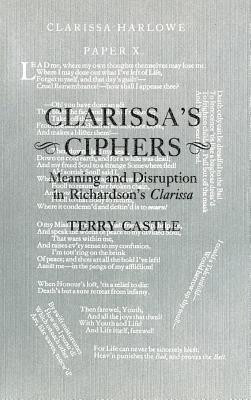
Clarissa's Ciphers book cover
Clarissa's Ciphers
Meaning and Disruption in Richardson's Clarissa
1982
First Published
3.60
Average Rating
204
Number of Pages
As Samuel Richardson's 'exemplar to her sex,’ Clarissa in the eponymous novel published in 1748 is the paradigmatic female victim. In Clarissa’s Ciphers, Terry Castle delineates the ways in which, in a world where only voice carries authority, Clarissa is repeatedly silenced, both metaphorically and literally. A victim of rape, she is first a victim of hermeneutic abuse. Drawing on feminist criticism and hermeneutic theory, Castle examines the question of authority in the novel. By tracing the patterns of abuse and exploitation that occur when meanings are arbitrarily and violently imposed, she explores the sexual politics of reading.

Avg Rating
3.60
Number of Ratings
10
5 STARS
10%
4 STARS
60%
3 STARS
10%
2 STARS
20%
1 STARS
0%
goodreads

Author

Terry Castle
Terry Castle
Author · 9 books
Terry Castle was once described by Susan Sontag as "the most expressive, most enlightening literary critic at large today." She is the author of seven books of criticism, including The Apparitional Lesbian: Female Homosexuality and Modern Culture (1993) and Boss Ladies, Watch Out! Essays on Women and Sex (2002). Her antholoy, The Literature of Lesbianism, won the Lambda Literary Editor's Choice Award in 2003. She lives in San Franciso and is Walter A. Haas Professor in the Humanities at Stanford University.
548 Market St PMB 65688, San Francisco California 94104-5401 USA
© 2026 Paratext Inc. All rights reserved