Margins


548 Market St PMB 65688, San Francisco California 94104-5401 USA
© 2026 Paratext Inc. All rights reserved
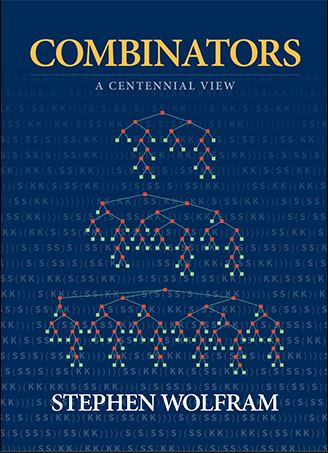
Combinators have inspired ideas about computation ever since they were first invented in 1920, and in this innovative book, Stephen Wolfram provides a modern view of combinators and their significance. Informed by his work on the computational universe of possible programs and on computational language design, Wolfram explains new and existing ideas about combinators with unique clarity and stunning visualizations, as well as provides insights on their historical connections and the curious story of Moses Schönfinkel, inventor of combinators. Though invented well before Turing machines, combinators have often been viewed as an inaccessibly abstract approach to computation. This book brings them to life as never before in a thought-provoking and broadly accessible exposition of interest across mathematics and computer science, as well as to those concerned with the foundations of formal and computational thinking, and with the history of ideas. Contents Preface A Centennial Ultimate Symbolic Abstraction • Computing with Combinators • A Hundred Years Later... • Combinators in the Some Zoology • Visualizing Combinators • Updating Schemes and Multiway Systems • The Question of Evaluation Order • The World of the S Combinator • Causal Graphs and the Physicalization of Combinators • Combinator Expressions as Dynamical Systems • Equality and Theorem Proving for Combinators • Lemmas and the Structure of Combinator Space • Empirical Computation Theory with Combinators • The Future of Combinators • Historical & Other Notes Combinators and the Story of Computation The Abstract Representation of Things • What Is Mathematics―and Logic―Made Of? • Combinators Arrive • What Is Their Mathematics? • Gödel's Theorem and Computability • Lambda Calculus • Practical Computation • Combinators in Culture • Designing Symbolic Language • Combinators in the Computational Universe • Combinators All the Way Down? Where Did Combinators Come From? Hunting the Story of Moses Schönfinkel December 7, 1920 • Who Was Moses Schönfinkel? • The Beginning of the Story • Going to College in Odessa • Göttingen, Center of the Mathematical Universe • Problems Are Brewing • The 1924 Paper • The "1927" Paper • To Moscow and Beyond... • Other Schönfinkels... • Haskell Curry • Schönfinkel Rediscovered • What Should We Make of Schönfinkel? A Little Closer to Finding What Became of Moses Schönfinkel, Inventor of Combinators 1920, 2020 and a $20,000 Announcing the S Combinator Challenge Hiding in Plain Sight for a Century? • The Basic Setup • The Operation of the S Combinator Challenge Excerpts from A New Kind of Science (2002) A Bibliography of Combinators Foundational Documents • Books • Surveys & Summaries • Combinators as Symbolic Expressions • Combinators as Mathematical Constructs • Combinator Computation • Extensions & Applications • Confusing Issues Index
Ships within a few days. US addresses only.
