Stephen Wolfram is the creator of Mathematica and Wolfram|Alpha and the author of A New Kind of Science and An Elementary Introduction to the Wolfram Language. In this short ebook, Dr. Wolfram dives into his theories of computation and the universe. Take a look at this short excerpt from the ebook Computation and the Future of the Human Condition: “In traditional engineering, one starts with some purpose in mind, then explicitly tries to construct a system that achieves that purpose. And typically at each step one insists on foreseeing what the system will do. With the result that the system must always be quite computationally reducible. But in the computational universe there are lots of systems that aren’t computationally reducible. So can we use these systems for technology? The answer is absolutely yes. Sometimes we look at the systems and realize that there’s some purpose for which they can be used. But more often, we first identify a purpose, and then start searching the computational universe for systems that can achieve that purpose. Things like this have been done a little in traditional engineering—even, say, with Edison searching for his light-bulb filaments. But it’s vastly more efficient and streamlined in the computational universe.
Author
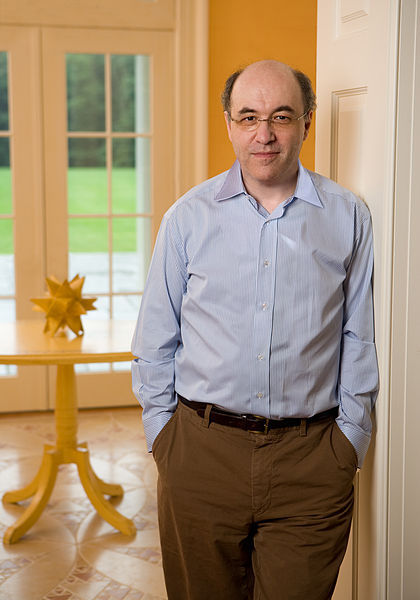
Stephen Wolfram's parents were Jewish refugees who emigrated from Germany to England in the 1930s. Wolfram's father Hugo was a textile manufacturer and novelist (Into a Neutral Country) and his mother Sybil was a professor of philosophy at the University of Oxford. He has a younger brother, Conrad. Wolfram is married to a mathematician and has four children. He was educated at Eton College, but claimed to be bored and left it prematurely in 1976. He entered St John's College, Oxford at age 17 but found lectures "awful", and left in 1978 without graduating. He received a Ph.D. in particle physics from the California Institute of Technology at age 20,[8] joined the faculty there and received one of the first MacArthur awards in 1981, at age 21. Wolfram presented a talk at the TED conference in 2010, and he was named Speaker of the Event for his 2012 talk at SXSW. In 2012 he became a fellow of the American Mathematical Society.