Though a well-regarded physicist, Carl Sagan (1934-1996) is best-known as a writer of popular nonfiction and science fiction and as the host of the PBS series Cosmos. Through his writings and spoken commentary, he worked to popularize interests in astronomy, the universe, and the possibility of extraterrestrial life. From the beginning of his public career, when he co-wrote Intelligent Life in the Universe to the very end as he worked on the 1997 film adaptation of his novel Contact, these subjects absorbed him. This interest in space was rooted in his understanding of the smallness and vulnerability of humanity measured against the immense size and power of the universe. This profound philosophical humility, mixed with personal exuberance, comes through in Conversations with Carl Sagan. In interviews and profiles, Sagan discusses with verve a wide variety of topicsthe environment, nuclear disarmament, religion, politics, extraterrestrial life, astronomy, physics, robotics. Whether he is discussing his science fiction or his well-researched nonfiction works, his voice embraces reason and skepticism. This volume shows how Sagan, a lifelong skeptic, refined his views and expressed amazement that Earth, for all his belief in extraterrestrial life, encompasses everything about which he cared. Tom Head of Jackson, Mississippi, is a writer and poet whose work includes Women and Families (Voices from the Civil War), Possessions and Exorcisms (Fact or Fiction?), and 1966 (The Turbulent 60s).
Author
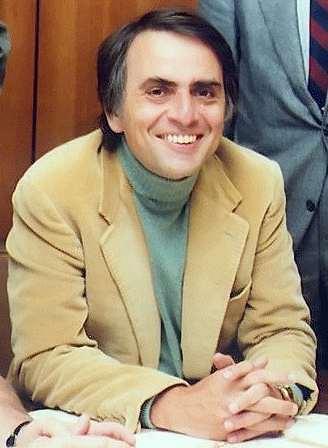
In 1934, scientist Carl Sagan was born in Brooklyn, N.Y. After earning bachelor and master's degrees at Cornell, Sagan earned a double doctorate at the University of Chicago in 1960. He became professor of astronomy and space science and director of the Laboratory for Planetary Studies at Cornell University, and co-founder of the Planetary Society. A great popularizer of science, Sagan produced the PBS series, "Cosmos," which was Emmy and Peabody award-winning, and was watched by 500 million people in 60 countries. A book of the same title came out in 1980, and was on The New York Times bestseller list for 7 weeks. Sagan was author, co-author or editor of 20 books, including The Dragons of Eden (1977), which won a Pulitzer, Pale Blue Dot (1995) and The Demon-Haunted World: Science As a Candle in the Dark (1996), his hardest-hitting on religion. With his wife, Ann Druyan, he was co-producer of the popular motion picture, "Contact," which featured a feminist, atheist protagonist played by Jodie Foster (1997). The film came out after Sagan's death, following a 2-year struggle with a bone marrow disease. Sagan played a leading role in NASA's Mariner, Viking, Voyager, and Galileo expeditions to other planets. Ann Druyan, in the epilogue to Sagan's last book, Billions and Billions: Thoughts on Life and Death at the Brink of the Millennium (published posthumously in 1997), gives a moving account of Carl's last days: "Contrary to the fantasies of the fundamentalists, there was no deathbed conversion, no last minute refuge taken in a comforting vision of a heaven or an afterlife. For Carl, what mattered most was what was true, not merely what would make us feel better. Even at this moment when anyone would be forgiven for turning away from the reality of our situation, Carl was unflinching. As we looked deeply into each other's eyes, it was with a shared conviction that our wondrous life together was ending forever." For his work, Dr. Sagan received the NASA medals for Exceptional Scientific Achievement and (twice) for Distinguished Public Service, as well as the NASA Apollo Achievement Award. Asteroid 2709 Sagan is named after him. He was also awarded the John F. Kennedy Astronautics Award of the American Astronautical Society, the Explorers Club 75th Anniversary Award, the Konstantin Tsiolkovsky Medal of the Soviet Cosmonauts Federation, and the Masursky Award of the American Astronomical Society, ("for his extraordinary contributions to the development of planetary science…As a scientist trained in both astronomy and biology, Dr. Sagan has made seminal contributions to the study of planetary atmospheres, planetary surfaces, the history of the Earth, and exobiology. Many of the most productive planetary scientists working today are his present and former students and associates"). He was also a recipient of the Public Welfare Medal, the highest award of the National Academy of Sciences. Dr. Sagan was elected Chairman of the Division of Planetary Sciences of the American Astronomical Society, President of the Planetology Section of the American Geophysical Union, and Chairman of the Astronomy Section of the American Association for the Advancement of Science. For twelve years he was the editor-in-chief of Icarus, the leading professional journal devoted to planetary research. He was cofounder and President of the Planetary Society, a 100,000-member organization that is the largest space-interest group in the world; and Distinguished Visiting Scientist, Jet Propulsion Laboratory, California Institute of Technology. In their posthumous award to Dr. Sagan of their highest honor, the National Science Foundation declared that his "research transformed planetary science… his gifts to mankind were infinite." D. 1996. More: https://ffrf.org/news/day/dayitems/it...