Margins
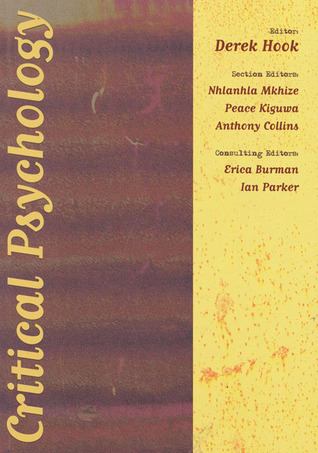
Critical Psychology book cover
Critical Psychology
2004
First Published
4.00
Average Rating
540
Number of Pages
Providing a broad introduction to critical psychology, this book explores the diverse concerns of the discipline as it applies to the sociopolitical contexts of postapartheid South Africa. Accommodating a spectrum of different approaches, it expands on the theoretical resources usually referred to in the field of critical psychology-Marxism, psychoanalysis, poststructuralism, and feminism-by providing substantive discussions of black consciousness, postcolonialism, and Africanist forms of critique. This book is also a response to the need to rethink a more politically aware and participant psychology in South Africa.

Avg Rating
4.00
Number of Ratings
3
5 STARS
0%
4 STARS
100%
3 STARS
0%
2 STARS
0%
1 STARS
0%
goodreads

Authors

Ian Parker
Ian Parker
Author · 8 books

Ian Parker is a British psychologist who has been a principal exponent of three quite diverse critical traditions inside the discipline. His writing has provided compass points for researchers searching for alternatives to ‘mainstream’ psychology in the English-speaking world (that is, mainstream psychology that is based on laboratory-experimental studies that reduce behavior to individual mental processes). The three critical traditions Parker has promoted are ‘discursive analysis’, ‘Marxist psychology’ and ‘psychoanalysis’. Each of these traditions is adapted by him to encourage an attention to ideology and power, and this modification has given rise to fierce debates, not only from mainstream psychologists but also from other ‘critical psychologists’. Parker moves in his writing from one focus to another, and it seems as if he is not content with any particular tradition of research, using each of the different critical traditions to throw the others into question.

Anthony Collins
Anthony Collins
Author · 1 book

Librarian Note: There is more than one author by this name in the Goodreads database. Anthony Collins (21 June 1676 O.S. – 13 December 1729 O.S.), was an English philosopher. In 1676, Anthony Collins, pronounced the "Goliath of freethinking" by Thomas Huxley, was born in Heston, England. Collins studied at Eton and King's College, Cambridge, and was a close friend of John Locke. He moved in a circle of leading freethinkers, including John Toland and Matthew Tindal. "An Essay Concerning the Use of Reason" was published (anonymously) in 1707, along with a letter addressing immateriality and the soul. A debate in 1708 with Samuel Clarke resulted in the publication of four pamphlets by each participant. In 1710, Collins wrote "Vindication of the Divine Attributes, in Some Remarks on Archbishop (King's) Sermon." The 1713 book, A Discourse of Freethinking, was Collins' most influential work, helping to popularize the term "freethought." Philosophical Inquiry Concerning Human Liberty, published in 1717, won the praise of Voltaire. The Grounds and Reasons of the Christian Religion (1724) rejected the claim that Jesus fulfilled Old Testament prophecies. Posthumously, two of his essays were published, including an article challenging religious authority. Although Collins left England for a time when debate heated up after the publication of A Discourse of Freethinking, the courteous scholar was debated and taken most seriously by leading religionists and Anglicans. Grounds, with its serious arguments against prophecy and its advancement of the scientific principle, provoked more than 30 books and essays by religionists trying to counter it. Collins, best described as a deist and materialist who opposed "priestcraft," at one time became county squire. Joseph Smith in The Unreasonableness of Deism, or, the Certainty of a Divine Revelation (1720) called deists in general “the Wicked and Unhappy men we have to deal with.” With respect to Collins’s controversy on “the soul,” T. H. Huxley said, "I do not think anyone can read the letters which passed between Clarke and Collins without admitting that Collins, who writes with wonderful Power and closeness of reasoning, has by far the best of the argument, so far as the possible materiality of the soul goes; and that in this battle the Goliath of Freethinking overcame the champion of what was considered orthodoxy." Berkeley, however, claimed that Collins had announced “that he was able to demonstrate the impossibility of God’s existence.” Upon his death, the Earl of Egmont, John Percival, wrote: “Of Collins Esq. deceased December 1729 . . . [he] is a Speculative Atheist and has been for many years, as he owned to Archibald Hutchinson Esq. who told it to Dr. Dodd M.D. and to me.”

548 Market St PMB 65688, San Francisco California 94104-5401 USA
© 2026 Paratext Inc. All rights reserved