Margins
Margins
Sign in
Margins
Subscribe to our newsletter
548 Market St PMB 65688, San Francisco California 94104-5401 USA
hello@margins.app
·
+1 (650) 223-5283
Privacy Policy
·
Terms of Use
© 2026 Paratext Inc. All rights reserved
📚 Critical Theory
📚
Critical Theory
Pedagogy of the Oppressed
1968
Paulo Freire
First published in Portuguese in 1968, Pedagogy of the Oppressed was translated and published in English in 1970. The methodology of the late Paulo Freire has helped to empower countless impoverished and illiterate people throughout the world. Freire's work has taken on especial urgency in the United States and Western Europe, where the creation of a permanent underclass among the underprivileged and minorities in cities and urban centers is increasingly accepted as the norm. With a substantive new introduction on Freire's life and the remarkable impact of this book by writer and Freire confidant and authority Donaldo Macedo, this anniversary edition of Pedagogy of the Oppressed will inspire a new generation of educators, students, and general readers for years to come.
The Society of the Spectacle
1967
Guy Debord
Few works of political and cultural theory have been as enduringly provocative as Guy Debord's The Society of the Spectacle. From its publication amid the social upheavals of the 1960s up to the present, the volatile theses of this book have decisively transformed debates on the shape of modernity, capitalism and everyday life in the late twentieth century. Now finally available in a superb English translation approved by the author, Debord's text remains as crucial as ever for understanding the contemporary effects of power, which are increasingly inseparable from the new virtual worlds of our rapidly changing image/information culture.
Simulacra and Simulation
1981
Jean Baudrillard
The publication of Simulacra et Simulation in 1981 marked Jean Baudrillard's first important step toward theorizing the postmodern. Moving away from the Marxist/Freudian approaches that had concerned him earlier, Baudrillard developed in this book a theory of contemporary culture that relies on displacing economic notions of cultural production with notions of cultural expenditure. Baudrillard uses the concepts of the simulacra—the copy without an original—and simulation. These terms are crucial to an understanding of the postmodern, to the extent that they address the concept of mass reproduction and reproduceability that characterizes our electronic media culture. Baudrillard's book represents a unique and original effort to rethink cultural theory from the perspective of a new concept of cultural materialism, one that radically redefines postmodern formulations of the body. Sheila Glaser is an editor at Artforum magazine.
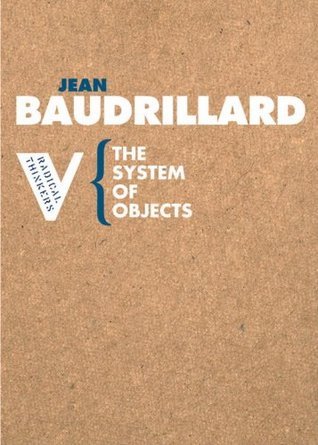
The System of Objects
1968
Jean Baudrillard
A tour de force of the materialist semiotics of the early Baudrillard. The System of Objects is a tour de force—a theoretical letter-in-a-bottle tossed into the ocean in 1968, which brilliantly communicates to us all the live ideas of the day. Pressing Freudian and Saussurean categories into the service of a basically Marxist perspective, The System of Objects offers a cultural critique of the commodity in consumer society. Baudrillard classifies the everyday objects of the “new technical order” as functional, nonfunctional and metafunctional. He contrasts “modern” and “traditional” functional objects, subjecting home furnishing and interior design to a celebrated semiological analysis. His treatment of nonfunctional or “marginal” objects focuses on antiques and the psychology of collecting, while the metafunctional category extends to the useless, the aberrant and even the “schizofunctional.” Finally, Baudrillard deals at length with the implications of credit and advertising for the commodification of everyday life. The System of Objects is a tour de force of the materialist semiotics of the early Baudrillard, who emerges in retrospect as something of a lightning rod for all the live ideas of the day: Bataille's political economy of “expenditure” and Mauss' theory of the gift; Reisman's lonely crowd and the “technological society” of Jacques Ellul; the structuralism of Roland Barthes in The System of Fashion; Henri Lefebvre's work on the social construction of space; and last, but not least, Guy Debord's situationist critique of the spectacle.