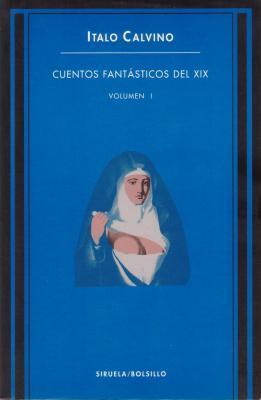



El cuento fantástico es uno de los productos más característicos de la narrativa del siglo XIX y, para nosotros, uno de los más significativos, pues es el que más nos dice sobre la interioridad del individuo y de la simbología colectiva” Italo Calvino, recopilador. Este primer volumen de cuentos, seleccionados por el gran escritor italiano bajo el epígafre de “lo fantástico visionario”, incluye esta inolvidable nómina: J. Potocki, J. von Eichendorff, E. T. A. Hoffmann, W. Scott, H. de Balzac, Ph. Chasles, G. de Nerval, N. Hawthorne, N. V. Gogol, T. Gautier, P. Merimée y J. S. Le Fanu.
Authors

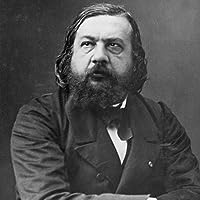
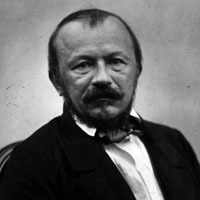
Gérard de Nerval was the nom-de-plume of the French poet, essayist and translator Gérard Labrunie, one of the most essentially Romantic French poets. Gérard de Nerval, nom de plume de Gérard Labrunie, écrivain et poète français. Figure majeure du romantisme français, il est essentiellement connu pour ses poèmes et ses nouvelles.


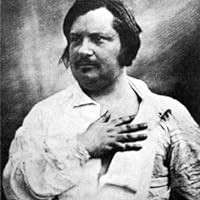
Honoré de Balzac was a nineteenth-century French novelist and playwright. His magnum opus was a sequence of almost 100 novels and plays collectively entitled La Comédie humaine, which presents a panorama of French life in the years after the fall of Napoléon Bonaparte in 1815. Due to his keen observation of fine detail and unfiltered representation of society, Balzac is regarded as one of the founders of realism in European literature. He is renowned for his multi-faceted characters; even his lesser characters are complex, morally ambiguous and fully human. Inanimate objects are imbued with character as well; the city of Paris, a backdrop for much of his writing, takes on many human qualities. His writing influenced many famous authors, including the novelists Marcel Proust, Émile Zola, Charles Dickens, Gustave Flaubert, Henry James and Jack Kerouac, as well as important philosophers such as Friedrich Engels. Many of Balzac's works have been made into films, and they continue to inspire other writers. An enthusiastic reader and independent thinker as a child, Balzac had trouble adapting himself to the teaching style of his grammar school. His willful nature caused trouble throughout his life, and frustrated his ambitions to succeed in the world of business. When he finished school, Balzac was apprenticed as a legal clerk, but he turned his back on law after wearying of its inhumanity and banal routine. Before and during his career as a writer, he attempted to be a publisher, printer, businessman, critic, and politician. He failed in all of these efforts. La Comédie Humaine reflects his real-life difficulties, and includes scenes from his own experience. Balzac suffered from health problems throughout his life, possibly due to his intense writing schedule. His relationship with his family was often strained by financial and personal drama, and he lost more than one friend over critical reviews. In 1850, he married Ewelina Hańska, his longtime paramour; he passed away five months later.

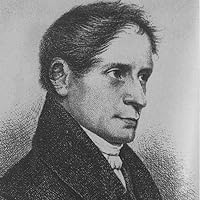
Joseph Freiherr von Eichendorff (March 10, 1788 – November 26, 1857) was a German poet and novelist of the later German romantic school. Eichendorff is regarded as one of the most important German Romantics and his works have sustained high popularity in Germany from production to the present day.

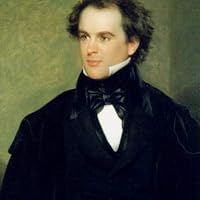
Nathaniel Hawthorne was a 19th century American novelist and short story writer. He is seen as a key figure in the development of American literature for his tales of the nation's colonial history. Shortly after graduating from Bowdoin College, Hathorne changed his name to Hawthorne. Hawthorne anonymously published his first work, a novel titled Fanshawe, in 1828. In 1837, he published Twice-Told Tales and became engaged to painter and illustrator Sophia Peabody the next year. He worked at a Custom House and joined a Transcendentalist Utopian community, before marrying Peabody in 1842. The couple moved to The Old Manse in Concord, Massachusetts, later moving to Salem, the Berkshires, then to The Wayside in Concord. The Scarlet Letter was published in 1850, followed by a succession of other novels. A political appointment took Hawthorne and family to Europe before returning to The Wayside in 1860. Hawthorne died on May 19, 1864, leaving behind his wife and their three children. Much of Hawthorne's writing centers around New England and many feature moral allegories with a Puritan inspiration. His work is considered part of the Romantic movement and includes novels, short stories, and a biography of his friend, the United States President Franklin Pierce.

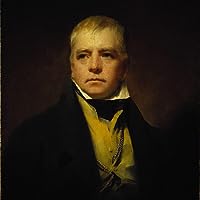
Librarian Note: There is more than one author in the GoodReads database with this name. British writer Sir Walter Scott popularized and refined a genre of ballads and historical novels; his works include Waverley (1814) and Ivanhoe (1819). Sir Walter Alva Scott created and called a series. Scott arranged the plots and characters so that the reader enters into the lives of great and ordinary persons, caught in violent, dramatic changes. Work of Scott shows the influence of the 18th century Enlightenment. He thought of every basically decent human, regardless of class, religion, politics, or ancestry. A major theme tolerates. They express his theory in the need for social progress that rejects not the traditions of the past. He first portrayed peasant characters sympathetically and realistically and equally justly portrayed merchants, soldiers, and even kings. In central themes, cultures conflict and oppose. Normans and Saxons warred. In The Talisman (1825), Christians and Muslims conflict. He deals with clashes between the new English and the old Scottish culture. Other great include Old Mortality (1816), The Heart of Midlothian (1819), and Saint Ronan's Well (1824). His series includes Rob Roy (1817), A Legend of Montrose (1819), and Quentin Durward (1823). Amiability, generosity, and modesty made Scott popular with his contemporaries. He also famously entertained on a grand scale at Abbotsford, his Scottish estate.

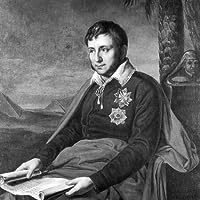
Jan Potocki was born into the Potocki family, an aristocratic family, that owned vast estates in Poland. He was educated in Geneva and Lausanne, served twice in the Polish Army as a captain of engineers, and spent some time on a galley as a novice Knight of Malta. He was probably a Freemason and had a strong interest in the occult. Potocki's colorful life took him across Europe, Asia and North Africa, where he embroiled himself in political intrigues, flirted with secret societies, contributed to the birth of ethnology—he was one of the first to study the precursors of the Slavic peoples from a linguistic and historical standpoint. In 1790 he became the first person in Poland to fly in a hot air balloon when he made an ascent over Warsaw with the aeronaut Jean-Pierre Blanchard, an exploit that earned him great public acclaim. He also established in 1788 in Warsaw a publishing house named Drukarnia Wolna (Free Press) as well as the city's first free reading room. Potocki's wealth enabled him to travel extensively about Europe, the Mediterranean and Asia, visiting Italy, Sicily, Malta, the Netherlands, Germany, France, England, Russia, Turkey, Spain, Tunisia, Morocco, Egypt, and even Mongolia. He was also one of the first travel writers of the modern era, penning lively accounts of many of his journeys, during which he also undertook extensive historical, linguistic and ethnographic studies. As well as his many scholarly and travel writings, he also wrote a play, a series of sketches and a novel. Potocki married twice and had five children. His first marriage ended in divorce, and both marriages were the subject of scandalous rumors. In 1812, disillusioned and in poor health, he retired to his estate at Uladowka in Podolia, suffering from "melancholia" (which today would probably be diagnosed as depression), and during the last few years of his life he completed his novel. Potocki committed suicide in December 1815 at the age of 54, though the exact date is uncertain—possibly November 20, December 2 or December 11. There are also several versions of the circumstances of his death; the best-known story is that he shot himself in the head with a silver bullet—fashioned from the strawberry-shaped knob of a sugar bowl given to him by his mother—which he first had blessed by his castle priest. One version of Potocki's suicide suggests that he gradually filed the knob off the lid, a little every morning. Potocki's most famous work is The Manuscript Found in Saragossa. Originally written in French as Manuscrit trouvé à Saragosse, it is a frame tale which he wrote to entertain his wife. On account of its rich interlocking structure and telescoping story sequences, the novel has drawn comparisons to such celebrated works as the Decameron and the Arabian Nights.