Margins
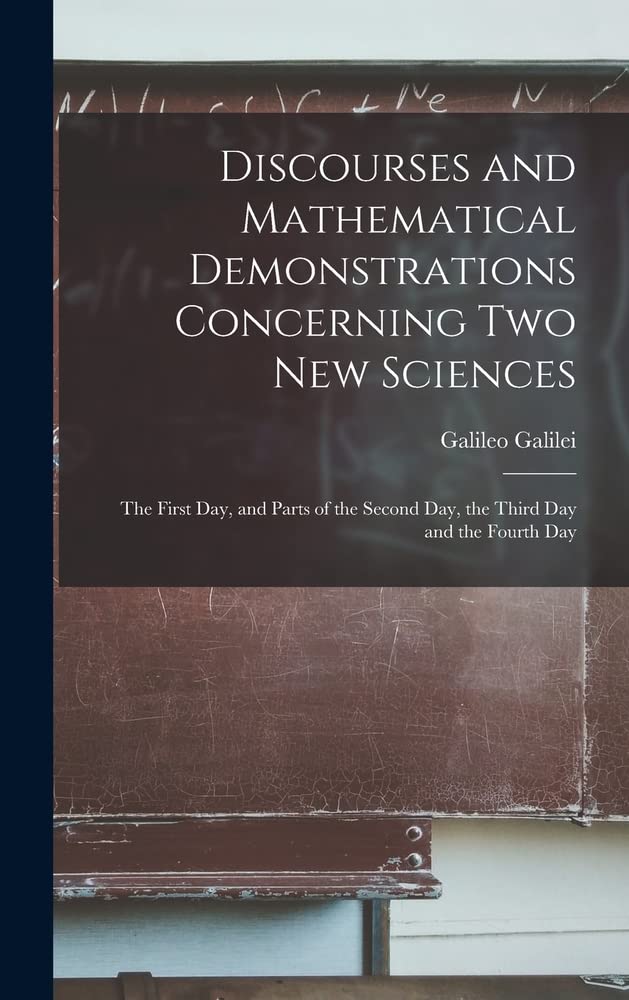
Discourses and Mathematical Demonstrations Concerning Two New Sciences book cover
Discourses and Mathematical Demonstrations Concerning Two New Sciences
the First Day, and Parts of the Second Day, the Third Day and the Fourth Day
2021
First Published
3.50
Average Rating
178
Number of Pages
This work has been selected by scholars as being culturally important and is part of the knowledge base of civilization as we know it. This work is in the public domain in the United States of America, and possibly other nations. Within the United States, you may freely copy and distribute this work, as no entity (individual or corporate) has a copyright on the body of the work. Scholars believe, and we concur, that this work is important enough to be preserved, reproduced, and made generally available to the public. To ensure a quality reading experience, this work has been proofread and republished using a format that seamlessly blends the original graphical elements with text in an easy-to-read typeface. We appreciate your support of the preservation process, and thank you for being an important part of keeping this knowledge alive and relevant.

Avg Rating
3.50
Number of Ratings
2
5 STARS
0%
4 STARS
50%
3 STARS
50%
2 STARS
0%
1 STARS
0%
goodreads

Author

Galileo Galilei
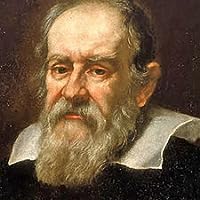
Galileo Galilei
Author · 13 books

Galileo Galilei was a Tuscan (Italian) physicist, mathematician, astronomer, and philosopher who played a major role in the Scientific Revolution. His achievements include improvements to the telescope and consequent astronomical observations, and support for Copernicanism. Galileo has been called the "father of modern observational astronomy", the "father of modern physics", the "father of science", and "the Father of Modern Science." The motion of uniformly accelerated objects, taught in nearly all high school and introductory college physics courses, was studied by Galileo as the subject of kinematics. His contributions to observational astronomy include the telescopic confirmation of the phases of Venus, the discovery of the four largest satellites of Jupiter, named the Galilean moons in his honour, and the observation and analysis of sunspots. Galileo also worked in applied science and technology, improving compass design. Galileo's championing of Copernicanism was controversial within his lifetime. The geocentric view had been dominant since the time of Aristotle, and the controversy engendered by Galileo's presentation of heliocentrism as proven fact resulted in the Catholic Church's prohibiting its advocacy as empirically proven fact, because it was not empirically proven at the time and was contrary to the literal meaning of Scripture. Galileo was eventually forced to recant his heliocentrism and spent the last years of his life under house arrest on orders of the Roman Inquisition.

548 Market St PMB 65688, San Francisco California 94104-5401 USA
© 2026 Paratext Inc. All rights reserved