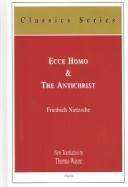
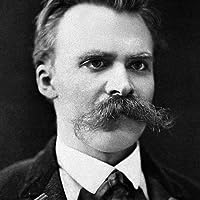
For some, the question Why Nietzsche? Friedrich Nietzsche (1844-1900) was quite simply one of the most original and influential philosophers who ever lived; in addition, his writing style was brilliant, epigrammatic, idiosyncratic. This brings us to a second Why The Antichrist and Ecce Homo? Two of this great German's most germane offerings, they were among his last writings. Although he completed them both by the end of 1888, they were considered to be so inflammatory that they were published only years later, in 1895 and 1908, respectively. Both are products of Nietzsche's last creative year. Yet Ecce Homo is relatively calm and tranquil, while The Antichrist is a jeremiad full of venom and vitriol. The latter is in fact one of the most devastating condemnations of Christianity ever; Nietzsche calls it "the one immortal blemish on mankind," the greatest sin possible against reality, against the spirit of the earth. He goes on to say that "the first and last Christian died on the Cross." His analysis of Jesus and Paul as superlative Jewish types and his portrait of Pontius Pilate as a superior Roman type are thought-provoking, to say the least. This leads us to a third Why this translation? This version is more faithful than any other, thus, I think, better than any other. Every sentence has been weighed and sifted, sifted and weighed to reproduce Nietzsche's hybrid, high-bred style - that style which encompasses the shrill, strident, sarcastic and bombastic as well as the eloquent, impassioned, refined and resplendent. Nietzsche without tears, then, without scholarly excuses or pretentious "improvements"; Nietzsche without shortcuts; better yet, Nietzschestraight.