Margins
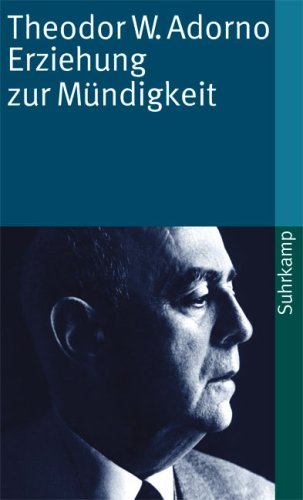
Erziehung Zur Mundigkeit by Theodor W. Adorno book cover
Erziehung Zur Mundigkeit by Theodor W. Adorno
1993
First Published
4.22
Average Rating
147
Number of Pages
Theodor W. ADORNO está considerado como uno de los intelectuales más influyentes y brillantes del siglo XX, pero su aportación pedagógica ha pasado injustamente desapercibida hasta el momento. Los grandes desastres ocasionados por el nazismo y las dictaduras le llevaron a valorar la importancia de los sistemas educativos en la construcción de sociedades democráticas. En esta obra el autor constata cómo a veces también la formación puede conducir a la barbarie y a la dominación; algo que el nazismo puso de manifiesto al propugnar en las instituciones escolares una ‘falsa cultura’, a la vez que impedía el pensamiento crítico. Uno de los principales interrogantes que el filósofo se plantea es cómo puede este mundo, tan desarrollado científica y tecnológicamente, presentar al mismo tiempo tanta miseria. Prestar atención a lo que está sucediendo obliga a atender a la formación de las personas, analizar el papel tanto de las instituciones como de los medios de comunicación y, entre éstos, el de la televisión. Capítulos ¿Qué significa superar el pasado?, La filosofía y los profesores, Televisión y formación cultural, Tabúes sobre la profesión de enseñar, Educación después de Auschwitz, Educación, ¿para qué?, Educación para la superación de la barbarie y Educación para la emancipación, son suficientemente sugerentes y demuestran el interés de ADORNO por la dimensión emancipatoria que debe promover una educación, una cultura y una ética destinadas a la formación de personas democráticas.

Avg Rating
4.22
Number of Ratings
210
5 STARS
42%
4 STARS
41%
3 STARS
14%
2 STARS
2%
1 STARS
0%
goodreads

Author

Theodor W. Adorno
Theodor W. Adorno
Author · 51 books

Theodor Wiesengrund Adorno was one of the most important philosophers and social critics in Germany after World War II. Although less well known among anglophone philosophers than his contemporary Hans-Georg Gadamer, Adorno had even greater influence on scholars and intellectuals in postwar Germany. In the 1960s he was the most prominent challenger to both Sir Karl Popper's philosophy of science and Martin Heidegger's philosophy of existence. Jürgen Habermas, Germany's foremost social philosopher after 1970, was Adorno's student and assistant. The scope of Adorno's influence stems from the interdisciplinary character of his research and of the Frankfurt School to which he belonged. It also stems from the thoroughness with which he examined Western philosophical traditions, especially from Kant onward, and the radicalness to his critique of contemporary Western society. He was a seminal social philosopher and a leading member of the first generation of Critical Theory. Unreliable translations hampered the initial reception of Adorno's published work in English speaking countries. Since the 1990s, however, better translations have appeared, along with newly translated lectures and other posthumous works that are still being published. These materials not only facilitate an emerging assessment of his work in epistemology and ethics but also strengthen an already advanced reception of his work in aesthetics and cultural theory.

548 Market St PMB 65688, San Francisco California 94104-5401 USA
© 2026 Paratext Inc. All rights reserved