Margins
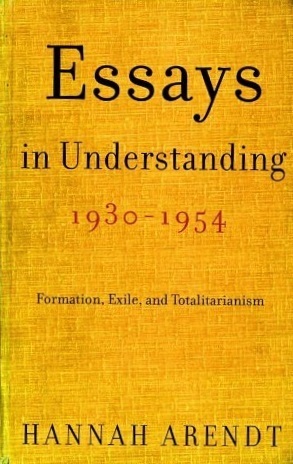
Essays in Understanding, 1930-1954 book cover
Essays in Understanding, 1930-1954
Formation, Exile, and Totalitarianism
1994
First Published
4.15
Average Rating
458
Number of Pages
Few thinkers have tackled the political horrors and complexities of this century with the insight and passionate intellectual integrity of Hannah Arendt. A philosophic champion of human freedom, she was among the first to draw the now-evident parallel between Nazism and Bolshevism and to identify totalitarianism as a threat inherent to the modern world. Jerome Kohn, Arendt's longtime assistant, has compiled, edited, and annotated her manuscripts for publication, beginning with some of her earliest published work and including essays on Augustine, Rilke, Kierkegaard, and figures of the nineteenth-century "Berlin Salon"; the loyalties of immigrant groups within the United States; the unification or "federation" of Europe; "the German problem"; religion, politics, and intellectual life; the dangers of isolation and careerism in American society; the logical consequences of "scientific" theories of Nature and History; the terror that was the organizing principle of both the Nazi and the Communist states. Two seminal essays have never before been published in complete form: On the Nature of Totalitarianism: An Essay in Understanding (1953) and Concern with Politics in Recent European Philosophical Thought (1954).

Avg Rating
4.15
Number of Ratings
197
5 STARS
40%
4 STARS
40%
3 STARS
16%
2 STARS
4%
1 STARS
1%
goodreads

Author

Hannah Arendt
Hannah Arendt
Author · 65 books
Hannah Arendt (1906 – 1975) was one of the most influential political philosophers of the twentieth century. Born into a German-Jewish family, she was forced to leave Germany in 1933 and lived in Paris for the next eight years, working for a number of Jewish refugee organisations. In 1941 she immigrated to the United States and soon became part of a lively intellectual circle in New York. She held a number of academic positions at various American universities until her death in 1975. She is best known for two works that had a major impact both within and outside the academic community. The first, The Origins of Totalitarianism, published in 1951, was a study of the Nazi and Stalinist regimes that generated a wide-ranging debate on the nature and historical antecedents of the totalitarian phenomenon. The second, The Human Condition, published in 1958, was an original philosophical study that investigated the fundamental categories of the vita activa (labor, work, action). In addition to these two important works, Arendt published a number of influential essays on topics such as the nature of revolution, freedom, authority, tradition and the modern age. At the time of her death in 1975, she had completed the first two volumes of her last major philosophical work, The Life of the Mind, which examined the three fundamental faculties of the vita contemplativa (thinking, willing, judging).
548 Market St PMB 65688, San Francisco California 94104-5401 USA
© 2026 Paratext Inc. All rights reserved