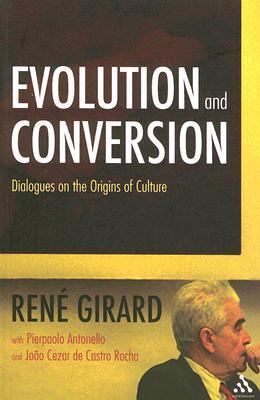
Presented as a series of conversations, Evolution and Conversion is a thorough discussion of the major tenets of Girard's thought. René Girard is one of the most brilliant and striking intellectuals of the 20th century. His theory on the imitative nature of desire and on the violent origin of culture has been at the centre of the philosophical and theoretical debate since the publication in 1971 of his seminal book: Violence and the Sacred. His reflection on the relationship between violence and religion is one of the most original and persuasive and, given the urgency of this issue in our contemporary world, demands a reappraisal. Girard, who has been hailed by Michel Serres as "the Charles Darwin" of human sciences, is in fact one of the few thinkers in the humanities and social sciences that takes into full consideration an evolutionary perspective to explain the emergence of culture and institutions. The authors draw out this aspect of his thought by foregrounding ethological, anthropological and evolutionary theories. Methodological and epistemological systematization has also been lacking in Girard's previous books, and by questioning him on the issue of evidence and truth, the authors provide a convincing framework for further inquiries. In the last chapters, Girard proposes a provocative re-reading of the Biblical texts, seen as the culmination of an enduring process of historical awareness of the presence and function of collective violence in our world. In fact, Girard's long argument is a historical spiral in which the origin of culture and archaic religion is reunited with the contemporary world by means of a reinterpretation of Christianity and its revelation of the intrinsic violent nature of the human being.

Author

René Girard was a French-born American historian, literary critic, and philosopher of social science whose work belongs to the tradition of anthropological philosophy. He was born in the southern French city of Avignon on Christmas day in 1923. Between 1943 and 1947, he studied in Paris at the École des Chartres, an institution for the training of archivists and historians, where he specialized in medieval history. In 1947 he went to Indiana University on a year’s fellowship and eventually made almost his entire career in the United States. He completed a PhD in history at Indiana University in 1950 but also began to teach literature, the field in which he would first make his reputation. He taught at Duke University and at Bryn Mawr before becoming a professor at Johns Hopkins in Baltimore. In 1971 he went to the State University of New York at Buffalo for five years, returned to Johns Hopkins, and then finished his academic career at Stanford University where he taught between 1981 and his retirement in 1995. Girard is the author of nearly thirty books, with his writings spanning many academic domains. Although the reception of his work is different in each of these areas, there is a growing body of secondary literature on his work and his influence on disciplines such as literary criticism, critical theory, anthropology, theology, psychology, mythology, sociology, economics, cultural studies, and philosophy.Girard’s fundamental ideas, which he has developed throughout his career and provide the foundation for his thinking, are that desire is mimetic (all of our desires are borrowed from other people), that all conflict originates in mimetic desire (mimetic rivalry), that the scapegoat mechanism is the origin of sacrifice and the foundation of human culture, and religion was necessary in human evolution to control the violence that can come from mimetic rivalry, and that the Bible reveals these ideas and denounces the scapegoat mechanism. In 1990, friends and colleagues of Girard’s established the Colloquium on Violence and Religion to further research and discussion about the themes of Girard’s work. The Colloquium meets annually either in Europe or the United States. René Girard died on November 4, 2015, at the age of 91 in Stanford.