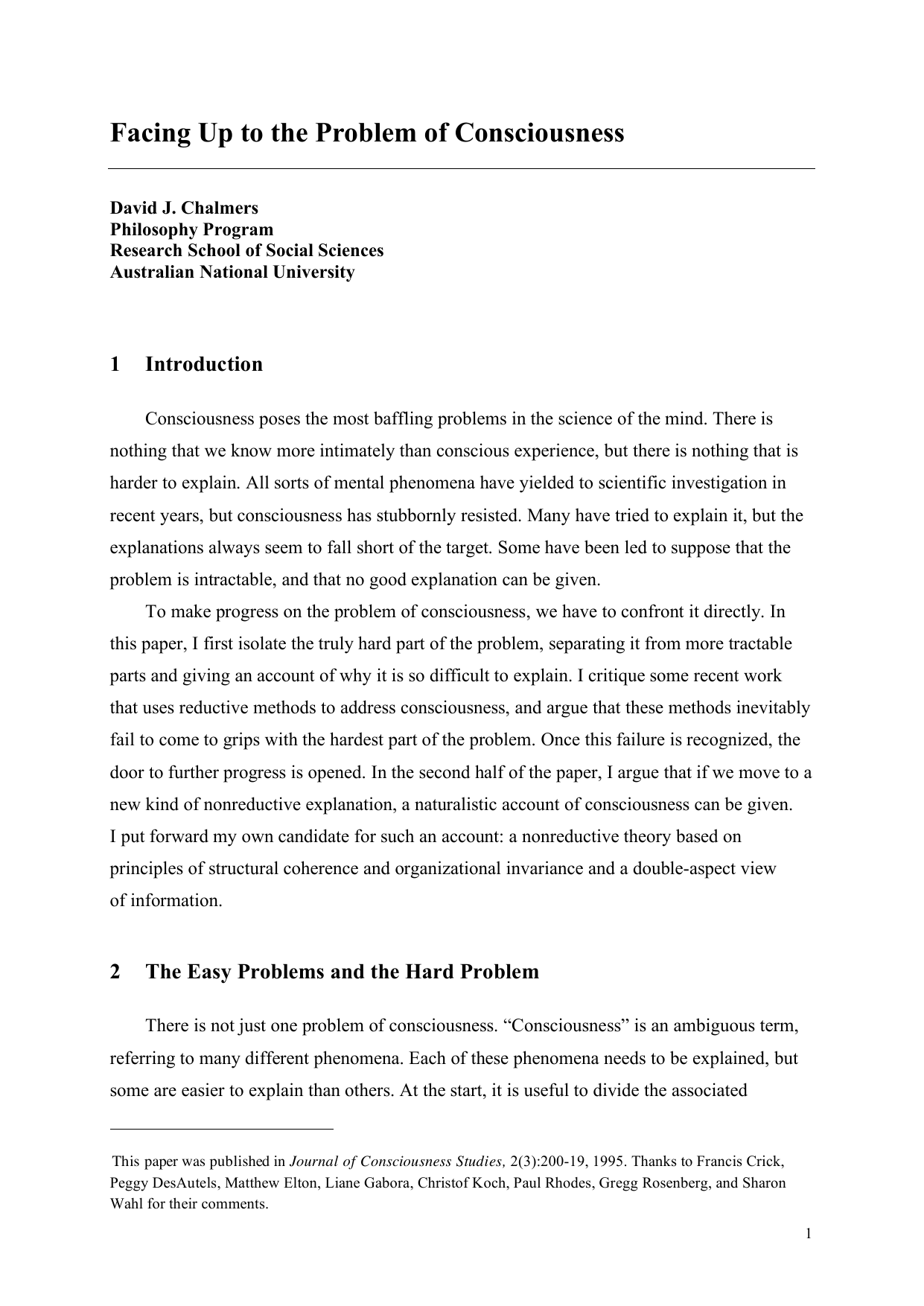
Chalmers is best known for formulating what he calls the "hard problem of consciousness," in both his 1995 paper "Facing Up to the Problem of Consciousness" and his 1996 book The Conscious Mind. He makes a distinction between "easy" problems of consciousness, such as explaining object discrimination or verbal reports, and the single hard problem, which could be stated "why does the feeling which accompanies awareness of sensory information exist at all?" The essential difference between the (cognitive) easy problems and the (phenomenal) hard problem is that the former are at least theoretically answerable via the dominant strategy in the philosophy of mind: physicalism. Chalmers argues for an "explanatory gap" from the objective to the subjective, and criticizes physicalist explanations of mental experience, making him a dualist. Chalmers characterizes his view as "naturalistic dualism": naturalistic because he believes mental states supervene "naturally" on physical systems (such as brains); dualist because he believes mental states are ontologically distinct from and not reducible to physical systems. He has also characterized his view by more traditional formulations such as property dualism.