Margins
Margins
Sign in
Margins
Subscribe to our newsletter
548 Market St PMB 65688, San Francisco California 94104-5401 USA
hello@margins.app
·
+1 (650) 223-5283
Privacy Policy
·
Terms of Use
© 2026 Paratext Inc. All rights reserved
❤️ Favorites
❤️
Favorites
The Stream of Life
1973
Clarice Lispector
Lispector at her most philosophically radical. A meditation on the nature of life and time, Água Viva (1973) shows Lispector discovering a new means of writing about herself, more deeply transforming her individual experience into a universal poetry. In a body of work as emotionally powerful, formally innovative, and philosophically profound as Clarice Lispector’s, Água Viva stands out as a particular triumph.
The Blind Owl
1936
Sadegh Hedayat
Considered the most important work of modern Iranian literature, The Blind Owl is a haunting tale of loss and spiritual degradation. Replete with potent symbolism and terrifying surrealistic imagery, Sadegh Hedayat's masterpice details a young man's despair after losing a mysterious lover. And as the author gradually drifts into frenzy and madness, the reader becomes caught in the sandstorm of Hedayat's bleak vision of the human condition. The Blind Owl, which has been translated into many foreign languages, has often been compared to the writing of Edgar Allan Poe.
No Longer Human
1948
Osamu Dazai
Osamu Dazai's No Longer Human, this leading postwar Japanese writer's second novel, tells the poignant and fascinating story of a young man who is caught between the breakup of the traditions of a northern Japanese aristocratic family and the impact of Western ideas. In consequence, he feels himself "disqualified from being human" (a literal translation of the Japanese title). Donald Keene, who translated this and Dazai's first novel, The Setting Sun, has said of the author's work: "His world … suggests Chekhov or possibly postwar France, … but there is a Japanese sensibility in the choice and presentation of the material. A Dazai novel is at once immediately intelligible in Western terms and quite unlike any Western book." His writing is in some ways reminiscent of Rimbaud, while he himself has often been called a forerunner of Yukio Mishima. Cover painting by Noe Nojechowiz, from the collection of John and Barbara Duncan; design by Gertrude Huston
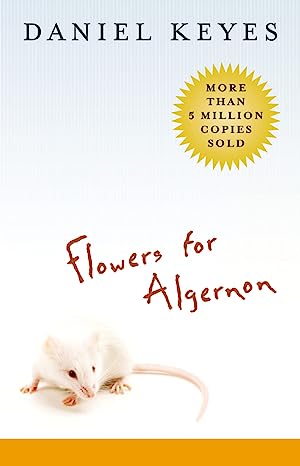
Flowers for Algernon
1966
Daniel Keyes
Winner of both the Hugo and Nebula Awards, the powerful, classic story about a man who receives an operation that turns him into a genius...and introduces him to heartache. Charlie Gordon is about to embark upon an unprecedented journey. Born with an unusually low IQ, he has been chosen as the perfect subject for an experimental surgery that researchers hope will increase his intelligence-a procedure that has already been highly successful when tested on a lab mouse named Algernon. As the treatment takes effect, Charlie's intelligence expands until it surpasses that of the doctors who engineered his metamorphosis. The experiment appears to be a scientific breakthrough of paramount importance, until Algernon suddenly deteriorates. Will the same happen to Charlie?
The Book Thief
2005
Markus Zusak
Librarian's note: An alternate cover edition can be found here It is 1939. Nazi Germany. The country is holding its breath. Death has never been busier, and will be busier still. By her brother's graveside, Liesel's life is changed when she picks up a single object, partially hidden in the snow. It is The Gravedigger's Handbook, left behind there by accident, and it is her first act of book thievery. So begins a love affair with books and words, as Liesel, with the help of her accordian-playing foster father, learns to read. Soon she is stealing books from Nazi book-burnings, the mayor's wife's library, wherever there are books to be found. But these are dangerous times. When Liesel's foster family hides a Jew in their basement, Liesel's world is both opened up, and closed down. In superbly crafted writing that burns with intensity, award-winning author Markus Zusak has given us one of the most enduring stories of our time. (Note: this title was not published as YA fiction)