Margins
Margins
Sign in
Margins
Subscribe to our newsletter
548 Market St PMB 65688, San Francisco California 94104-5401 USA
hello@margins.app
·
+1 (650) 223-5283
Privacy Policy
·
Terms of Use
© 2026 Paratext Inc. All rights reserved
♀️
Feminism
I Who Have Never Known Men
1995
Jacqueline Harpman
"As far back as I can recall, I have been in the bunker." A young woman is kept in a cage underground with thirty-nine other females, guarded by armed men who never speak; her crimes unremembered... if indeed there were crimes. The youngest of forty—a child with no name and no past—she survives for some purpose long forgotten in a world ravaged and wasted. In this reality where intimacy is forbidden—in the unrelenting sameness of the artificial days and nights—she knows nothing of books and time, of needs and feelings. Then everything changes... and nothing changes. A young woman who has never known men—a child who knows of no history before the bars and restraints—must now reinvent herself, piece by piece, in a place she has never been... and in the face of the most challenging and terrifying of unknowns: freedom.
Women, Race & Class
1981
Angela Y Davis
From one of our most important scholars and civil rights activist icon, a powerful study of the women’s liberation movement and the tangled knot of oppression facing Black women. "Angela Davis is herself a woman of undeniable courage. She should be heard." —The New York Times Angela Davis provides a powerful history of the social and political influence of whiteness and elitism in feminism, from abolitionist days to the present, and demonstrates how the racist and classist biases of its leaders inevitably hampered any collective ambitions. While Black women were aided by some activists like Sarah and Angelina Grimke and the suffrage cause found unwavering support in Frederick Douglass, many women played on the fears of white supremacists for political gain rather than take an intersectional approach to liberation. Here, Davis not only contextualizes the legacy and pitfalls of civil and women's rights activists, but also discusses Communist women, the murder of Emmitt Till, and Margaret Sanger's racism. Davis shows readers how the inequalities between Black and white women influence the contemporary issues of rape, reproductive freedom, housework and child care in this bold and indispensable work.
We Should All Be Feminists
2012
Chimamanda Ngozi Adichie
What does “feminism” mean today? That is the question at the heart of We Should All Be Feminists, a personal, eloquently-argued essay—adapted from her much-viewed TEDx talk of the same name—by Chimamanda Ngozi Adichie, the award-winning author of Americanah and Half of a Yellow Sun. With humor and levity, here Adichie offers readers a unique definition of feminism for the twenty-first century—one rooted in inclusion and awareness. She shines a light not only on blatant discrimination, but also the more insidious, institutional behaviors that marginalize women around the world, in order to help readers of all walks of life better understand the often masked realities of sexual politics. Throughout, she draws extensively on her own experiences—in the U.S., in her native Nigeria, and abroad—offering an artfully nuanced explanation of why the gender divide is harmful for women and men, alike. Argued in the same observant, witty and clever prose that has made Adichie a bestselling novelist, here is one remarkable author’s exploration of what it means to be a woman today—and an of-the-moment rallying cry for why we should all be feminists.
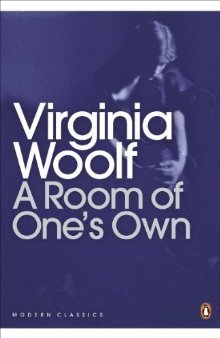
A Room of One's Own
1929
Virginia Woolf
A Room of One's Own is an extended essay by Virginia Woolf. First published on the 24th of October, 1929, the essay was based on a series of lectures she delivered at Newnham College and Girton College, two women's colleges at Cambridge University in October 1928. While this extended essay in fact employs a fictional narrator and narrative to explore women both as writers and characters in fiction, the manuscript for the delivery of the series of lectures, titled Women and Fiction, and hence the essay, are considered nonfiction. The essay is seen as a feminist text, and is noted in its argument for both a literal and figural space for women writers within a literary tradition dominated by patriarchy.
♀️ Feminism