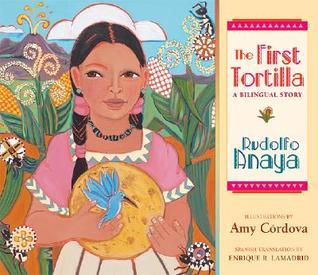



The First Tortilla is a moving, bilingual story of courage and discovery. A small Mexican village is near starvation. There is no rain, and the bean and squash plants are dying. Jade, a young village girl, is told by a blue hummingbird to take a gift to the Mountain Spirit. Then it will send the needed rain. Burning lava threatens her, but Jade reaches the top of the volcano. The Mountain Spirit is pleased. It allows the ants in a nearby cave to share their corn with Jade. The corn was sweet and delicious and Jade took some back to save the village. Jade grinds the dry corn, adds water, and makes dough. She pats the masa and places it on hot stones near the fire. She has made the first tortilla. Soon the making of corn tortillas spreads throughout Mexico and beyond. Reading level: grade 3 and up The story of a young Mexican girl who saves her village by making the first tortilla with the help of the Mountain Spirit.
Author

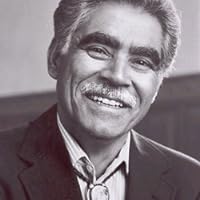
Rudolfo Anaya lives and breathes the landscape of the Southwest. It is a powerful force, full of magic and myth, integral to his writings. Anaya, however, is a native Hispanic fascinated by cultural crossings unique to the Southwest, a combination of oldSpain and New Spain, of Mexico with Mesoamerica and the anglicizing forces of the twentieth century. Rudolfo Anaya is widely acclaimed as the founder of modern Chicano literature. According to the New York Times, he is the most widely read author in Hispanic communities, and sales of his classic Bless Me, Ultima (1972) have surpassed 360,000, despite the fact that none of his books have been published originally by New York publishing houses. His works are standard texts in Chicano studies and literature courses around the world, and he has done more than perhaps any other single person to promote publication of books by Hispanic authors in this country. With the publication of his novel, Albuquerque (1992),Newsweek has proclaimed him a front-runner in "what is better called not the new multicultural writing, but the new American writing." His most recent volume, published in 1995, is Zia Summer. "I've always used the technique of the cuento. I am an oral storyteller, but now I do it on the printed page. I think if we were very wise we would use that same tradition in video cassettes, in movies, and on radio." from http://www.unm.edu/~wrtgsw/anaya.html and http://www.gale.cengage.com/free\_reso...