2003
First Published
4.20
Average Rating
294
Number of Pages
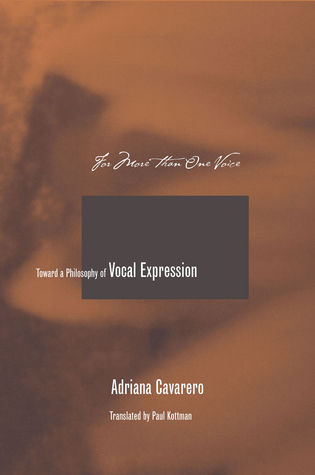
The human voice does not deceive. The one who is speaking is inevitably revealed by the singular sound of her voice, no matter "what" she says. We take this fact for granted―for example, every time someone asks, over the telephone, "Who is speaking?" and receives as a reply the familiar utterance, "It's me." Starting from the given uniqueness of every voice, Cavarero rereads the history of philosophy through its peculiar evasion of this embodied uniqueness. She shows how this history―along with the fields it comprehends, such as linguistics, musicology, political theory, and studies in orality―might be grasped as the "devocalization of Logos," as the invariable privileging of semantike over phone, mind over body. Female figures―from the Sirens to the Muses, from Echo to opera singers―provide a crucial counterhistory, one in which the embodied voice triumphs over the immaterial semantic. Reconstructing this counterhistory, Cavarero proposes a "politics of the voice" wherein the ancient bond between Logos and politics is reconfigured, and wherein what matters is not the communicative content of a given discourse, but rather who is speaking.

Avg Rating
4.20
Number of Ratings
71
5 STARS
44%
4 STARS
39%
3 STARS
10%
2 STARS
7%
1 STARS
0%
goodreads
Author

Adriana Cavarero
Author · 10 books
Adriana Cavarero teaches philosophy of politics at the University of Verona, Italy, and is a visiting professor at New York University. Her field of research includes classical, modern and contemporary thought, with a special focus on the political significance of philosophy. Two main concerns shape her approach to the Western philosophical tradition. First, the 'thought of sexual difference', a theoretical perspective that enables the deconstruction of Western textuality from a feminist standpoint. Second, the thought of Hannah Arendt, reinterpreted in its most innovative categories: birth, uniqueness, action and narration. The result is an inquiry that foregrounds the individual and unique existence of the human being, as related to body and gender. Cavarero resists both the solitary abstraction of the philosophical Subject, and the volatile fragmentation of the postmodern subject, in the name of the living uniqueness of a self being generated through plural relationships with other human beings, and the acceptance of the constraints of individuality and the body.