Margins
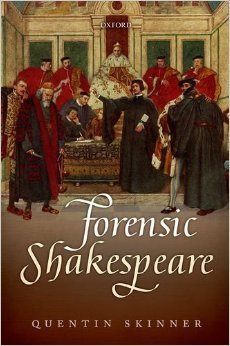
Forensic Shakespeare book cover
Forensic Shakespeare
2014
First Published
4.15
Average Rating
368
Number of Pages
Shakespeare and Judicial Rhetoric illustrates Shakespeare's creative processes by revealing some of the intellectual materials out of which some of his most famous works were composed. Focusing on the narrative poem Lucrece, on four of his late Elizabethan plays—Romeo and Juliet, TheMerchant of Venice, Julius Caesar and Hamlet—and on three early Jacobean dramas, Othello, Measure for Measure and All's Well That Ends Well, Quentin Skinner argues that there are major speeches, and sometimes sequences of scenes, that are crafted according to a set of rhetorical precepts about how to develop a persuasive judicial case, either in accusation or defence. Some of these works have traditionally been grouped together as "problem plays," but here Skinner offers a different explanation for their frequent similarities of tone. There have been many studies of Shakespeare's rhetoric, but they have generally concentrated on his wordplay and use of figures and tropes. By contrast, this study concentrates on Shakespeare's use of judicial rhetoric as a method of argument. By approaching the plays from this perspective, Skinner is able to account for some distinctive features of Shakespeare's vocabulary, and also help to explain why certain scenes follow a recurrent pattern and arrangement.

Avg Rating
4.15
Number of Ratings
13
5 STARS
38%
4 STARS
38%
3 STARS
23%
2 STARS
0%
1 STARS
0%
goodreads

Author

Quentin Skinner
Quentin Skinner
Author · 16 books

Educated at Caius College, Cambridge, where he was elected to a Fellowship upon obtaining a double-starred first in History, Quentin Skinner accepted, however, a teaching Fellowship at Christ's College, Cambridge, where he taught until 2008, except for four years in the 1970s spent at the Institute for Advanced Study in Princeton, New Jersey. In 1978 he was appointed to the chair of Political Science at Cambridge University, and subsequently regarded as one of the two principal members (along with J.G.A. Pocock) of the influential 'Cambridge School' of the history of political thought, best known for its attention to the 'languages' of political thought. Skinner's primary interest in the 1970s and 1980s was the modern idea of the state, which resulted in two of his most highly regarded works, The Foundations of Modern Political Thought: Volume I: The Renaissance and The Foundations of Modern Political Thought: Volume II: The Age of Reformation.

548 Market St PMB 65688, San Francisco California 94104-5401 USA
© 2026 Paratext Inc. All rights reserved