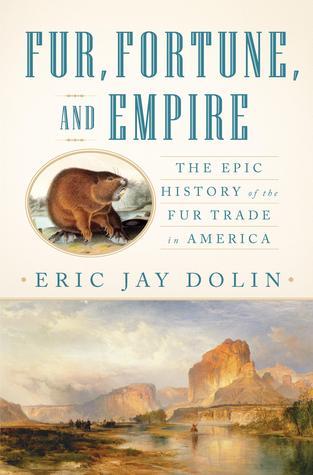
From the best-selling author of Leviathan comes this sweeping narrative of one of America’s most historically rich industries. Beginning his epic history in the early 1600s, Eric Jay Dolin traces the dramatic rise and fall of the American fur industry, from the first Dutch encounters with the Indians to the rise of the conservation movement in the late nineteenth century. Dolin shows how the fur trade, driven by the demands of fashion, sparked controversy, fostered economic competition, and fueled wars among the European powers, as North America became a battleground for colonization and imperial aspirations. The trade in beaver, buffalo, sea otter, and other animal skins spurred the exploration and the settlement of the vast American continent, while it alternately enriched and gravely damaged the lives of America’s native peoples. Populated by a larger-than-life cast—including Dutch governor Peter Stuyvesant; President Thomas Jefferson; America’s first multimillionaire, John Jacob Astor; and mountain man Kit Carson—Fur, Fortune, and Empire is the most comprehensive and compelling history of the American fur trade ever written. 16 pages of color and 16 pages of black-and-white illustrations, as well as a two-page, endpaper map of the American fur trade beyond the Mississippi. Starred reviews from Publisher's Weekly and Kirkus Reviews. "Nobody writes about the link between American history and natural history with the scholarly grace of Eric Jay Dolin. Fur, Fortune, and Empire is a landmark study filled with a cast of eccentric Western-type characters. Dolin's research is prodigious. Not since the days of Francis Parkman has a historian analyzed the fur trade industry with such brilliance. Highly recommended!" — Douglas Brinkley, Author, Cronkite and The Wilderness Warrior "Fur, Fortune, and Empire is no melancholy affair. The book bursts with colorful characters, venal corporations, and violent confrontations, all presented with sharp-eyed clarity in a narrative that clips right along... One of the great pleasures of Eric Jay Dolin's work in both Leviathan and Fur, Fortune, and Empire comes in discovering centuries old antecedents of the economic and natural resource issues that we struggle with today... there are plenty of insights as well as much reading pleasure to be had here." Bruce Barcott, Audubon Magazine "A superb one-volume examination of an era when American ingenuity and its competitive spirit began to flourish. . . Dolin describes in marvelous detail . . . colorful figures of the American fur trades' western expansion... at last, we now have a book that properly accounts for America's rise as a fur-trade power." — Michael Taube, The Wall Street Journal "Though guns, germs and steel certainly played their parts, Dolin's "Fur, Fortune, and Empire" leaves little doubt that the trade in pelts "was a powerful force in shaping the course of American history from the early 1600s through the late 1800s, playing a major role in the settlement and evolution of the colonies, and in the growth of the United States." Dolin puts forth a compelling and well-annotated tale of greed, slaughter and geopolitics as the Dutch, English, French, Spanish, Swedes, Russians and the American colonists fought for a slice of the profit." — Art Winslow, The Los Angeles Times
Author

I grew up near the coasts of New York and Connecticut, and since an early age I was fascinated by the natural world, especially the ocean. I spent many days wandering the beaches on the edge of Long Island Sound and the Atlantic, collecting seashells and exploring tidepools. When I left for college I wanted to become a marine biologist or more specifically a malacologist (seashell scientist). At Brown University I quickly realized that although I loved learning about science, I wasn't cut out for a career in science, mainly because I wasn't very good in the lab, and I didn't particularly enjoy reading or writing scientific research papers. So, after taking a year off and exploring a range of career options, I shifted course turning toward the field of environmental policy, first earning a double-major in biology and environmental studies, then getting a masters degree in environmental management from Yale, and a Ph.D. in environmental policy and planning from MIT, where my dissertation focused on the role of the courts in the cleanup of Boston Harbor. I have held a variety of jobs, including stints as a fisheries policy analyst at the National Marine Fisheries Service, a program manager at the U.S. Environmental Protection Agency, an environmental consultant stateside and in London, an American Association for the Advancement of Science writing fellow at Business Week, a curatorial assistant in the Mollusk Department at Harvard's Museum of Comparative Zoology, and an intern at the National Wildlife Federation, the Massachusetts Office of Coastal Zone Management, and the U.S. Senate. Throughout my career, one thing remained constant—I enjoyed writing and telling stories. And that's why I started writing books—to share the stories that I find most intriguing (I have also published more than 60 articles for magazines, newspapers, and professional journals). My most recent books include: ***A Furious Sky: The Five-Hundred-Year History of America's Hurricanes (Liveright, 2020), which was chosen by: The Washington Post—One of 50 Notable works of Nonfiction for 2020 Library Journal—One of the Best Science & Technology Books of 2020 Kirkus Reviews—One of the top 100 nonfiction books of 2020 (it was also a finalist for the Kirkus Prize) Booklist — 10 Top Sci-Tech Books of 2020 Amazon.com—One of the Best Science Books of 2020 And also was an Editor's Choice by the New York Times Book Review. New York Times—Editor's Choice ***Black Flags, Blue Waters: The Epic History of America's Most Notorious Pirates (Liveright, 2018), which was chosen as a "Must-Read" book for 2019 by the Massachusetts Center for the Book, and was a finalist for the 2019 Julia Ward Howe Award given by the Boston Author's Club. ***Brilliant Beacons: A History of the American Lighthouse (Liveright, 2016), which was chosen by gCaptain and Classic Boat as one of the best nautical books of 2016. ***When America First Met China: An Exotic History of Tea, Drugs, and Money in the Age of Sail (Liveright, September 2012), which was chosen by Kirkus Reviews as one of the ten best non-fiction books of Fall 2012. ***Fur, Fortune, and Empire: the Epic History of the Fur Trade in America (W. W. Norton, 2010), a national bestseller, which was chosen by New West, The Seattle Times, and The Rocky Mountain Land Library as one of the top non-fiction books of 2010. It also won the 2011 James P. Hanlan Book Award, given by the New England Historical Association, and was awarded first place in the Outdoor Writers Association of America, Excellence in Craft Contest. ***Leviathan: The History of Whaling in America (W. W. Norton, 2007), which was selected as one of the best nonfiction books of 2007 by The Los Angeles Times, The Boston Globe, and The Providence Journal. Leviathan was also chosen by Amazon.com's editors as one of the 10 best history books of 2007. Leviathan garnered the the 23rd annual (2007) L. Byrne Waterman