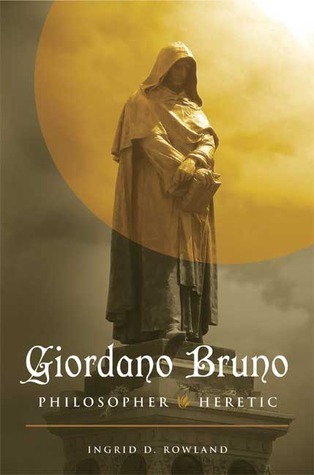
Giordano Bruno is one of the great figures of early modern Europe, and one of the least understood. Ingrid D. Rowland’s pathbreaking life of Bruno establishes him once and for all as a peer of Erasmus, Shakespeare, and Galileo, a thinker whose vision of the world prefigures ours. By the time Bruno was burned at the stake as a heretic in 1600 on Rome’s Campo dei Fiori, he had taught in Naples, Rome, Venice, Geneva, France, England, Germany, and the “magic Prague” of Emperor Rudolph II. His powers of memory and his provocative ideas about the infinity of the universe had attracted the attention of the pope, Queen Elizabeth—and the Inquisition, which condemned him to death in Rome as part of a yearlong jubilee. Writing with great verve and sympathy for her protagonist, Rowland traces Bruno’s wanderings through a sixteenth-century Europe where every certainty of religion and philosophy had been called into question and shows him valiantly defending his ideas (and his right to maintain them) to the very end. An incisive, independent thinker just when natural philosophy was transformed into modern science, he was also a writer of sublime talent. His eloquence and his courage inspired thinkers across Europe, finding expression in the work of Shakespeare and Galileo. Giordano Bruno allows us to encounter a legendary European figure as if for the first time.