Margins
Margins
Sign in
Margins
Subscribe to our newsletter
548 Market St PMB 65688, San Francisco California 94104-5401 USA
hello@margins.app
·
+1 (650) 223-5283
Privacy Policy
·
Terms of Use
© 2026 Paratext Inc. All rights reserved
🏰
Gothic
Frankenstein
1818
Mary Shelley
'Now that I had finished, the beauty of the dream vanished, and breathless horror and disgust filled my heart ...' Obsessed with creating life itself, Victor Frankenstein plunders graveyards for the material to fashion a new being, which he shocks into life with electricity. But his botched creature, rejected by Frankenstein and denied human companionship, sets out to destroy his maker and all that he holds dear. Mary Shelley's chilling Gothic tale was conceived when she was only eighteen, living with her lover Percy Shelley near Byron's villa on Lake Geneva. It would become the world's most famous work of horror fiction, and remains a devastating exploration of the limits of human creativity. Based on the third edition of 1831, this volume contains all the revisions Mary Shelley made to her story, as well as her 1831 introduction and Percy Bysshe Shelley's preface to the first edition. This revised edition includes as appendices a select collation of the texts of 1818 and 1831 together with 'A Fragment' by Lord Byron and Dr John Polidori's 'The Vampyre: A Tale'.
The Monk
1796
Matthew Gregory Lewis
'He now saw himself stained with the most loathed and monstrous sins, the object of universal execration ... doomed to perish in tortures the most severe' Shocking, erotic and violent, The Monk is the story of Ambrosio, torn between his spiritual vows and the temptations of physical pleasure. His internal battle leads to sexual obsession, rape and murder, yet this book also contains knowing parody of its own excesses as well as social comedy. Written by Matthew Lewis when he was only nineteen, it was a ground-breaking novel in the Gothic Horror genre and spawned hundreds of imitators, drawn in by its mixture of bloodshed, sex and scandal.
The Romance of the Forest
1791
Ann Radcliffe
This novel, although not as well-known as Radcliffe's later works, is thought to represent her work at its best. More than just a work of suspense and mystery, it is a work of ideas—a discussion of the contrasts between hedonistic doctrines and a system of education and values.
Dr. Jekyll and Mr. Hyde
1886
Robert Louis Stevenson
Robert Louis Stevenson's masterpiece of the duality of good and evil in man's nature sprang from the darkest recesses of his own unconscious—during a nightmare from which his wife awakened him, alerted by his screams. More than a hundred years later, this tale of the mild\-mannered Dr. Jekyll and the drug that unleashes his evil, inner persona—the loathsome, twisted Mr. Hyde—has lost none of its ability to shock. Its realistic police\-style narrative chillingly relates Jekyll's desperation as Hyde gains control of his soul—and gives voice to our own fears of the violence and evil within us. Written before Freud's naming of the ego and the id, Stevenson's enduring classic demonstrates a remarkable understanding of the personality's inner conflicts—and remains the irresistibly terrifying stuff of our worst nightmares.
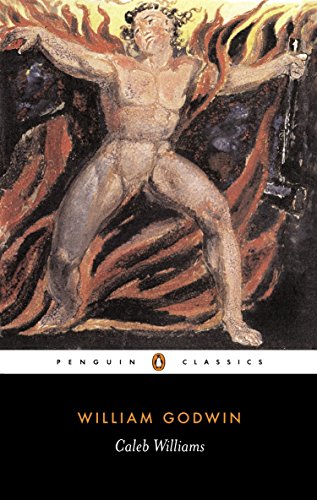
Caleb Williams
1794
William Godwin
When honest young Caleb Williams comes to work as a secretary for Squire Falkland, he soon begins to suspect that his new master is hiding a secret. As he digs deeper into Falkland’s past and finally unearths the horrible truth, the results of his curiosity prove calamitous when—even though Caleb has loyally sworn never to disclose what he has discovered—the Squire enacts a cruel revenge. A tale of gripping suspense and psychological power, William Godwin’s novel creates a searing depiction of the intolerable persecution meted out to a good man in pursuit of justice and equality. Written to expose the political oppression and corrupt hierarchies its author saw in the world around him, Caleb Williams makes a radical call to end the tyrannical misuses of power.
The Castle of Otranto
1764
Horace Walpole
First published pseudonymously in 1764, The Castle of Otranto purported to be a translation of an Italian story of the time of the crusades. In it Walpole attempted, as he declared in the Preface to the Second Edition, "to blend the two kinds of romance: the ancient and the modern." Crammed with invention, entertainment, terror, and pathos, the novel was an immediate success and Walpole's own favorite among his numerous works. The novel is reprinted here from a text of 1798, the last that Walpole himself prepared for the press.
🏰 Gothic