


Margins
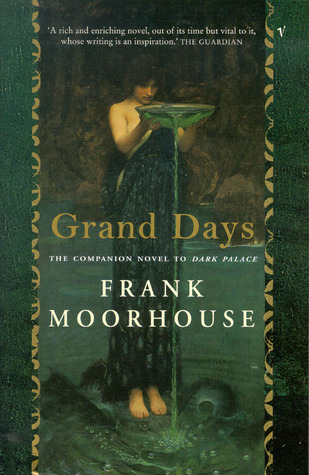
Grand Days book cover
Grand Days
1993
First Published
3.73
Average Rating
635
Number of Pages

Part of Series

A contemporary romantic Australian masterpiece, Grand Days tells of the moral and sexual awakening of an idealistic young Australian woman working in the diplomatic corps in Europe in the aftermath of World War I. On a train from Paris to Geneva, Edith Campbell Berry meets Major Ambrose Westwood in the dining car, and allows him to kiss her passionately. Their early intimacy binds them together once they reach Geneva and their posts at the newly created League of Nations. There, a heady idealism prevails over Edith and her young colleagues, and nothing seems beyond their grasp, certainly not world peace. The exuberance of the times carries over into Geneva nights: Edith is drawn into a glamorous and dangerous underworld where, coaxed by Ambrose, she becomes more and more sexually adventurous. Vivid, funny and wise, full of shocks of revelation and recognition, Grand Days is a dazzling evocation of a golden bygone era and an unerring portrait of a woman of her times - as well as a stunning novel which speaks vividly to readers today.
Avg Rating
3.73
Number of Ratings
897
5 STARS
23%
4 STARS
39%
3 STARS
27%
2 STARS
8%
1 STARS
2%
goodreads

Author

Frank Moorhouse
Author · 19 books

Frank Thomas Moorhouse AM (21 December 1938 – 26 June 2022) was an Australian writer. He won major Australian national prizes for the short story, the novel, the essay, and for script writing. His work has been published in the United Kingdom, France, and the United States and also translated into German, Spanish, Chinese, Japanese, Serbian, and Swedish. Moorhouse was perhaps best known for winning the 2001 Miles Franklin Literary Award for his novel, Dark Palace; which together with Grand Days and Cold Light, the "Edith Trilogy" is a fictional account of the League of Nations, which trace the strange, convoluted life of a young woman who enters the world of diplomacy in the 1920s through to her involvement in the newly formed International Atomic Energy Agency after World War II. The author of 18 books, Moorhouse became a full-time fiction writer during the 1970s, also writing essays, short stories, journalism and film, radio and TV scripts. In his early career he developed a narrative structure which he has described as the 'discontinuous narrative'. He lived for many years in Balmain, where together with Clive James, Germaine Greer and Robert Hughes, he became part of the "Sydney Push" - an anti-censorship movement that protested against rightwing politics and championed freedom of speech and sexual liberation. In 1975 he played a fundamental role in the evolution of copyright law in Australia in the case University of New South Wales v Moorhouse. - Wikipedia

548 Market St PMB 65688, San Francisco California 94104-5401 USA
© 2026 Paratext Inc. All rights reserved