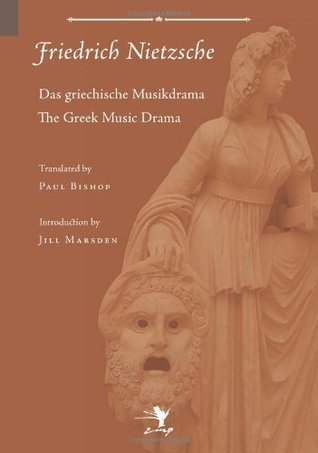
The Greek Music Drama marks an intriguing moment in the development of Nietzsche's thought. Delivered in 1870 at the Basel Museum, it was the first public enunciation of the great themes that would echo throughout Nietzsche s philosophy: the importance of aesthetic experience for culture, the primacy of the body and physiological drives, and the centrality of music to Greek tragedy. Here we see Nietzsche s genealogical methodology in embryonic form alongside the anti-humanist aesthetics that will bloom in his later work. Addressing the material conditions of Greek theater in detail, Nietzsche repudiates the abstract scholarly approach to the art of classical antiquity, proposing that in its stead we cultivate different emotional and intellectual powers in order to gain greater insight into that art. This seminal lecture offers an account of tragic experience from the sole perspective of the Dionysian, presenting a reading of nature of startling and far-reaching implications. While The Greek Music Drama is a text written on the brink of the insights that inform The Birth of Tragedy, it stands on its own right as a singular text. This work is of considerable importance and is now made available in English for the very first time, with the translation set parallel to the original German in this elegant bilingual edition. Paul Bishop s preface and informative critical notes and Jill Marsden s illuminating introduction not only serve to make good the comparative neglect this seminal text has suffered in Nietzsche studies, they also lend the unique expertise of two Nietzsche scholars to the early thought of a philosopher who is crucial not just to philosophy scholars and aficionados, but to anyone interested in theater, performance, and the art of tragedy.