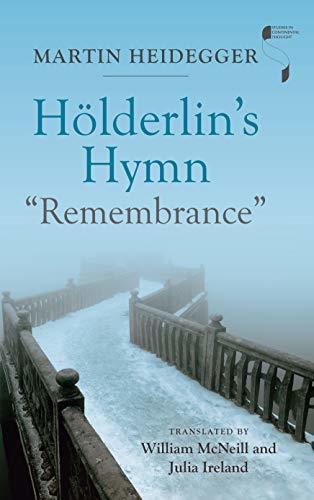
Hölderlin's Hymn "Remembrance"
1992
First Published
4.21
Average Rating
204
Number of Pages
Martin Heidegger's 1941–1942 lecture course on Friedrich Hölderlin's hymn, "Remembrance," delivered immediately following his confrontation with Nietzsche, lays out a detailed plan for the interpretation of Hölderlin's poetry in which remembrance is a central concern. With its emphasis on the "free use of the national" and the "holy of the fatherland," the course marks an important progression in Heidegger's political thought. In addition to its startlingly innovative analyses of greeting, the festive, and the dream, the text provides Heidegger's fullest elaboration of the structure of commemorative thinking in relationship to time and the possibility of an "other beginning." This English translation by William McNeill and Julia Ireland completes the series of Heidegger's major lecture courses on Hölderlin.

Avg Rating
4.21
Number of Ratings
14
5 STARS
50%
4 STARS
21%
3 STARS
29%
2 STARS
0%
1 STARS
0%
goodreads
Author

Martin Heidegger
Author · 91 books
Martin Heidegger (1889-1976) was a German philosopher whose work is perhaps most readily associated with phenomenology and existentialism, although his thinking should be identified as part of such philosophical movements only with extreme care and qualification. His ideas have exerted a seminal influence on the development of contemporary European philosophy. They have also had an impact far beyond philosophy, for example in architectural theory (see e.g., Sharr 2007), literary criticism (see e.g., Ziarek 1989), theology (see e.g., Caputo 1993), psychotherapy (see e.g., Binswanger 1943/1964, Guignon 1993) and cognitive science (see e.g., Dreyfus 1992, 2008; Wheeler 2005; Kiverstein and Wheeler forthcoming).