Margins


548 Market St PMB 65688, San Francisco California 94104-5401 USA
© 2026 Paratext Inc. All rights reserved

Hsing Yun (Chinese: 星云大师;星雲大師; pinyin: Xīngyún Dàshī; born August 30, 1927) is a Chinese Buddhist monk and the founder founder of the Fo Guang Shan Buddhist order and the affiliated Buddha's Light International Association, one of the largest international Buddhist organizations in Taiwan and in the Buddhist world. Hsing Yun is a forty-eighth generation lineage holder of the Linji Chan (Rinzai Zen) school through Master Zhi Kai, his teacher. He served as the first, second and third term director and abbot of the order before voluntarily resigning his position in 1985 in favor of his disciple, Hsin Ping. Hsing Yun is known for his "Humanistic Buddhism" philosophy employed by the Fo Guang Shan order, which utilizes Buddhism to fit the needs of a modern world. He is credited by Buddhist scholars as one of the forefront leaders in modern reformation of Buddhism by opening monasteries, universities and schools around the world, as well as engaging in religious dialogue amongst other Buddhist sects and religious faiths. In Taiwan, Hsing Yun is notable for his activity in political affairs, particularly on the One China Policy as well as government legislation supported by the Kuomintang, and is often criticized for his views by those in favor of Taiwanese independence, conservative Buddhists and religious figures. He was a figure of interest during the 1996 United States finance scandal involving then-U.S. Vice President Al Gore and a visit to Hsi Lai Temple, the U.S. branch of Hsing Yun's organization

Buddhism and Our Changing Society 1
2006

Buddhist Ethics for Everyday Life
1998

2002
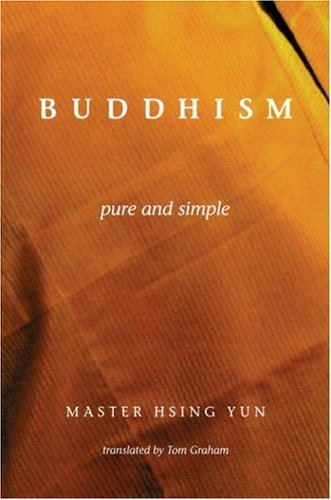
2001

A Commentary on the Diamond Sutra
2001

A Guide to Buddhist Practice
2010

A Blueprint for Life
2003

Politics, Human Rights, and What the Buddha Said About Life
2011

1999

A Guide to Chinese Buddhist Meditation
1999

2013

2006

Essays in Basic Buddhism
2012

A Commentary on the Eight Realizations of a Bodhisattva Sutra
2010